
The Genoese in 1251 acquire the Mediterranean …
Years: 1251 - 1251
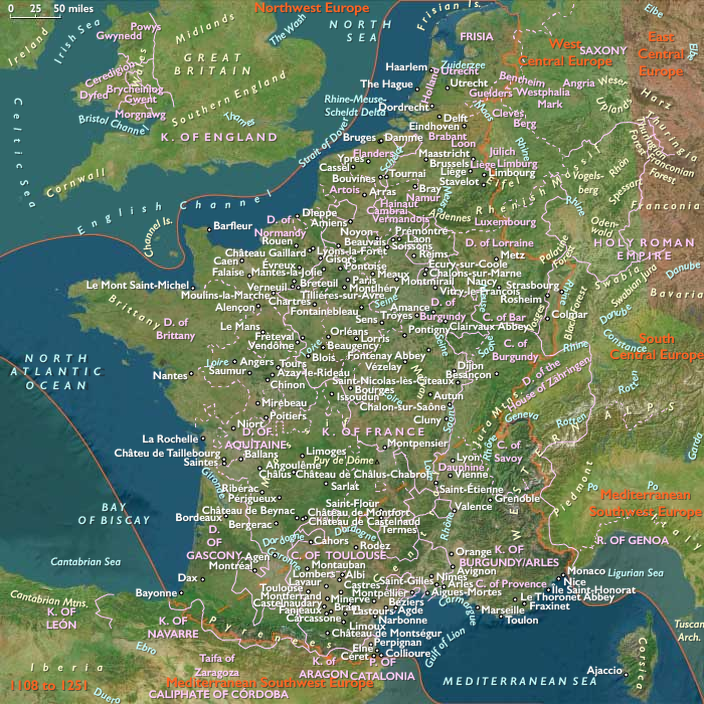
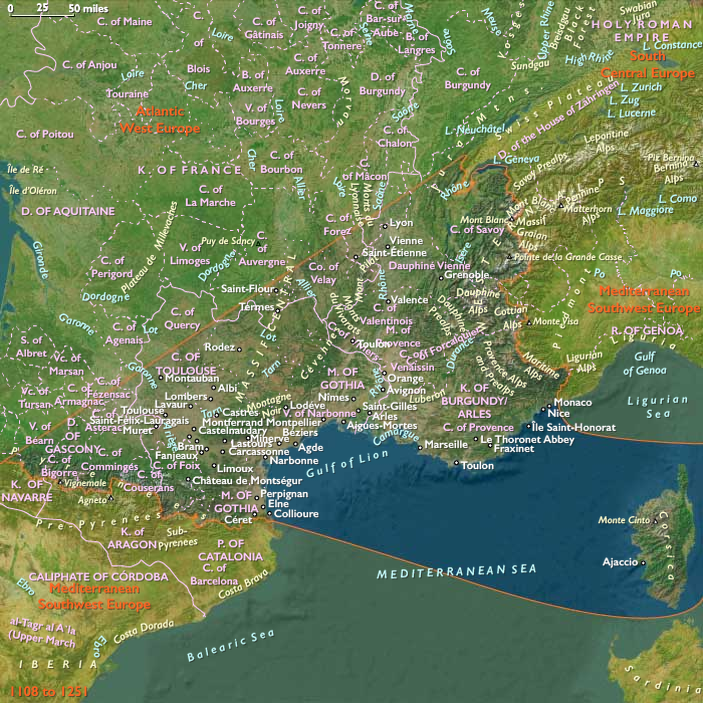
The Genoese in 1251 acquire the Mediterranean Sea port of Monaco on the Cote d’Azur, thought to have been originally settled by Phoenicians attracted by the natural harbor, and subsequently settled by Greeks, Carthaginians, and Romans.
Locations
Groups
Subjects
Regions
Subregions
Related Events
Filter results
Showing 10 events out of 46622 total
After Jayavarman VII's death, Kambuja enters a long period of decline that leads to its eventual disintegration.
The Thai are a growing menace on the empire's western borders.
The spread of Theravada Buddhism, which comes to Kambuja from Sri Lanka by way of the Mon kingdoms, challenges the royal Hindu and Mahayana Buddhist cults.
Preaching austerity and the salvation of the individual through his or her own efforts, Theravada Buddhism does not lend doctrinal support to a society ruled by an opulent royal establishment maintained through the virtual slavery of the masses.
A Thai army captures Angkor in 1353.
It is recaptured by the Khmer, but wars continue and the capital is looted several times.
During the same period, Khmer territory north of the present Laotian border is lost to the Lao kingdom of Lan Xang.
Contact with Ming Dynasty (1368-1644) China is renewed during the Muromachi period after the Chinese seek support in suppressing Japanese pirates, or wako, who control the seas and pillage coastal areas of China.
Wanting to improve relations with China and to rid Japan of the wako threat, Yoshimitsu accepts a relationship with the Chinese that is to last for half a century.
Japanese wood, sulfur, copper ore, swords, and folding fans are traded for Chinese silk, porcelain, books, and coins in what the Chinese consider tribute but the Japanese see as profitable trade.
Monaco had been refounded in 1215 as a colony of Genoa following a land grant from Emperor Henry VI in 1191.
Monaco is first ruled by a member of the House of Grimaldi in 1297, when Francesco Grimaldi, known as "Il Malizia" (translated from Italian either as "The Malicious One" or "The Cunning One"), and his men capture the fortress protecting the Rock of Monaco while dressed as Franciscan monks—a monaco in Italian, although this is a coincidence as the area was already known by this name.
Francesco, however, is evicted only a few years afterwards by the Genovese forces, and the struggle over "the Rock" continues for another century.
The Grimaldi family is Genoese and the struggle is something of a family feud.
However, the Genoese become engaged in other conflicts, and in the late 1300s Genoa becomes involved in a conflict with the Crown of Aragon over Corsica.
The death of Güyük in 1248 had probably averted an impending family war.
His widow and regent, Ogul-Gaimish, attempts to hold power for Ögödei’s sons and his brother Chaghatai, but the 1251 election goes to Möngke, son of Ghengis Khan’s youngest son Tolui.
The Ögödei princes conspire against Möngke, who has most of them executed, then orders Ogul-Gaimish wrapped in a carpet and cast in a river to drown.
Wenceslaus leads a successful invasion of Austria, completed by 1251.
Wenceslaus releases Ottokar II and names him Margrave of Moravia, then has Ottokar proclaimed Duke of Austria and acclaimed by the nobility.
In order to secure dynastic rights to Austria, Wenceslaus has another female Babenberg proclaimed Duchess and betrothed to his son.
Tremendous subterranean deposits of salt are discovered in Poland in 1251.
The salt mines of Poland will lead to a vast kingdom in the sixteenth century, only to be destroyed when Germans bring in sea salt (which most of the world will come to consider superior to rock salt, which is naturally gray in various shades, resembling unpolished granite rather than the white or crystalline look of sea salt).
Manfred, although only about nineteen years old at Frederick's death, had acted loyally and with vigor in the execution of his trust.
The reign is in turmoil, mainly due to riots spurred by Pope Innocent IV.
Manfred is able to subdue numerous rebel cities, with the exception of Naples.
The years of Alexander II’s minority feature an embittered struggle for the control of affairs between two rival parties, the one led by Walter Comyn, Earl of Menteith, the other by Alan Durward, Justiciar of Scotia.
The rivalry is a national phenomenon, and represents a larger factional conflict within the kingdom.
Comyn dominates the early years of Alexander's reign.
At the marriage of Alexander to Margaret of England in 1251, Henry III of England seizes the opportunity to demand from his son-in-law homage for the Scottish kingdom, but Alexander does not comply.
King Haakon had become able to devote his energies to strengthening and expanding his domain after the end of the civil war in Norway in 1240, erecting strong castles throughout Norway and adding Iceland and Greenland to his realm.
