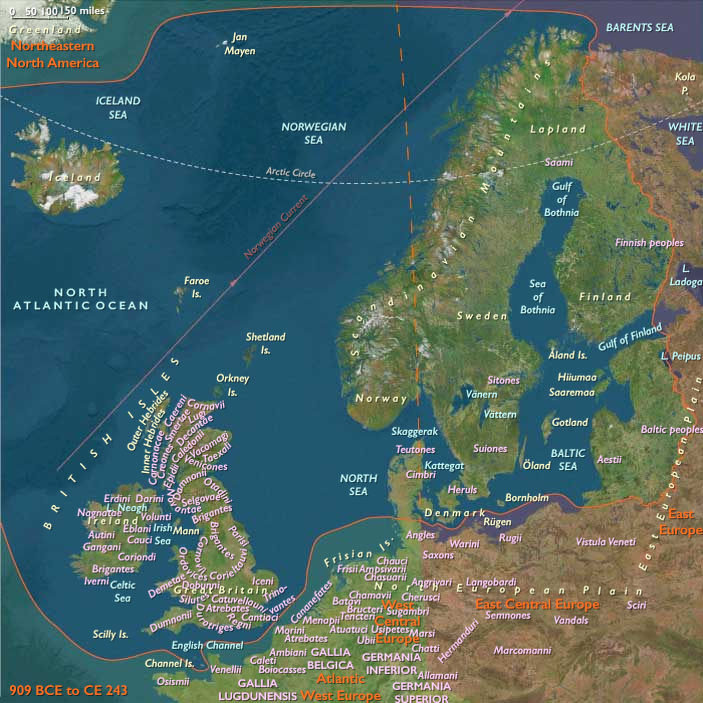
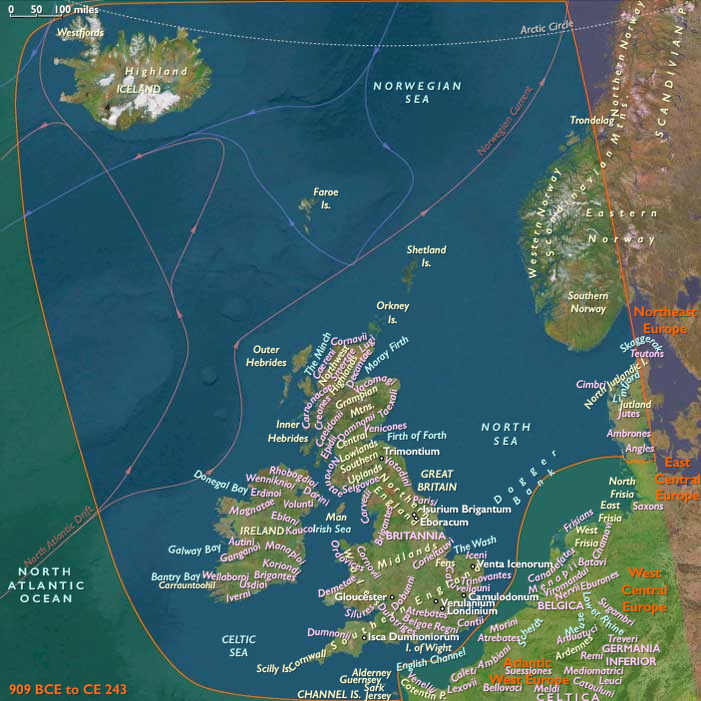
The future governor Quintus Petillius Cerialis, at …
Years: 61 - 61
The future governor Quintus Petillius Cerialis, at this time commanding the Legio IX Hispana, attempts to relieve the city, but suffers an overwhelming defeat.
His infantry is wiped out—only the commander and some of his cavalry escape.
The location of this famous battle is now claimed by some to be the village of Great Wratting, in Suffolk, which lies in the Stour Valley on the Icknield Way west of Colchester, and by a village in Essex.
After this defeat, Catus Decianus flees to Gaul.
Locations
People
- Boudica
- Catus Decianus
- Gaius Suetonius Paulinus
- Nero
- Prasutagus
- Publius Petronius Turpilianus
- Quintus Petilius Cerialis
Groups
Topics
- Classical antiquity
- Pre-Roman Iron Age of Northern Europe
- Roman Age Optimum
- Pax Romana
- Roman Conquest of Britain
- Boudica's uprising
Commodoties
Subjects
Regions
Subregions
Related Events
Filter results
Showing 10 events out of 61694 total
Tigranes invades the neighboring Kingdom of Adiabene in 61 and deposes its King Monobazes, who is a Parthian vassal.
The so-called Villa of the Mysteries is a large Roman country villa located near Pompeii, initially built in the third century BCE, and surrounded on at least three sides by a terrace with a colonnade.
The villa is remodeled sometime before the earthquake of CE 62-63, the colonnade being replaced on the main axis of the villa by a rectangular verandah.
Decorating a large (twenty-nine by nineteen feet/nine by six meters) rectangular hall in the villa are the superb paintings—dating from the first century BCE and late Hellenistic in style—that give the villa its name, featuring numerous life-size figures of humans and deities in a Dionysiac ceremony against vivid red walls.
The rebels' first target is Camulodunum (Colchester), the former Trinovantian capital and now a Roman colonia.
The Roman veterans who had been settled there have mistreated the locals and a temple to the former emperor Claudius has been erected there at local expense, making the city a focus for resentment.
The Roman inhabitants seek reinforcements from the procurator, Catus Decianus, but he sends only two hundred auxiliary troops.
Boudica's army falls on the poorly defended city and destroys it, besieging the last defenders in the temple for two days before it falls.
Archaeologists have shown that the city was methodically demolished.
Suetonius, when news of the rebellion reaches him at Anglesey, hurries along Watling Street through hostile territory to Londinium.
A relatively new settlement, founded after the conquest of CE 43, Londinium has grown to be a thriving commercial center with a population of travelers, traders, and, probably, Roman officials.
Suetonius considers giving battle here, but considering his lack of numbers, and chastened by Petillius's defeat, decides to sacrifice the city to save the province.
Londinium is abandoned to the rebels, who burn it down, slaughtering anyone who had not evacuated with Suetonius.
Archaeology shows a thick red layer of burnt debris covering coins and pottery dating before 60 CE within the bounds of Roman Londinium.
Verulamium (St. Albans), which had grown into a substantial town in the past decade, is sacked and burnt: a black ash layer has been recorded by archaeologists, thus confirming the Roman written record.
In the three settlements destroyed, between seventy and eighty thousand people are said to have been killed.
Tacitus says that the Britons had no interest in taking or selling prisoners, only in slaughter by gibbet, fire, or cross.
Dio's account gives more detail; that the noblest women were impaled on spikes and had their breasts cut off and sewn to their mouths, "to the accompaniment of sacrifices, banquets, and wanton behavior" in sacred places, particularly the groves of Andraste.
Tacitus, the most important Roman historian of this period, took a particular interest in Britain as Gnaeus Julius Agricola, his father-in-law and the subject of his first book, served there three times.
Agricola was a military tribune under Suetonius Paulinus, which almost certainly gave Tacitus an eyewitness source for Boudica's revolt.
Cassius Dio's account is only known from an epitome, and his sources are uncertain.
He is generally agreed to have based his account on that of Tacitus, but he simplifies the sequence of events and adds details, such as the calling in of loans, that Tacitus does not mention.
Suetonius regroups with his own Legio XIV Gemina, some vexillationes (detachments) of the XX Valeria Victrix, and any available auxiliaries, while Boudica's army continue their assault in Verulamium.
IX Hispana had been routed trying to relieve Camulodunum, and the prefect of Legio II Augusta, Poenius Postumus, stationed near Exeter, ignores the call, but nonetheless the governor is able to call on almost ten thousand men.
He takes a stand at an unidentified location, probably in the West Midlands somewhere along the Roman road now known as Watling Street, in a defile with a wood behind him—but his men are heavily outnumbered.
Dio says that, even if they were lined up one deep, they would not have extended the length of Boudica's line.
By now the rebel forces are said to have numbered two hundred and thirty thousand, however, this number should be treated with skepticism—Dio's account is known only from a late epitome, and ancient sources commonly exaggerate enemy numbers.
Boudica exhorts her troops from her chariot, her daughters beside her.
Tacitus gives her a short speech in which she presents herself not as an aristocrat avenging her lost wealth, but as an ordinary person, avenging her lost freedom, her battered body, and the abused chastity of her daughters.
She said their cause was just, and the deities were on their side; the one legion that had dared to face them had been destroyed.
She, a woman, is resolved to win or die; if the men want to live in slavery, that is their choice.
However, the lack of maneuverability of the British forces, combined with lack of open-field tactics to command these numbers, puts them at a disadvantage to the Romans, who are skilled at open combat due to their superior equipment and discipline.
Also, the narrowness of the field means that Boudica can put forth only as many troops as the Romans can at a given time.
First, the Romans stand their ground and used volleys of pila (heavy javelins) to kill thousands of Britons who are rushing toward the Roman lines.
The Roman soldiers, having used up their pila, are now able to engage Boudica's second wave in the open.
As the Romans advance in a wedge formation, the Britons attempt to flee, but are impeded by the presence of their own families, whom they have stationed in a ring of wagons at the edge of the battlefield, and are slaughtered.
This is not the first instance of this tactic—the women of the Cimbri, in the Battle of Vercellae against Gaius Marius, were stationed in a line of wagons and acted as a last line of defense.
Ariovistus of the Suebi is reported to have done the same thing in his battle against Julius Caesar.
Tacitus reports that "according to one report almost eighty thousand Britons fell" compared with only four hundred Romans.
According to Tacitus in his Annals, Boudica poisoned herself, though in the Agricola, which was written almost twenty years prior, he mentions nothing of suicide and attributes the end of the revolt to socordiam (indolence); Dio says she fell sick and died and then was given a lavish burial; though this may be a convenient way to remove her from the story.
Considering Dio must have read Tacitus, it is worth noting he mentions nothing about suicide (which was also how Postumus and Nero ended their lives).
Postumus, on hearing of the Roman victory, falls on his sword.
Suetonius conducts punitive operations.

Nero's adviser, Burrus, dies in 6.
Additionally, Seneca is again faced with embezzlement charges, and asks Nero for permission to retire from public affairs.
Nero divorces and banished Octavia on grounds of infertility, leaving him free to marry the pregnant Poppaea.
After public protests, Nero is forced to allow Octavia to return from exile, but she is executed shortly after her return.
Accusations of treason being plotted against Nero and the Senate first appear in 62.
The Senate rules that Antistius, a praetor, should be put to death for speaking ill of Nero at a party.
Later, Nero orders the exile of Fabricius Veiento, who had slandered the Senate in a book.
Tacitus writes that the roots of the conspiracy led by Gaius Calpurnius Piso began in this year.
Piso leverages senatorial anger with the emperor Nero to gain power.
Already there is talk among those of senatorial rank, in the nobility, and among the equites that Nero is ruining Rome.
For the first eight years of Nero's rule of the Roman Empire, Burrus and Nero's former tutor Seneca have helped maintain a stable government.
Burrus had acquiesced to Nero's murder of Agrippina the Younger but had nevertheless lost his influence over Nero.
He dies in 62, some say from poison.
Gaius Ofonius Tigellinus, a native of Agrigentum, of humble origin and possibly of Greek descent, replaces Burrus as Praetorian prefect.
Banished in 39, during the reign of Caligula, he had been accused of adultery with Agrippina the Younger and Julia Livilla, the two surviving sisters of the Roman Emperor.
He was recalled by Claudius in 41.
Having inherited a fortune, he had bought land in Apulia and Calabria and devoted himself to breeding racehorses.
In this manner he gained the favor of Nero, whom he aids and abets in his vices and cruelties.
In 62, after rumors that Plautus is in negotiations with the eastern general Gnaeus Domitius Corbulo over rebellion, Plautus is executed by Nero.
When his head is given to Nero by a freedman, Nero mockingly notes how frightening the long nose of Plautus was.
At the same time, Nero's cousin, Faustus Cornelius Sulla Felix (the second husband of Claudia Antonia, daughter of Claudius), is murdered in Gaul.
Tigellinus had sent assassins to murder Faustus, who was slain at dinner, five days after Tigellinus had given his orders.
Faustus' head was transported to the palace.
At times, Nero will tease Faustus's head, due to his baldness and grayness to his hair.
This unfortunate Sulla Felix is Nero's cousin and his brother-in-law (both men once being married to sisters).
Tacitus described Faustus' character as "timid and despicable" and also stated that Faustus was incapable of attempting to plot against Nero.
Catus Decianus, who had fled to Gaul, is replaced by Gaius Julius Alpinus Classicianus, who has expressed concern to the Emperor Nero that the punitive policies of the governor, Suetonius Paulinus, will lead to continued hostilities.
Nero dispatches his freedman, Polyclitus, to lead an inquiry.
An excuse, that Suetonius had lost some ships, is found to relieve him of command and replace him with the more conciliatory Publius Petronius Turpilianus.
The historian Suetonius tells us the crisis had almost persuaded Nero to abandon Britain.
Vologases had been prevented from attacking the vassal king of Adiabene by an invasion of the eastern nomads, according to Josephus.
At last, a peace is concluded, by which the Parthians sign a treaty with Corbulo acknowledging Tiridates as king of Armenia, but he has to become a vassal of the Romans; he goes to Rome, where Roman emperor Nero gives him back the diadem; from this time forward, an Arsacid dynasty rules in Armenia under Roman supremacy.
Vologases is satisfied with this result, and will honor the memory of Nero (Suetonius Nero, 57).
The Pharisees (despite the unflattering portrayal of them in the New Testament) are for the most part intensely religious Jews and adhere to a strict though non-literal observance of the Torah.
Politically, however, the Pharisees have no sympathy with the intense Jewish nationalism of such sects as the military patriotic Zealots and are willing to submit to Roman rule if only the Jews could maintain their religious independence.
The Roman-supported Sadducees, drawn mainly from the conservative and aristocratic priestly class, have engaged in an ongoing power struggle with the Pharisees, who tend to be middle class and open to religious innovation.
The struggle has led to rancor and, in some instances, violence.
The Sadducees reject the Pharisee's markedly fatalistic emphasis on divine providence, as well as their belief in resurrection and elaborate angelology.
The Pharisees also differ from the Sadducees in their use of oral legal tradition to supplement the Torah.
However, all scrupulously adhere to the Pharisaic interpretations of the law, once given.
Years: 61 - 61
Locations
People
- Boudica
- Catus Decianus
- Gaius Suetonius Paulinus
- Nero
- Prasutagus
- Publius Petronius Turpilianus
- Quintus Petilius Cerialis
Groups
Topics
- Classical antiquity
- Pre-Roman Iron Age of Northern Europe
- Roman Age Optimum
- Pax Romana
- Roman Conquest of Britain
- Boudica's uprising