
The Funnelbeaker culture, named for its characteristic …
Years: 4077BCE - 3934BCE
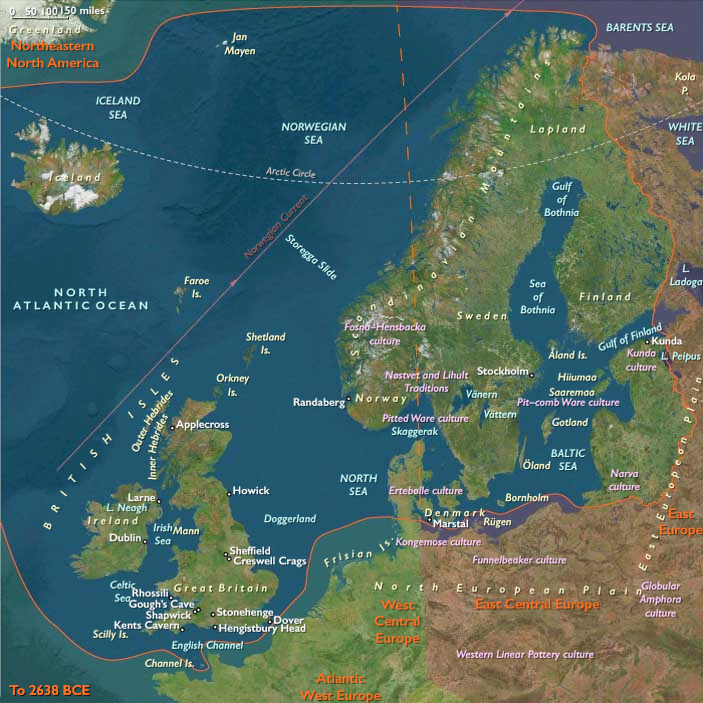
The Funnelbeaker culture, named for its characteristic pottery, emerges around 4000 BCE as the earliest Neolithic culture in northern Europe and Scandinavia.
Older traditions of hunting and fishing survive alongside agriculture in some areas, such as the Mesolithic Ertebolle culture of Denmark.
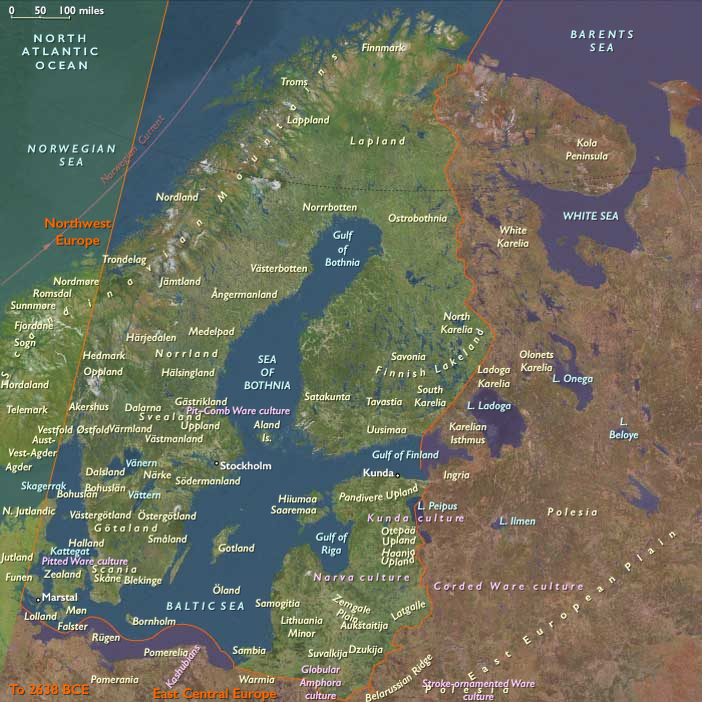
The Funnelbeaker culture ranges from the Elbe catchment in Germany and Bohemia with a western extension into the Netherlands, to southern Scandinavia (Denmark up to Uppland in Sweden and the Oslofjord in Norway) to the Vistula catchment in Poland.
Variants of the Funnelbeaker culture in or near the Elbe catchment area include the Tiefstich pottery group in northern Germany as well as the cultures of the Baalberge group (TRB-MES II and III; MES = Mittelelbe-Saale), the Salzmünde and Walternienburg and Bernburg (all TRB-MES IV) whose centers are in Saxony-Anhalt.
With the exception of some inland settlements such as Alvastra pile dwelling, the settlements are located near those of the previous Ertebølle culture on the coast.
The culture is characterized by single-family daubed houses of about twelve meters by six meters.
It is dominated by animal husbandry of sheep, cattle, pigs and goats, but there is also hunting and fishing.
Primitive wheat and barley is grown on small patches that are fast depleted, due to which the population frequently moves small distances.
There is also mining (e.g., in the Malmö region) and collection of flintstone, which is traded into regions lacking the stone, such as the Scandinavian hinterland.
The culture imports copper from Central Europe, especially daggers and axes.
The houses are centered on a monumental grave, a symbol of social cohesion.
Burial practices are varied, depending on region and change over time.
Inhumation seems to have been the rule.
The oldest graves consist of wooden chambered cairns inside long barrows, but will later be made in the form of passage graves and dolmens.
The structures are probably covered originally with a heap of dirt; a stone blocks the entrance.
Groups
Topics
Commodoties
Subjects
- Commerce
- Architecture
- Engineering
- Environment
- Labor and Service
- Conflict
- Faith
- Government
- Custom and Law
- Technology
- Anthropology
- Archaeology
Regions
Subregions
Related Events
Showing 5 events out of 5 total
Years: 4077BCE - 3934BCE
Groups
Topics
Commodoties
Subjects
- Commerce
- Architecture
- Engineering
- Environment
- Labor and Service
- Conflict
- Faith
- Government
- Custom and Law
- Technology
- Anthropology
- Archaeology
Regions
Subregions