…the frontier probably moves south to the …
Years: 105 - 105
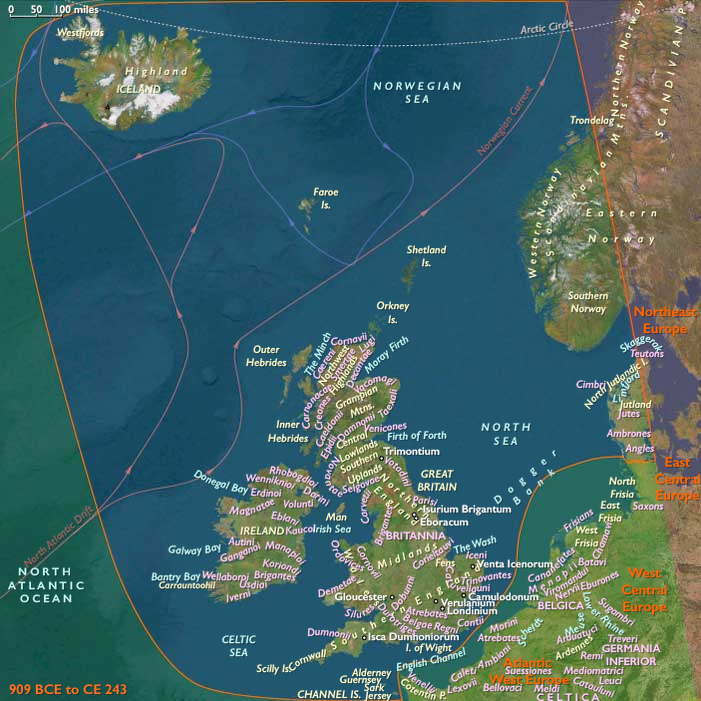
…the frontier probably moves south to the line of the Stanegate at the Solway-Tyne isthmus around this time.
Locations
People
Groups
Topics
Commodoties
Subjects
Regions
Subregions
Related Events
Filter results
Showing 10 events out of 61289 total
Paper is considered to be one of the Four Great Inventions of Ancient China, as the first standard papermaking process was developed in China during the early second century.
Inscription thus becomes relegated to a lesser role.
While the Han Dynasty Chinese court eunuch Cai Lun is widely regarded to have first invented the modern method of papermaking (inspired from wasps and bees) from wood pulp in 105, the discovery of specimens bearing written Chinese characters in 2006 at northeastern China's Gansu province suggest that paper had been in use by the ancient Chinese military more than one hundred years before Cai in 8 BCE.
Archaeologically however, true paper without writing has been excavated in China dating to the reign of Emperor Wu of Han from the second century BCE, used for purposes of wrapping or padding protection for delicate bronze mirrors.
It was also used for safety, such as the padding of poisonous 'medicine' as mentioned in the official history of the period.
Although paper used for writing will become widespread by the third century, paper will continue to be used for wrapping and other purposes.
The emperor, on his departure from Dacia in 102, had ordered the construction of a permanent stone bridge across the Danube near the present Romanian city of Turnu Severin.
The celebrated bridge, constructed between 103 and 105 by the architect Apollodorus of Damascus, is the largest in the Empire.
The Danube is about twelve hundred meters (four thousand feet) broad at this spot; the bridge is composed of twenty arches supported by stone pillars (only two of which are still visible at low water).
In the year of the bridge’s completion, Decebalus breaks the treaty, annihilating a Roman garrison stationed in Dacia and invading Moesia to attack a neighboring people allied to Rome.
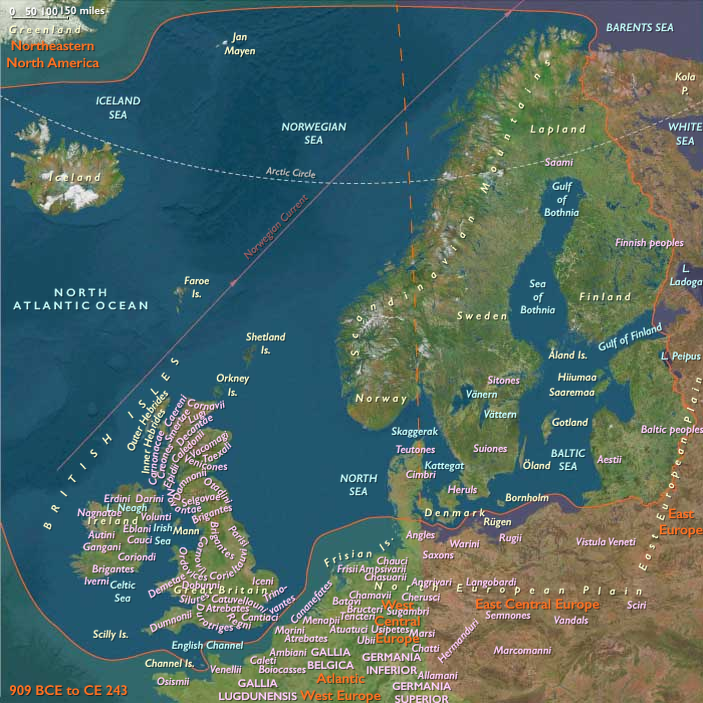
There appears to have been a serious setback at the hands of the tribes of the Picts of Alba around 105 CE: several Roman forts are destroyed by fire, with human remains and damaged armor at Trimontium (at modern Newstead, in southeast Scotland) indicating hostilities at least at this site.
There is also circumstantial evidence that auxiliary reinforcements were sent from Germany, and an unnamed British war of the period is mentioned on the gravestone of a tribune of Cyrene.
However, Trajan's Dacian Wars may have led to troop reductions in the area or even total withdrawal followed by slighting of the forts by the Picts rather than an unrecorded military defeat.
The Romans are also in the habit of destroying their own forts during an orderly withdrawal, in order to deny resources to an enemy.
In either case, …
Emperor He, the son of Emperor Zhang, had ascended the Chinese throne at the age of nine in 88; he would reign for seventeen years.
It is during his reign that the Eastern Han begins its decline.
Strife between consort clans and eunuchs had begun when the Empress Dowager Dou (Emperor He's adoptive mother) made her own family members important government officials.
Her family was corrupt and intolerant of dissension.
Emperor He had been able to remedy the situation in 92 by removing the empress dowager's brothers with the aid of the eunuch Zheng Zhong and his brother Liu Qing,the Prince of Qinghe.
This in turn had created a precedent for eunuchs to be involved in important affairs of state, a trend that would continue to escalate for the next century and contribute to the fall of the Han dynasty.
Further, while Qiang revolts, spurred by Han officials who were corrupt, oppressive, or both, had begun during Emperor Zhang's reign, they have begun to create major problems for the Han during Emperor He's reign and would last until the reign of Emperor Ling.
Emperor He himself appears to be a largely kind and gentle man who, however, lacks his father's and grandfather Emperor Ming's acumen for governance and for judgment of character.
Although Emperor He's reign arguably initiated Han's long decline, notable scientific progresses are made during this period including the invention of paper by the eunuch Cai Lun in 105.
At the emperor’s death in 106, Liu Sheng, the elder of his surviving sons, is still young (his actual age is unrecorded) and believed to be constantly ill; the younger, Liu Long, is only one hundred days old.
Both are welcomed back to the palace, and Empress Deng creates Liu Long crown prince, believing that he would be healthier, and he is that evening proclaimed Emperor Shang, but dies later in 106.
Empress Dowager Deng, apprehensive that Liu Sheng might resent her for not making him emperor first, now refuses to make him emperor, and instead creates Prince Qing's twelve-year-old son Liu Hu as Emperor An.
She will rule remain as regent until her death in 121.
Prince Long had been born in autumn 105 to Emperor He and a concubine whose identity is unknown.
Because Emperor He has, during his reign, frequently lost sons due to illnesses in childhood, according to the superstitions of the time, both Prince Long and his older brother Prince Sheng had been given to foster parents outside the palace to nurture.
When Emperor He dies early 106, his wife, Empress Deng Sui, retrieves the young princes back to the palace.
Prince Sheng is older but regarded as frequently ill and unfit for the throne, for Empress Deng first creates the infant Prince Long crown prince.
The same night, he is proclaimed emperor.
Empress Deng became empress dowager.
After Emperor Shang’s brother, Prince Sheng, is created the Prince of Pingyuan.
Concerned that Emperor Shang might not live long, Empress Dowager Deng also keeps Liu Hu, the twelve-year old cousin of Emperor Shang, in the capital Luoyang as insurance against the infant emperor's death.
(Prince Hu is the son of Prince Qing of Qinghe, who was once a crown prince under Emperor He's father Emperor Zhang but had been deposed due to machinations of Emperor Zhang's wife, Empress Dou.
Therefore, he is viewed by some as the rightful heir.)
As Emperor Shang is an infant, actual and formal power are in Empress Deng's hands.
Her brother Deng Zhi becomes the most powerful official in the imperial government.
She issues a general pardon, which benefits the people who had had rights stripped from them for associating with the family of Empress Dou.
Late in 106, Emperor Shang dies.
The officials have by this time realized that Prince Sheng, his older brother, is not as ill as originally thought, and want to make him emperor.
However, Empress Dowager Deng is concerned that he might bear a grudge at not being made emperor before his brother, and therefore insists on making Emperor Shang's cousin Prince Hu emperor instead, and he takes the throne as Emperor An.
Empress Dowager Deng remains as the regent.
Emperor Shang, having died as a toddler, is not given a separate tomb, as is customary for emperors.
Rather, in order to avoid unnecessary expenses, he is buried in the same tomb complex as his father Emperor He.

The Romans reorganize Dacia as a Roman province and build another capital at a distance of forty kilometers from the old Sarmizegetuza, naming it Colonia Ulpia Traiana Dacica Augusta Sarmizegetuza.
The province includes the modern Romanian regions of Transylvania, Banat and Oltenia, and temporarily Muntenia and southern Moldova, but not the nearby regions of Moesia.
A large part of the population has been either exterminated or fled to regions north of the Carpathians.
As a consequence of this depopulation, Roman colonists are brought in to cultivate the land and work the gold mines alongside the remaining Dacians.
Besides the Roman troops, these are mainly first- or second-generation Roman colonists from Noricum or Pannonia, later to be supplemented with colonists from other provinces: South Thracians (from the provinces of Moesia or Thrace) and settlers from the Roman provinces of Asia Minor.
Roman influence is broadened by the construction of important roads; …
…Tsierna (Orsova) is established as a colony.
Trajan begins a second campaign: invading Dacia in 106, his legions successfully besiege the capital.
Following the conclusion of the siege, Bicilis, a confidant of Decebalus, betrays his king, and leads the Romans to the Dacian treasure which, according to Jerome Carcopino, consists of one hundred and sixty-five thousand kilograms of pure gold and three hundred and thirty-one thousand kilograms of silver in the bed of the Sergetia River.
Decebalus had managed to flee with his family and many of his followers.
Trajan’s forces hunt down all Dacians who have fled or refused to immediately surrender.
Decebelus and his officers, apprehended by Roman cavalry, commit suicide by drinking hemlock.
Buddhism had long since splintered into different schools by the time of the Fourth Buddhist councils.
The Theravada tradition had had a Fourth Buddhist Council in 29 BCE in Tambapanni, i.e.
Sri Lanka, under the patronage of King Vattagamani.
It is said to have been devoted to committing the entire Pali Canon to writing, which had previously been preserved by memory.
Another Fourth Buddhist Council is held in the Sarvastivada tradition, said to have been convened by the Kushan emperor Kanishka, around 100 CE at Jalandhar or in Kashmir.
The Fourth Council of Kashmir is not recognized as authoritative in Theravada; reports of this council can be found scriptures which were kept in the Mahayana tradition.
It is said that Kanishka gathered five hundred Bhikkhus in Kashmir, headed by Vasumitra, to systematize the Sarvastivadin Adhidharma texts, which were translated form earlier Prakrit vernacular languages (such as Gandhari in Kharosthi script) into the classical language of Sanskrit.
It is said that during the council three hundred thousand verses and over nine million statements were compiled, a process which took twelve years to complete.
Although the Sarvastivada are no longer extant as an independent school, its traditions would be inherited by the Mahayana tradition.
The late Monseigneur Professor Etienne Lamotte, an eminent Buddhologist, held that Kanishka's Council was fictitious.
However, David Snellgrove, another eminent Buddhologist, considers the Theravada account of the Third Council and the Sarvastivada account of the Fourth Council "equally tendentious," illustrating the uncertain veracity of much of these histories.
The first century CE had seen another incursion of the Sakas of Central Asia into India, where they had formed the dynasty of the Western Kshatrapas.
During the reign of the Western Satrap Nahapana, the Satavahanas, who rule in the Deccan, had lost a considerable territory to the satraps, including eastern Malwa, Southern Gujarat, and Northern Konkan, from Broach to Sopara and the Nasik and Poona districts.
Eventually the Satavahana king Gautamiputra Sātakarni, an ardent supporter of Hinduism who reigned from 78, defeated the Western Satrap ruler Nahapana, restoring the prestige of his dynasty by reconquering a large part of the former dominions of the Sātavāhanas.
His son and successor, Vasisthiputra Sri Pulamavi, who rules from 106, is the first Sātavāhana king to issue the portrait-type coinage, in a style derived from the Western Satraps.