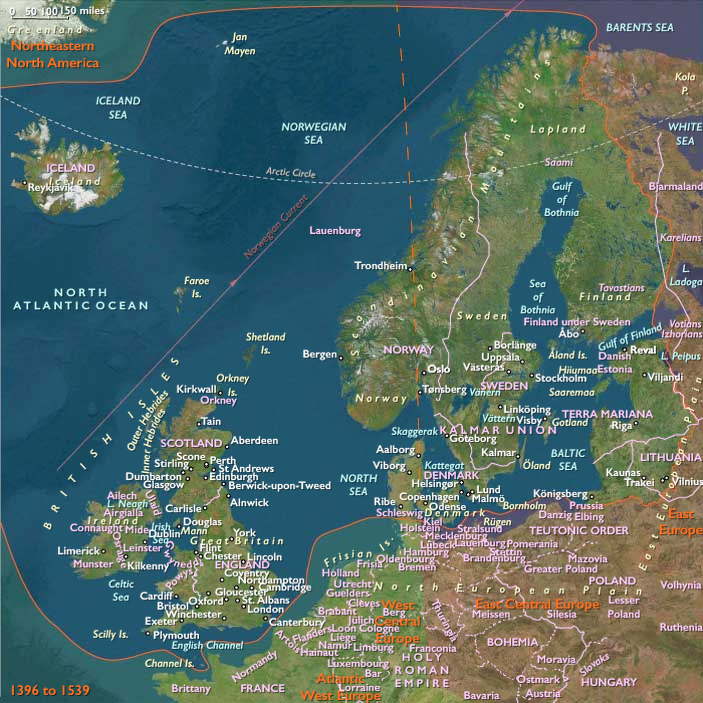
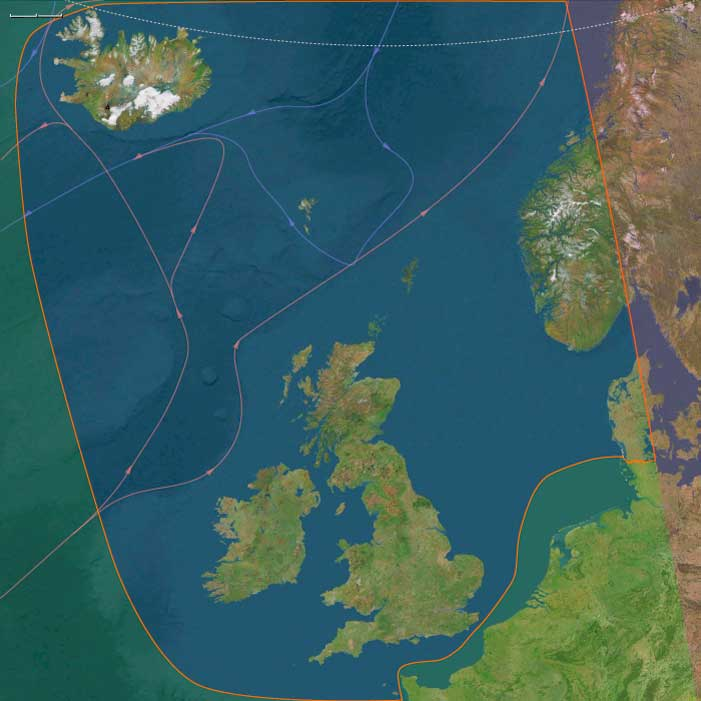
…the French make a landing on the …
Years: 1403 - 1403
…the French make a landing on the Isle of Wight.
Locations
People
- Henry IV of England
- Henry Percy (Hotspur)
- Henry Percy, 1st Earl of Northumberland
- Henry V of England
- Owain Glyndŵr
Groups
- Brittanny, Duchy of
- Scotland, Kingdom of
- France, (Valois) Kingdom of
- England, (Plantagenet, Lancastrian) Kingdom of
Topics
- Hundred Years' War
- Anglo-Scottish Wars
- Hundred Years' War: Second Peace
- Glyndŵr Rising, or Welsh Revolt
- Percy's Rebellion
Commodoties
Subjects
Regions
Subregions
Related Events
Filter results
Showing 10 events out of 42646 total
Crown Prince Zhu Biao, the son and designated heir of the Hongwu Emperor, had died in 1392, before ascending to the throne, and the emperor had made Zhu Biao's son Zhu Yunwen his successor, rather than Zhu Biao's younger brother Zhu Di.
Thus, succession had passed over the Hongwu Emperor's six surviving sons.
Zhu Yunwen, assuming the throne at sixteen in 1398 as the Jianwen Emperor, immediately sets about breaking the power of his six ambitious uncles.
In the space of a year, the young emperor had reduced three of them to the status of private citizens, driven a fourth to suicide, and caused a fifth to retire to a monastery.
He had begun to suppress feudal lords, including his uncle Zhu Di, the Prince of Yen, who, feeling threatened, had raised an army in 1399 and begun to march towards Nanjing from his northern base in Beijing under the banner of the Jingnan campaign, eventually gaining control of all the northern provinces.
Advancing with his strong army on the walled imperial capital at Nanjing (Nanking), he compels the city’s surrender in 1402 with little fighting, aided in this by court defectors.
Zhu Yunwen disappears: he and his concubines are said to have died in a palace fire during the coup, or (the scenario thought more likely by Chinese historians) he escapes in the disguise of a Buddhist monk.
The new emperor, whose era name "Yongle" means "Perpetually Jubilant", will generally be considered one of the greatest emperors of the Ming Dynasty, and to be among the greatest of Chinese emperors.
His usurpation of the throne is now sometimes called the "Second Founding" of the Ming.
The Yongle emperor and his administration had spent the latter part of 1402 brutally purging China of Jianwen's supporters.
The Jianwen emperor had been advised by a group of scholars who, killed by Yongle, are to become known as the Four Martyrs.
Yongle systematically erases the record of Jianwen's rule; no temple name is given to him.
Bunei, the son of Chuzan’s longtime king, Satto, had succeeded his father in 1395, and has overseen the continuation of the policies and developments of his father's reign.
Relations with China have grown stronger, and a number of institutions have been established to cater to Chinese envoys to Chūzan.
Trade is booming, and relations with other countries have likewise continued to expand.
Although China accepts tributary missions from Hokuzan and Nanzan as well at this time, they officially recognize only the King of Chūzan as a head of state in Ryukyu.
Chūzan continues to enjoy formal diplomatic relations with Ayutthaya and Korea, and trade relations with Java, Sumatra, and other states, as do the other two Ryukyuan kingdoms.
However, only Chūzan has managed to establish formal relations with Japan's Ashikaga shogunate, having sent a mission in 1403.
These political advantages, coupled with control of Naha, the most active port on Okinawa, have allowed Chūzan to gain significant political and economic superiority over its two neighbors.
It has also benefited greatly culturally; trade always brings cultural exchange along with it, and many of the states in the region have experiences great cultural surges as a result.
In particular, it is believed that Buddhism from Korea and Shintō from Japan are first introduced to Okinawa to a significant extent at this time.
Students and other travelers to Korea have returned with texts, statues, rituals, and other Buddhist objects and ideas, and in exchange, King Bunei has promised to send shipwrecked Koreans, and those who have been the victims of Japanese pirates (wakō), back home safely.
Domestically, Bunei's reign has seen significant development in the organization and formalization of the royal administration, and increased literacy and education among the administrative officials.
Government documents, particularly those concerning trade and diplomacy, are first compiled in 1403.
However, this increased organization has not been accompanied by political stability; the kings of Nanzan and Hokuzan, along with the emperor of China, had all died between 1395 and 1398.
These events have heightened tensions between the three kingdoms, all of which seek the favor of the Ming court, which has largely been unresponsive.
As a result of these political instabilities, the anji (local territorial lords) have begun to seize more power for themselves within their tiny local domains.

The Ming dynasty had driven the Mongols out of China by 1368.
The first Ming Empero, Hongwu, had demanded and received homage from many Central Asian states paid to China as the political heirs to the former House of Kublai.
Timur has more than once sent to the Ming Government gifts that could have passed as tribute, at first not daring to defy the economic and military might of the Middle Kingdom.
Vasily I has continued the process of unification of the Russian lands: in 1392, he had annexed the principalities of Nizhny Novgorod and Murom.
Nizhny Novgorod had been given to Vasily by the Khan of the Golden Horde in exchange for the help Moscow had given against one of his rivals.
Kaluga, Vologda, Veliki Ustyug and Komi peoples' lands had been annexed in 1397 and 1398.
To prevent Russia from being attacked by the Golden Horde, Vasily I had entered into alliance with the Grand Duchy of Lithuania in 1392 and married Sophia of Lithuania, the only daughter of Vytautas the Great.
The alliance turns out to be fragile, since Vytautas invades in 1403, capturing Vyazma.
Mongol emir Timur had raided the Slavic lands in 1395, ruining the Volgan regions but not penetrating so far as Moscow.
Timur's raid had been of service to the Russian prince as it damaged the Golden Horde, which for the ensuing several years has been a state of anarchy.
During the whole of this time no tribute has been paid to the khan, Olug Moxammat, though vast sums of money continue to be collected in the Moscow treasury for military purposes.
Wenceslas, deposed from his German throne in 1400 by the electors, is in 1402-03 again held prisoner by the Bohemian magnates with the help of his half-brother, Sigismund, who has ruled Bohemia for nineteen months.
After again granting minor concessions to secure his release, Wenceslas regains his Bohemian throne and continues to battle the noble opposition.
John VII Palaiologos had acted as regent for Manuel at Constantinople from 1399 to 1402 during the latter’s fruitless solicitation of Western aid.
Timur’s victory over the Ottoman Turks the previous year has, however, resulted in a respite for the embattled empire.
During Manuel's absence, John has arranged a treaty with the Ottomans, granting them financial and religious privileges.
Manuel, having acquired mercenaries to compel the Ottoman Turks to withdraw from their ten-year siege of Constantinople, disavows the treaty on his return, …
…arranges a peace treaty in 1403 with Bayezid's eldest son and putative successor Süleyman, putting an end to tribute payments, and recovering Thessalonica (modern Thessaloníki, Greece) to which he sends John as governor.
Manuel I Megas Komnenos, ruler of Trebizond from 1238 to 1263, had preserved internal security and acquired the reputation of a great commander, but the empire was already losing outlying provinces to the Turkmen, and found itself forced to pay tribute to the Seljuqs of Rum and then to the Mongols of Persia, a sign of things to come.
The troubled reign of John II (1280–1297) included a reconciliation with Constantinople and the end of Trapezuntine claims to the great metropolis.
Trebizond had reached its greatest wealth and influence during the long reign of Alexios II (1297–1330) but suffered a period of repeated imperial depositions and assassinations from the end of Alexios' reign until the first years of Alexius III, ending in 1355.
The empire will never fully recover its internal cohesion, commercial supremacy or territory.
Manuel III Megas Komnenos, who succeeded his father Alexios III as emperor in 1390, had in 1391 and 1396 confirmed the privileges of the Venetians.
Manuel had come under the overlordship of Timur by 1402, while the Ottoman Turks were encroaching on his western frontier.
Timur had demanded that Manuel and his army join him in the coming war with the Ottoman Turks, but somehow the Emperor had avoided this demand, although he had contributed twenty galleys to Timur's general effort.
The Battle of Ankara in 1402 and defeat of Sultan Bayezid has been a considerable benefit to Empire of Trebizond, since the expanding Ottomans are a serious threat to it.
Janus continues his effort to regain Famagusta from the Genoese, who also control Kyrenia.
In 1403, the Governor of Genoa, de Mengre, negotiates with Janus' representative George Billi and the talks end with an agreement.
The conflicts end but the two cities remain under Genoese hands.
Shortly afterward, Janus again attempts to take over Famagusta, forcing the Cypriot people to pay special taxes to assemble an army and build siege machinery, using these to invest Famagusta.
The rule of the Melissenos family at Oinaion is presumed to have been destroyed by the ravages of part of Timur's army, which detaches from the whole to visit the city of Kerasous when he leaves Asia Minor in 1403.
Only the mountains around Kerasous prevent them from venturing any further, much to the relief of the people of Trebizond.
Years: 1403 - 1403
Locations
People
- Henry IV of England
- Henry Percy (Hotspur)
- Henry Percy, 1st Earl of Northumberland
- Henry V of England
- Owain Glyndŵr
Groups
- Brittanny, Duchy of
- Scotland, Kingdom of
- France, (Valois) Kingdom of
- England, (Plantagenet, Lancastrian) Kingdom of
Topics
- Hundred Years' War
- Anglo-Scottish Wars
- Hundred Years' War: Second Peace
- Glyndŵr Rising, or Welsh Revolt
- Percy's Rebellion