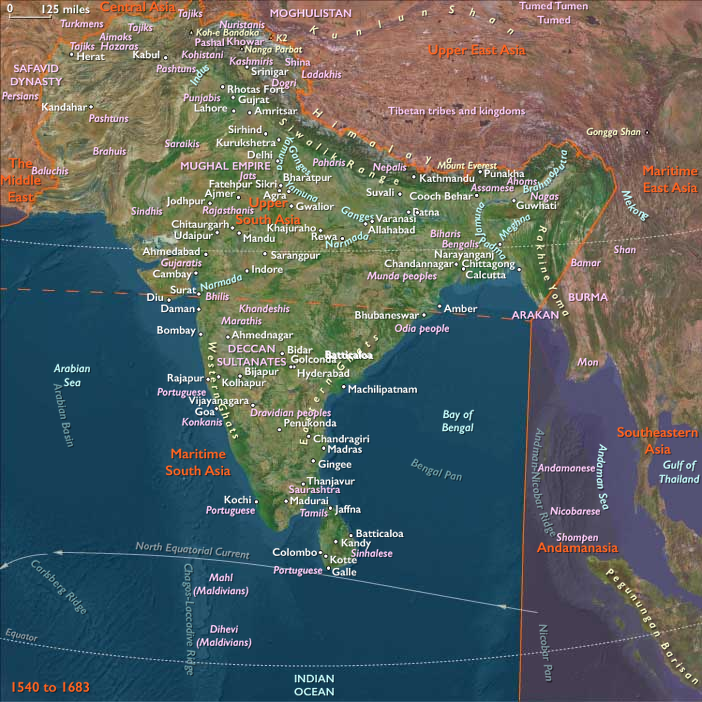
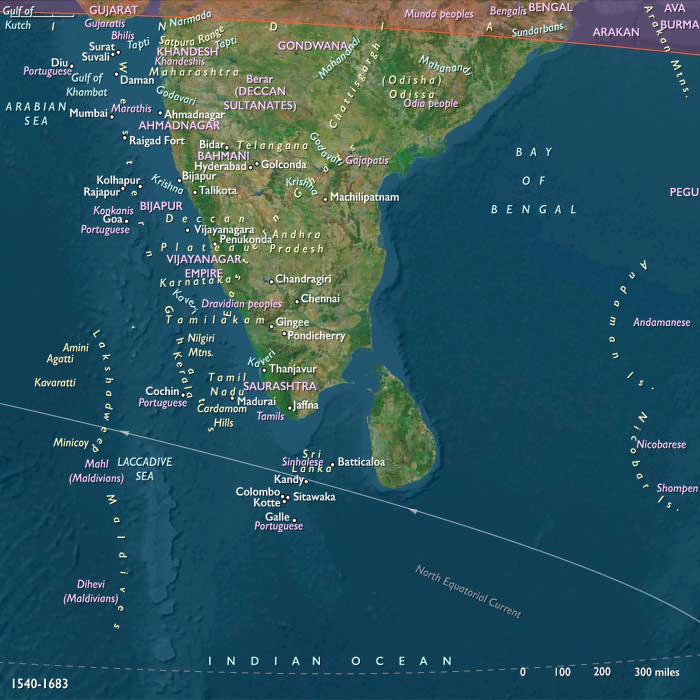
The French acquire Valikondapuram, on the Coromandel …
Years: 1673 - 1673
The French acquire Valikondapuram, on the Coromandel Coast, from the Sultan of Bijapur in 1674, and thus is laid the foundation of Pondichéry, which is to become a principal base of the French East India Company.
Locations
Groups
- Adil Shahi dynasty (Bijapur, Sultanate of)
- France, (Bourbon) Kingdom of
- Dutch East India Company (Vereenigde Oostindische Compagnie or VOC in Dutch, literally "United East Indies Company")
- Mughal Empire (Delhi)
- French East India Company
Topics
Commodoties
Subjects
Regions
Subregions
Related Events
Filter results
Showing 10 events out of 30668 total
Wu Sangui had in 1667 submitted a request to the Kangxi Emperor, asking for permission to be relieved of his duties in Yunnan and Guizhou provinces, on the excuse that he was ill, and the Emperor had approved.
The Kangxi Emperor decides in 1673 to make Wu Sangui, along with the two other princes who had been rewarded with large fiefs in southern and western China, move from their lands to resettle in Manchuria.
As a result, the three revolt.
Thus begins the eight-year civil war known as the Revolt of the Three Feudatories (also known as the San-fan War), with Wu Sangui declaring himself the "All-Supreme-Military Generalissimo".
The Commonwealth Sejm, with most of the deputies finally united by anger due to the territorial losses and the demeaning tribute (which can in fact be seen as reducing the Commonwealth to Ottomans' vassal), instead of ratifying the peace treaty with the Sublime Porte, finally raises taxes for a new army (an army of about thirty-seven thousand strong is raised) and increases the Cossack register to forty thousand.
The French had taken Saint Thomas in 1672 but had soon been driven out by the Dutch.
Chandernagore (present-day Chandannagar) is established in 1673 with the permission of Nawab Shaista Khan, the Mughal governor of Bengal.
Louis XIV's interest in ballet had waned as he aged, and his dancing ability had declined (his last performance was in 1670) and so the Italian composer Jean-Baptiste Lully, who has spent most of his life working in the French royal court, pursues opera.
He had bought the privilege for opera from Pierre Perrin and, with the backing of Jean-Baptiste Colbert and the king, had created a new privilege which essentially gives Lully complete control of all music performed in France until his death in 1687.
Lully can be considered the founder of French opera, having forsaken the Italian method of dividing musical numbers into separate recitatives and arias, choosing instead to combine the two for dramatic effect.
Lully also has opted for quicker story development as this is more to the taste of the French public.
Antonie van Leeuwenhoek, a Dutch tradesman and Delft native, after developing his method for creating powerful lenses and applying them to a thorough study of the microscopic world, had been introduced via correspondence to the Royal Society of London by the famous Dutch Physician Regnier de Graaf.
Leeuwenhoek's interest in microscopes and a familiarity with glass processing leads to one of the most significant, and simultaneously well-hidden, technical insights in the history of science.
By placing the middle of a small rod of soda lime glass in a hot flame, van Leeuwenhoek can pull the hot section apart like taffy to create two long whiskers of glass.
By then reinserting the end of one whisker into the flame, he can create a very small, high-quality glass sphere.
These spheres become the lenses of his microscopes, with the smallest spheres providing the highest magnifications.
An experienced businessman, van Leeuwenhoek realizes that if his simple method for creating the critically important lens were to be revealed, the scientific community would likely disregard or even forget his role in microscopy.
He therefore allows others to believe that he is laboriously spending most of his nights and free time grinding increasingly tiny lenses to use in microscopes, even though this belief conflicts both with his construction of hundreds of microscopes and his habit of building a new microscope whenever he chances upon an interesting specimen that he wants to preserve.
Van Leeuwenhoek uses samples and measurements to estimate numbers of microorganisms in units of water.
Making good use of the huge lead provided by his method, he studies a broad range of microscopic phenomena, and shares the resulting observations freely with groups such as the English Royal Society.
Such work firmly establishes his place in history as one of the first and most important explorers of the microscopic world.
In 1673, his earliest observations are published by the Royal Society in its journal, Philosophical Transactions.
Among these published observations are Leeuwenhoek's accounts of bee mouthparts and stings.

The versatile Thomas Flatman writes Poems and Songs (1674), of which there are several editions.
Among his earliest verses are lines prefixed to Graphice (1658) by Sir William Sanderson (the Sanderson Baronets), a work containing a description of the art of miniature painting, based on Edward Norgate’s writings.
Flatman divides his career between writing poetry (in which his earnest religious temperament is revealed) and painting portraits in miniature.
A versatile man, he was made a Fellow of the newly founded Royal Society in 1668.
A number of his friends were leading clergymen, and many of his sitters were drawn from the Church and other intellectual circles.
His miniatures are noted for their vitality.
One of his self-portraits is in the Victoria and Albert Museum.
A portrait of Charles II is in the Wallace Collection, London.
French colonists will adapt a form of the Illinois language-name for the people: Wimihsoorita.
Their name means "One who has dugout canoes".
In their own Siouan language, the Missouri call themselves Niúachi, also spelled Niutachi, meaning "People of the River Mouth."
The Misssouria tribe's oral history tells that they once lived north of the Great Lakes.
They began migrating south in the sixteenth century.
By 1600, the Missouria lived near the confluence of the Grand and Missouri rivers, where they will settle through the eighteenth century.
Their tradition says that they split from the Otoe tribe, which belongs to the same Chiwere branch of the Siouan language, because of a love affair between the children of two tribal chiefs.
The seventeenth century has brought hardships to the Missouria.
The Sauk and Fox frequently attack them.
Their society will be even more disrupted by the high fatalities from epidemics of smallpox and other Eurasian infectious diseases that accompanied contact with Europeans.
The Occaneechi, who live primarily on a large, four-mile (6.4 kilometers) long Island surrounded by the Dan and Roanoke rivers near current day Clarksville, Virginia, are Siouan-speaking, and thus related to the Saponi, Tutelo, Eno and other Southeastern Siouan-language peoples living in the Piedmont region of present-day North Carolina and Virginia.
The Occaneechi are mentioned in seventeenh-century colonial English records as living on the Trading Path that connects Virginia with the interior of North America.
Their position on the Trading Path gives the Occaneechi the power to act as trading "middlemen" between Virginia and various tribes to the west.
Abraham Wood, an English fur trader (specifically the beaver and deerskin trades) sometimes referred to as "General" or "Colonel" Wood, sends his friend James Needham and his indentured servant Gabriel Arthur into the southern Appalachian Mountains in 1673 in an attempt to make direct contact with the Cherokee, thus bypassing the Occaneechi, and to find an outlet to the Pacific Ocean.
The Miami have by 1673 also established settlements in present Michigan near the mouth of the St. Joseph River at the site of present-day St. Joseph and Benton Harbor.
The river is one of the most significant early transportation routes both to Native Americans and to early French fur trappers in the Illinois Country, a legally undefined region without formal boundaries, centered around present day southwest Illinois that is the French begin in 1673 to explore and settle.
The St. Joseph River furnishes two different portages that allow early continuous travel by canoe among different watersheds of the region.
The first major transfer point is at its headwaters in southwestern Michigan, where it furnishes a portage to the St. Joseph River of the Maumee River watershed, which drains into Lake Erie.
The second major transfer point is at ...
Years: 1673 - 1673
Locations
Groups
- Adil Shahi dynasty (Bijapur, Sultanate of)
- France, (Bourbon) Kingdom of
- Dutch East India Company (Vereenigde Oostindische Compagnie or VOC in Dutch, literally "United East Indies Company")
- Mughal Empire (Delhi)
- French East India Company