
The free settlers of New South Wales …
Years: 1844 - 1844
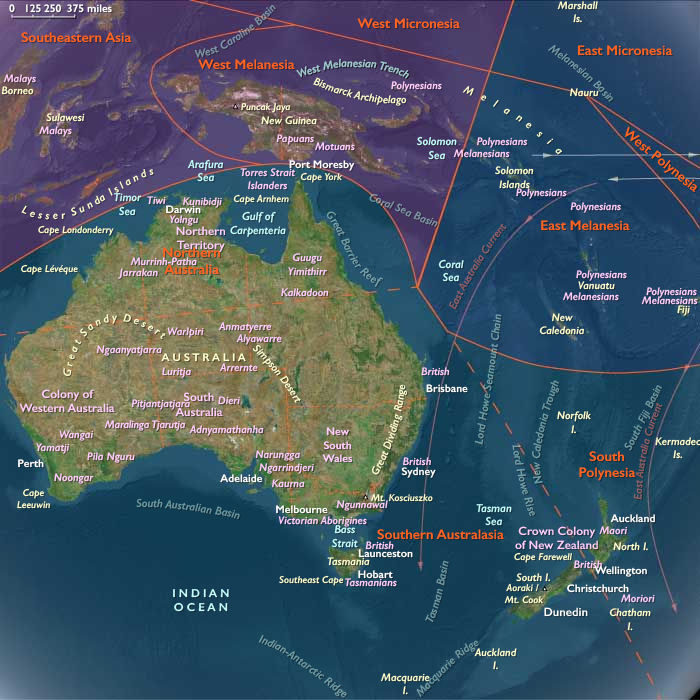
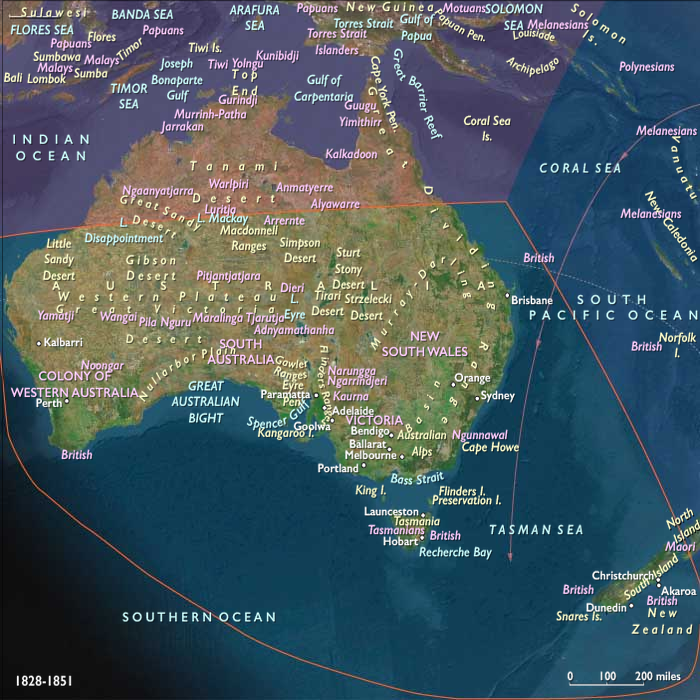
The free settlers of New South Wales have successfully petitioned the British government to cease transporting convicts to the colony by 1844; shipment of prisoners to other Australian colonies will continue.
Locations
Groups
- Australia, British
- New South Wales (British colony)
- Britain (United Kingdom of Great Britain and Ireland)
Topics
Subjects
Regions
Subregions
Related Events
Filter results
Showing 10 events out of 17228 total
Merchant Captain Warren Delano, Jr., an American, had sailed to Canton in 1833, where he had done so well that within seven years he had become a senior partner in Russell & Company at age thirty-one.
Delano becomes a member of the Canton Regatta Club in 1844 and initiates dealings with the Hong Society, laying the basis for his future wealth in opium trafficking as the head of Russell and Company.
The Chinese government pays an indemnity of twelve million dollars to cover the expenses of the British expedition, in addition to six billion dollars already paid as ransom for the city of Canton.
Further, they pay a compensation of six million dollars as the value of the destroyed opium stocks.
Another three million dollars is to be paid by Chinese merchants to the British subjects at Canton.
Karl Klaus, professor at Kazan State University, re-investigates Gotttfrid Osann's platinum residues and establishes the existence of the rare metal ruthenium in 1844, after a four-year investigation involving fifteen pounds of native platinum.
The Livonian chemist retains the name, which honors Ruthenia, the Latinized word for Russia, where the metal-bearing ore is first mined.
Heinrich Rose announces the discovery of a new element, which is actually columbium, in 1844.
A professor at the University of Berlin from 1823, the German chemist names it niobium, after Niobe, the mythical daughter of Tantalus, who had lent his name to tantalum, the next heavier member of Group 5 to which niobium belongs, and with which niobium is often associated in minerals.
Niobium had been first identified by English chemist Charles Hatchett in 1801, who found a new element in a mineral sample that had been sent to England from Connecticut, United States in 1734 by John Winthrop F.R.S. (grandson of John Winthrop the Younger) and named the mineral columbite and the new element columbium after Columbia, the poetical name for the United States.
The columbium discovered by Hatchett was probably a mixture of the new element with tantalum.
Subsequently, there was considerable confusion over the difference between columbium (niobium) and the closely related tantalum.
In 1809, English chemist William Hyde Wollaston compared the oxides derived from both columbium—columbite, with a density 5.918 g/cm3, and tantalum—tantalite, with a density over 8 g/cm3, and concluded that the two oxides, despite the significant difference in density, were identical; thus he kept the name tantalum.
This conclusion will be disputed in 1846 by Rose, who will argue that there are two different elements in the tantalite sample, and name them after children of Tantalus: niobium (from Niobe) and pelopium (from Pelops).
This confusion arises from the minimal observed differences between tantalum and niobium.
The claimed new elements pelopium, ilmenium, and dianium are in fact identical to niobium or mixtures of niobium and tantalum.
Chemists will continue to confuse niobium, or columbium, with tantalum, closely associated in ores and in properties, until Rose's experiments with tantalic and niobic acid demonstrate their distinct characters.
Iranian Mirza Ali Muhammad of Shiraz, announcing his divine election as the Bab (“doorway to heaven”) in 1844, founds the Babi movement.
This will later be merged with the General Assembly's Institution to form the Scottish Church College, one of the pioneering institutions of the Bengali Renaissance.
Louis Édouard Bouët signs treaties with the kings of the Grand Bassam and Assinie regions of the Ivory Coast in 1843-1844, placing their territories under a French protectorate.
The second period of the rule of Otto of Greece begins in March 1844, when in the aftermath of the military coup he convenes a national assembly to draft a constitution.
When the assembly finishes its work in the spring, a new system of government is established.
Otto will henceforth rule as a constitutional monarch.
A bicameral legislature will be elected by all property-holding males over twenty-five.
In theory, this makes Greece one of the most democratic states in Europe, but Otto retains the power to appoint and dismiss government ministers, to dissolve parliament, to veto legislation, and issue executive decrees.
Parliamentary democracy, instead of promoting political parties, spawns a new factionalism based on the patronage of prominent individuals.
The career of Ioannis Kolettis, who is appointed prime minister under the new system, exemplifies the politics of personality.
The restricted borders of the modern Greek state at its inception in 1830 had disappointed the inhabitants of Epirus and Macedonia, who remain under Ottoman rule.
Addressing these concerns to the constitutional assembly in Athens, Kolettis states, "the kingdom of Greece is not Greece; it is only a part, the smallest and poorest, of Greece.
The Greek is not only he who inhabits the kingdom, but also he who lives in Ioannina), or Thessaloniki, or Serres, or Adrianople."
Konstantin Siegwart-Müller, elected on a wave of renascent clericalism to the Lucerne state council in 1841, by 1844 has become Schultheiss (chief magistrate) and, simultaneously, president of the Diet.
He presses for clericalist objectives—the readmission of the Jesuits to Lucerne and the restoration in Aargau of the eight monasteries that had been dissolved by the local government.
The Jesuits, whom the liberals detest, are invited to take charge of religious education in Luzern.
Switzerland’s seven Catholic cantons—Luzern, ...
Years: 1844 - 1844
Locations
Groups
- Australia, British
- New South Wales (British colony)
- Britain (United Kingdom of Great Britain and Ireland)
