
Filters:
The Barbarian Invasions resume from the beginning …
Years: 388 - 531
The Barbarian Invasions resume from the beginning of the fifth century, and Germanic tribes such as the Vandals, Suebi and Alans cross the Rhine and settle in Gaul, Spain and other parts of the collapsing Roman Empire.
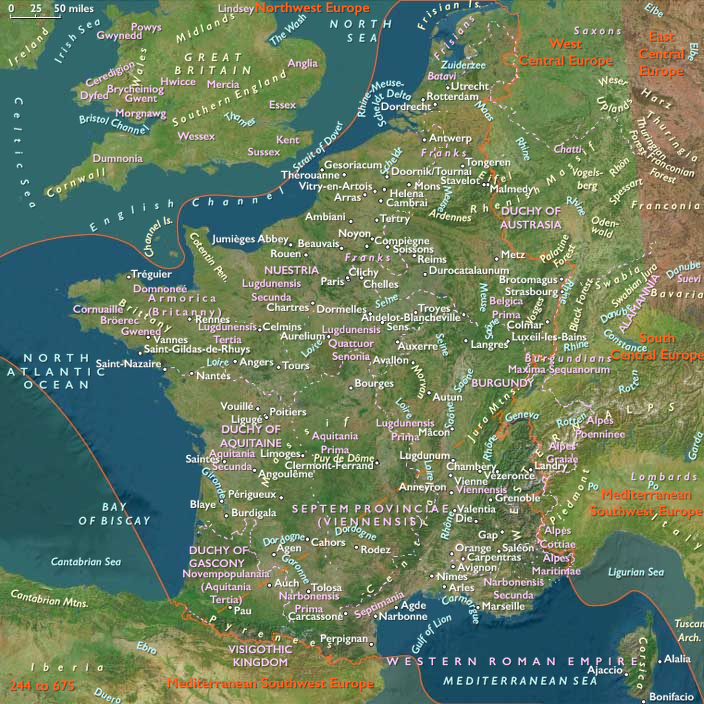
At the end of the Antiquity period, ancient Gaul is divided into several Germanic kingdoms and a remaining Gallo-Roman territory, known as the Kingdom of Soissons, also known as the Domain of Syagrius.
Simultaneously, Celtic Britons, fleeing the Anglo-Saxon settlement of Britain, settle the western part of Armorica.
As a result, the Armorican peninsula will be renamed Brittany, Celtic culture is revived and independent petty kingdoms arise in this region.
The pagan Franks, from whom the ancient name of "Francie" is derived, originally settle the north part of Gaul, but under Clovis I conquer most of the other kingdoms in northern and central Gaul.
In 498, Clovis I is the first Germanic conqueror after the fall of the Roman Empire to convert to Catholic Christianity, rather than Arianism; thus France is given the title "Eldest daughter of the Church" (French: La fille aînée de l'Église) by the papacy, and French kings will be called "the Most Christian Kings of France" (Rex Christianissimus).
The Franks embrace the Christian Gallo-Roman culture and ancient Gaul s eventually renamed Francia ("Land of the Franks").
The Germanic Franks adopt Romanic languages, except in northern Gaul where Roman settlements are less dense and where Germanic languages emerge.
Clovis makes Paris his capital and establishes the Merovingian dynasty, but his kingdom does not survive his death.
The Franks treat land purely as a private possession and divide it among their heirs, so four kingdoms emerge from Clovis's: Paris, Orléans, Soissons, and Rheims.
At the end of the Antiquity period, ancient Gaul is divided into several Germanic kingdoms and a remaining Gallo-Roman territory, known as the Kingdom of Soissons, also known as the Domain of Syagrius.
Simultaneously, Celtic Britons, fleeing the Anglo-Saxon settlement of Britain, settle the western part of Armorica.
As a result, the Armorican peninsula will be renamed Brittany, Celtic culture is revived and independent petty kingdoms arise in this region.
The pagan Franks, from whom the ancient name of "Francie" is derived, originally settle the north part of Gaul, but under Clovis I conquer most of the other kingdoms in northern and central Gaul.
In 498, Clovis I is the first Germanic conqueror after the fall of the Roman Empire to convert to Catholic Christianity, rather than Arianism; thus France is given the title "Eldest daughter of the Church" (French: La fille aînée de l'Église) by the papacy, and French kings will be called "the Most Christian Kings of France" (Rex Christianissimus).
The Franks embrace the Christian Gallo-Roman culture and ancient Gaul s eventually renamed Francia ("Land of the Franks").
The Germanic Franks adopt Romanic languages, except in northern Gaul where Roman settlements are less dense and where Germanic languages emerge.
Clovis makes Paris his capital and establishes the Merovingian dynasty, but his kingdom does not survive his death.
The Franks treat land purely as a private possession and divide it among their heirs, so four kingdoms emerge from Clovis's: Paris, Orléans, Soissons, and Rheims.
People
Groups
- Britons (historical)
- Franks
- Armorica
- Vandals (East Germanic tribe)
- Suebi (Suevi), Realms of the
- Christianity, Arian
- Alani, Realms of the
- Suebic Kingdom of Galicia
- Vandals and the Alans, Kingdom of the
- Christianity, Chalcedonian
- Soissons, (Gallo-Roman) Domain of
- Soissons (eventually Neustria), Frankish Kingdom of
- Paris, Frankish Kingdom of
- Orléans (eventually Burgundy), Frankish Kingdom of
- Reims, Frankish Kingdom of
- Reims and Metz (eventually Austrasia), Frankish Kingdom of
Topics
Subjects
Regions
Years: 388 - 531
People
Groups
- Britons (historical)
- Franks
- Armorica
- Vandals (East Germanic tribe)
- Suebi (Suevi), Realms of the
- Christianity, Arian
- Alani, Realms of the
- Suebic Kingdom of Galicia
- Vandals and the Alans, Kingdom of the
- Christianity, Chalcedonian
- Soissons, (Gallo-Roman) Domain of
- Soissons (eventually Neustria), Frankish Kingdom of
- Paris, Frankish Kingdom of
- Orléans (eventually Burgundy), Frankish Kingdom of
- Reims, Frankish Kingdom of
- Reims and Metz (eventually Austrasia), Frankish Kingdom of
Topics
Subjects
Regions