
The Franks, the Longiones, and the Vandals, …
Years: 279 - 279
The Franks, the Longiones, and the Vandals, despite their huge numbers, have all been defeated within two years.
At one point, Probus had captured the leader of the Longiones, called Semnon, and upon Semnon's acceptance of terms permitted his return to his homeland with his surviving people.
At one occasion during these successful campaigns, sixteen German chiefs are said to have knelt at Probus' feet.
Hostages are taken to ensure the peace and some sixteen thousand Germans are recruited into the Roman army.
In 279, the emperor sets out for Syria, desiring to reconquer Mesopotamia from Sassanid Persia.
Locations
People
Groups
- Persian people
- Lugii
- Franks
- Vandals (East Germanic tribe)
- Italy, Roman
- Germans
- Syria Palæstina, Roman province of (Judea, Samaria, and Idumea)
- Burgundians (East Germanic tribe)
- Persian Empire, Sassanid, or Sasanid
- Roman Empire (Rome): Non-dynastic
Topics
Commodoties
Subjects
Regions
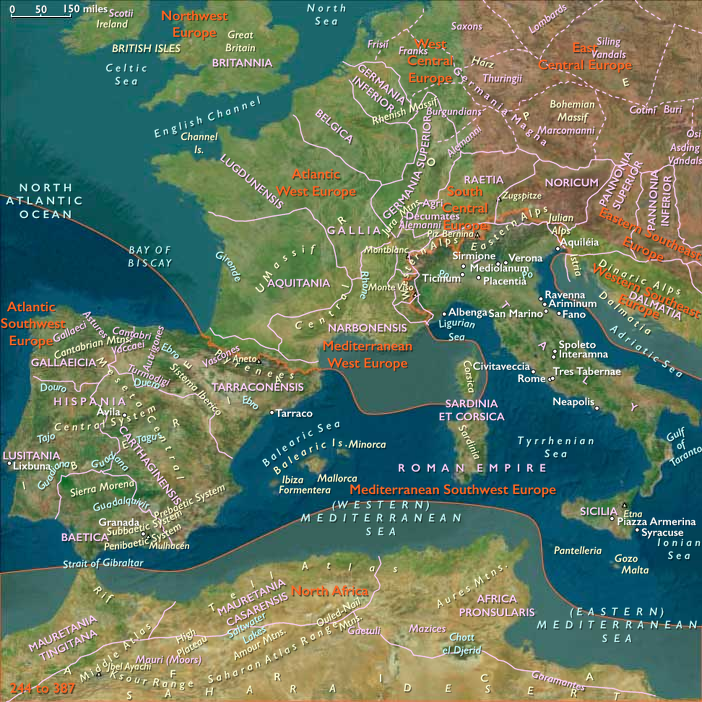
Subregions
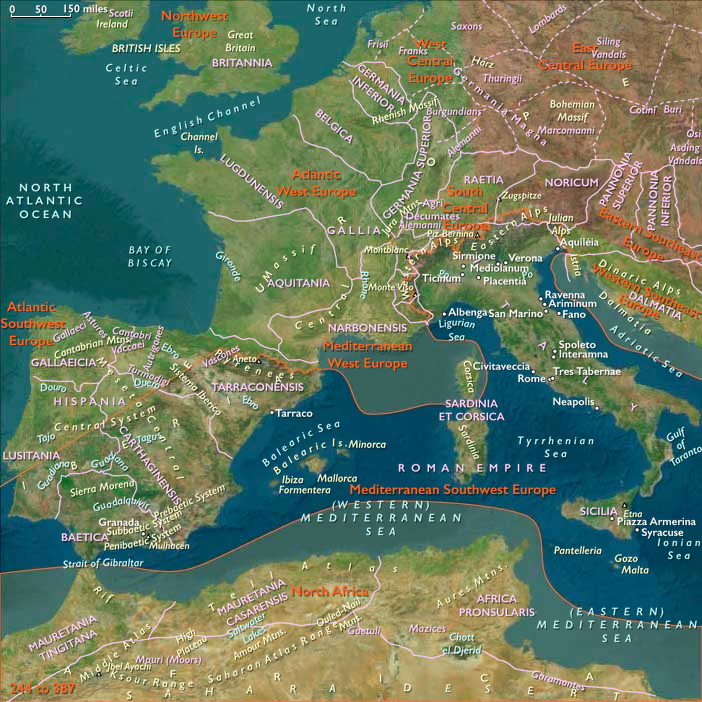
Related Events
Filter results
Showing 10 events out of 60187 total
Probus, while en route to Syria, repels an invasion by the Getae, who have crossed the lower Danube.
A military campaign launched by the Jin Dynasty against the state of Eastern Wu in 280, towards the very end of the Three Kingdoms period, concludes with the fall of Wu and the reunification of China under the Jin Dynasty.
A civil war for power among princes and dukes of the Chinese Jin Dynasty from 291 to 306 is called the War of the Eight Princes, the term stemming from biographies of eight princes collected in chapter fifty-nine of the "History of Jin Dynasty" (Jinshu).
While initial conflicts are relatively minor and confined to the imperial capital of Luoyang and its surroundings, the scope of the war will expand with each new prince that enters the struggle.
Diocletian’s Rise and the Transformation of the Roman Empire (284–305 CE)
In 284 CE, Diocletian was hailed as Imperator by the eastern legions, marking the beginning of his mission to restore stability to the Roman Empire after the prolonged Crisis of the Third Century (235–284 CE). Through sweeping political, economic, and military reforms, he restructured imperial governance, ensuring a stronger and more enduring state.
The Tetrarchy: A New System of Rule
To address the empire’s administrative and military challenges, Diocletian established the Tetrarchy, a system of shared imperial rule among four emperors:
- Diocletian – Augustus of the East, based in Nicomedia (Asia Minor).
- Maximian – Augustus of the West, based in Mediolanum (Milan).
- Galerius – Caesar of the East, subordinate to Diocletian.
- Flavius Constantius – Caesar of the West, subordinate to Maximian.
This system provided greater regional control, allowing for faster military response times and more efficient administration, particularly along the vulnerable frontiers.
Reforms and Military Campaigns
-
Economic and Taxation Reforms
- Diocletian stabilized the economy by reforming taxation, ensuring a steady flow of revenue to fund the military and administration.
- He introduced the Edict on Maximum Prices (301 CE) to combat inflation, though it had limited success.
-
Military Campaigns and Border Security
- He expelled the Sassanid Persians from Syria, reestablishing Roman dominance in the East.
- Alongside Maximian, he successfully defeated Germanic and other barbarian tribes, securing Rome’s frontiers.
- Strengthened Rome’s defensive infrastructure, including fortifying the Danube and Rhine borders.
Imperial Authority and Eastern Influence
Diocletian fundamentally changed the nature of Roman rule, adopting autocratic practices influenced by Eastern monarchies:
- Introduced ornate imperial regalia, including pearls, golden sandals, and elaborate robes.
- Instituted strict court ceremonies, requiring subjects to prostrate themselves before the emperor(proskynesis), a custom borrowed from Persian and Hellenistic courts.
- Unlike Augustus and his successors, who maintained the illusion of a restored Republic, Diocletian openly embraced absolute rule, making it clear that the emperor was above all others.
Legacy: The Transformation of the Roman Empire
- The Tetrarchy provided temporary stability, but after Diocletian’s abdication in 305 CE, it soon collapsed, leading to a civil war between rival claimants.
- However, his administrative and military reforms strengthened Rome, delaying the fall of the Western Roman Empire and shaping the governance of the Byzantine Empire.
- His authoritarian model of rule influenced later emperors, transitioning Rome from the principate (early empire) to the dominate (late empire), marking the beginning of Late Antiquity.
Diocletian’s reforms and centralized rule redefined the Roman state, transforming it into a more autocratic and militarized empire, ensuring its survival for another century in the West and over a millennium in the East.
East Central Europe (280–291 CE): Frontier Consolidation under Probus and Gradual Recovery
Between 280 and 291 CE, East Central Europe—including Poland, Czechia, Slovakia, Hungary, and those portions of Germany and Austria lying east of 10°E and north of a line stretching from roughly 48.2°N at 10°E southeastward to the Austro-Slovenian border near 46.7°N, 15.4°E—continued experiencing gradual stabilization following earlier frontier crises. Under Emperor Probus (276–282 CE) and his successors, Roman frontier provinces (Pannonia Superior, Pannonia Inferior, and Noricum) benefited from enhanced military fortifications, renewed economic activity, and strengthened diplomatic relations with neighboring tribes, including the Marcomanni, Quadi, Iazyges, Vandals, and Goths.
Political and Military Developments
Probus’s Frontier Policies and Military Strengthening
-
Emperor Probus significantly reinforced frontier defenses along the Danube, restoring military effectiveness by repairing and upgrading fortifications, improving infrastructure, and reorganizing frontier legions and auxiliaries.
-
His policies re-established a secure frontier presence, markedly reducing incursions by neighboring tribes.
Diplomatic Stabilization with Tribal Groups
-
Roman diplomacy maintained stable relations through alliances and treaties with major tribes such as the Marcomanni, Quadi, and Iazyges.
-
The Goths and Vandals, while still active, were restrained through strategic diplomacy and occasional military responses, easing frontier tensions.
Economic and Technological Developments
Continued Economic Recovery
-
Economic conditions improved steadily, supported by stabilized frontier defenses and gradually restored trade routes. Cross-border commerce resumed with increased frequency and security, benefiting both Roman provinces and neighboring tribal groups.
Renewed Infrastructure Investment
-
Infrastructure investments along the frontier expanded moderately. Improved roads, fortresses, and communications networks facilitated regional economic revival and enhanced Roman military logistics.
Cultural and Artistic Developments
Renewed Cultural Interaction
-
Cultural exchanges increased, reflecting improved stability. Artifacts from this era—ceramics, jewelry, metalwork—again showed creative integration of Roman and tribal elements.
Revival of Artistic Production
-
With frontier conditions stabilized, artisans resumed production of higher-quality objects, blending traditional tribal motifs and Roman artistic traditions, signaling gradual restoration of cultural vitality.
Settlement and Urban Development
Urban Revitalization
-
Roman towns along the Danube frontier, including Carnuntum, Vindobona, and Aquincum, experienced steady demographic and economic growth, though they remained fortified defensive strongholds.
Tribal Settlement Consolidation
-
Neighboring tribal settlements stabilized further, becoming more permanent and economically vibrant, benefiting from improved relations and renewed trade interactions with Roman provinces.
Social and Religious Developments
Tribal Leadership and Social Stability
-
Tribal societies enjoyed relative stability, with leadership focused less on immediate military survival and more on managing diplomatic and economic interactions with Rome.
Religious Continuity and Cultural Identity
-
Tribal religious practices continued, emphasizing traditional rites supporting community solidarity and protection, reflecting cautious optimism and stability.
Long-Term Consequences and Historical Significance
The era 280–291 CE represented a critical phase of continued stabilization and recovery in East Central Europe following decades of frontier crises. Roman frontier policies under Probus and his successors provided regional security, allowing economic revival and stable tribal-Roman relations. These developments contributed significantly to regional recovery, reestablishing a foundation for longer-term stability and setting conditions for subsequent historical developments.
Eastern Southeast Europe (280–291 CE): Imperial Stabilization and Frontier Reorganization
Settlement and Migration Patterns
Temporary Stabilization of Barbarian Incursions
Between 280 and 291 CE, following the reforms and military successes of Emperor Aurelian (270–275 CE), Eastern Southeast Europe experienced a temporary lull in barbarian incursions. This allowed for a brief recovery of frontier regions and stabilization of Roman control in critical areas such as Thrace and Moesia.
Reinforcement of Urban Settlements
In response to earlier devastation, Roman authorities strengthened defenses in strategic cities like Philippopolis and fortified outposts along the Danube frontier. These fortifications provided enhanced security and encouraged gradual resettlement and repopulation efforts, contributing to modest urban revival.
Political and Military Developments
Diocletian’s Ascendancy and Imperial Reforms
The ascension of Emperor Diocletian in 284 CE marked a significant turning point, bringing greater political stability to Eastern Southeast Europe. Diocletian initiated comprehensive administrative and military reforms, including the Tetrarchy (rule by four emperors), substantially improving governance and frontier defense efficiency.
Frontier Defense and Reorganization
Diocletian strengthened frontier fortifications along the Danube and restructured provincial administration, enhancing the responsiveness and effectiveness of the Roman military. His measures significantly improved regional security and restored imperial authority over contested territories.
Economic and Technological Developments
Economic Recovery and Agricultural Revitalization
The temporary stabilization under Diocletian allowed for a partial recovery of regional agriculture and commerce. Agricultural production and trade resumed more consistently, especially in fortified towns along major roads and river networks, boosting regional economic activity.
Infrastructure Restoration and Investment
Renewed investments in infrastructure, including repairs to vital roads and enhancements of defensive fortifications, significantly improved economic connectivity and military logistics. These projects facilitated commerce and stabilized urban life, laying the groundwork for future prosperity.
Cultural and Artistic Developments
Modest Revival of Urban Cultural Life
Urban centers began to experience a modest revival of cultural and public activities, with limited restoration of temples, public spaces, and civic buildings. Artistic expressions, though subdued compared to earlier eras, continued reflecting traditional Roman themes emphasizing imperial authority and resilience.
Social and Religious Developments
Enhanced Centralized Governance
Diocletian’s reforms significantly enhanced centralized governance, reasserting imperial authority and reinforcing provincial administration. This strengthened local administrative structures, improved taxation efficiency, and secured resources to sustain military and civic infrastructure.
Religious Stability and Pluralism
Religious life in the region remained pluralistic, characterized by traditional Roman religious practices alongside growing Christian communities. Christianity continued expanding in urban areas, gradually increasing its social presence despite periodic persecutions and restrictions.
Long-Term Consequences and Historical Significance
The era from 280 to 291 CE marked a critical phase of imperial stabilization and frontier reorganization, largely due to Diocletian’s effective administrative and military reforms. This period significantly restored regional stability, facilitated modest economic and cultural recovery, and established foundational administrative structures that would influence Eastern Southeast Europe’s evolution in subsequent decades.
The Middle East: 280–291 CE
Roman Triumph and the Persian Crisis
The era beginning in 280 CE witnesses intensified Roman–Persian conflicts as the Roman Empire seeks to assert dominance over its eastern rival, the Sassanid Empire. In 283 CE, Roman Emperor Carus initiates an aggressive campaign into Persian territories. This offensive culminates in the successful siege and sacking of the Sassanid capital, Ctesiphon—the third time the city has suffered this fate at Roman hands.
Carus's remarkable victory over the Persians momentarily shifts the balance of power in Rome's favor and demonstrates Roman military capabilities at their height. Yet, despite the significant triumph and apparent Roman advantage, the sudden and unexpected death of Emperor Carus in December 283 abruptly halts the Roman advance. This unforeseen event prevents further Roman consolidation or expansion into Persian domains.
The immediate aftermath sees Roman forces withdraw, allowing the Sassanids a respite and an opportunity to regroup. This brief but decisive incursion by Carus thus marks both a Roman high-water mark and a turning point, underscoring the persistent instability and shifting fortunes that characterize Roman–Persian rivalries throughout this turbulent century.
The Emperor Carus launches a successful invasion of Persia in 283, sacking the Sassanid capital Ctesiphon for the third time.
The Romans probably would have extended their conquests had Carus not died in December of this year.
Mediterranean Southwest Europe (280–291 CE): Diocletian’s Rise and the Road to Stability
The era 280–291 CE in Mediterranean Southwest Europe marks the beginning of a critical transformation under Emperor Diocletian, whose ascension initiates significant administrative, military, and economic reforms, laying foundations for lasting imperial recovery following decades of crisis.
Emergence of Diocletian and the Tetrarchy
In 284 CE, Diocletian becomes emperor, decisively addressing the prolonged instability and fragmented authority of the previous decades. Recognizing the challenges of governing an expansive empire alone, he establishes the Tetrarchy—a system of rule by four emperors—aiming to improve governance, enhance military responsiveness, and restore political stability.
Administrative and Provincial Reforms
Diocletian reorganizes the empire’s administrative structure by dividing provinces into smaller, more manageable units, enhancing bureaucratic efficiency and oversight. This restructuring strengthens imperial control, improves taxation efficiency, and significantly reduces corruption, providing greater stability and effectiveness in regional governance.
Military Strengthening and Border Defense
Continuing the defensive initiatives of predecessors like Aurelian, Diocletian significantly reinforces military forces and frontier fortifications. His reforms prioritize well-trained and disciplined troops, enhancing Rome’s capacity to respond swiftly to external threats, especially along vulnerable frontiers.
Economic Revitalization and Currency Reform
Diocletian addresses persistent economic instability by introducing currency reforms and price controls aimed at curbing inflation and stabilizing markets. Although these measures initially provide economic relief and improve trade conditions, their effectiveness is limited by ongoing implementation challenges.
Persecution and Growth of Christianity
During Diocletian’s early reign, Christianity continues its expansion despite occasional regional persecutions. Christian communities maintain their vibrant theological discourse and organizational consolidation, further embedding Christianity within the fabric of Roman social and cultural life, setting the stage for subsequent religious and political developments.
Cultural Continuity and Intellectual Engagement
Cultural life remains resilient, with ongoing artistic, literary, and intellectual achievements reflecting adaptability amidst changing political and social conditions. Artistic expression, philosophical dialogue, and theological debate flourish, underscoring enduring intellectual vitality despite recent upheavals.
Legacy of the Era
The era 280–291 CE signifies a pivotal transition towards long-term stability, largely due to Diocletian’s visionary reforms and decisive leadership. The establishment of the Tetrarchy, administrative restructuring, military strengthening, and economic stabilization efforts collectively contribute to revitalizing Mediterranean Southwest Europe, laying critical foundations for the empire’s recovery from the extended crisis of the third century.
North Africa (280–291 CE)
Imperial Recovery, Localized Stability, and Cultural Dynamism
Partial Stabilization and Regional Adaptation
Between 280 and 291 CE, North Africa experiences partial stabilization following the intense pressures of the Crisis of the Third Century. Efforts by Roman emperors to restore central authority yield moderate improvements in administrative efficiency and economic stability. Despite continued vulnerability, North Africa’s resilient governance structures and prosperous urban centers effectively leverage these imperial recovery initiatives to maintain regional stability.
Strengthened Military Defenses and Frontier Vigilance
Roman military presence in Numidia and Mauretania remains focused on frontier defense, effectively countering persistent threats from Berber tribes and Saharan nomadic incursions. Reinforcements of defensive fortifications, particularly along the line extending from Vescera (Biskra) to Ad Majores (Hennchir Besseriani), play a crucial role in safeguarding agricultural and commercial activities vital to regional prosperity.
Renewed Economic Activity and Sustained Prosperity
Despite continuing uncertainties, North Africa experiences renewed economic vigor. Agricultural productivity, notably in grain and olive oil, remains robust and essential to imperial sustenance. Trading cities such as Utica, Leptis Magna, and Caesarea (Cherchell) retain their significance as thriving commercial hubs, reinforcing North Africa’s indispensable role within the Mediterranean trade network.
Numidia and Mauretania: Stability and Integration
Numidia continues benefiting from ongoing Roman infrastructural investments, supporting agriculture and enhancing regional stability. The integration of local traditions within Roman administrative structures ensures sustained economic resilience and social cohesion.
Mauretania similarly thrives through active commerce, particularly in grain and olive oil. The consistent economic and infrastructural reinforcement of Caesarea further solidifies its prominent role as a regional economic and cultural center.
Cyrenaica: Scholarly Continuity and Economic Stability
Cyrenaica retains its economic vitality and scholarly reputation. The Greek Pentapolis—Cyrene, Barce (Al Marj), Euhesperides (Benghazi), Teuchira (Tukrah), and Apollonia (Susah)—continues active trade and intellectual endeavors, reinforcing the region’s cultural prominence despite broader imperial challenges.
Tripolitania: Sustained Cultural and Economic Prosperity
Tripolitania maintains its economic prosperity, notably through substantial olive oil exports and active trans-Saharan trade managed by the Garamantes. Cities such as Leptis Magna preserve their distinctive Punic heritage, remaining vibrant cultural and economic centers amid broader Roman cultural influences.
Berber, Garamantian, and Saharan Communities
Berber communities remain economically engaged through coastal urban centers like Oea (Tripoli), with inland Berber tribes preserving traditional governance structures and indirectly benefiting from coastal commerce.
The Garamantes sustain their critical role in trans-Saharan trade, facilitating economic exchanges between sub-Saharan Africa and Mediterranean markets.
Pastoral groups such as the Mauri (Moors) persist as essential intermediaries, maintaining key inland and coastal trade routes, thus significantly contributing to regional stability.
Expansion and Influence of Christian Communities
Christianity continues to expand significantly, solidifying its influence across North Africa. Christian communities reinforce social cohesion, becoming integral to regional identity and resilience amidst broader imperial fluctuations.
Cultural Syncretism and Vibrant Integration
Continued interactions among Berber, Roman, Greek, Jewish, Garamantian, Musulami, Gaetulian, Mauri, and Saharan nomadic communities further enrich the region’s cultural fabric. Persistent religious and cultural syncretism effectively blends indigenous Berber practices with Roman, Greek, Phoenician, and Saharan traditions, ensuring North Africa's vibrant cultural identity.
Ongoing Resilience and Strategic Importance
By 291 CE, North Africa demonstrates notable resilience and adaptability, effectively navigating a period of partial imperial recovery. Strong local governance, sustained economic activity, vibrant cultural integration, and fortified urban infrastructure collectively reinforce North Africa's enduring strategic importance within the late Roman Empire.
Atlantic Southwest Europe (280–291 CE): Provincial Stability, Economic Adaptation, and Cultural Vitality amid Imperial Reorganization
Between 280 and 291 CE, Atlantic Southwest Europe—covering northern and central Portugal, Galicia, Asturias, Cantabria, and northern Spain south of the Franco-Spanish border (43.05548° N, 1.22924° W)—experienced relative provincial stability during Emperor Diocletian's early reign (284–305 CE) and the imperial reforms that began reorganizing the Roman Empire. This period marked the gradual emergence from the Crisis of the Third Century, as Diocletian introduced administrative, military, and economic reforms aimed at restoring imperial coherence. The region continued to demonstrate considerable autonomy, adapting economically to evolving circumstances, reinforcing local governance, and sustaining vibrant cultural identities and traditions.
Political and Military Developments
Provincial Stability and Imperial Reforms
-
Under Diocletian’s early reforms, which began restructuring the imperial administration, Atlantic Southwest Europe maintained effective local governance and internal stability. The introduction of Diocletian’s tetrarchysystem (293 CE) would soon reshape imperial administration, but initial reforms did not significantly alter the strong regional autonomy already established.
-
Provincial civic institutions—municipal councils, fortified towns, local military garrisons—continued effectively managing regional affairs, reinforcing administrative stability, and ensuring internal peace during the early stages of imperial reorganization.
Continued Stability and Integration of Northern Tribes
-
Northern tribes, including the Gallaeci, Astures, and Cantabri, remained stable, economically prosperous, and well-integrated into provincial administration. These groups continued actively participating in local governance, maintaining peaceful regional cooperation.
-
The Vascones successfully maintained territorial autonomy, diplomatic neutrality, cultural distinctiveness, and internal stability, significantly reinforcing overall regional resilience.
Economic and Technological Developments
Continued Economic Adaptation and Regional Self-Reliance
-
Atlantic Southwest Europe further adapted economically to the shifting imperial context, increasingly prioritizing regional self-reliance. While Mediterranean trade persisted modestly, local production in agriculture, mining (silver, copper, tin), livestock husbandry, textiles, pottery, and timber remained robust, supporting regional economic stability.
-
Provincial elites navigated the new economic landscape adeptly, maintaining prosperity through strengthened internal trade networks and localized economic strategies.
Further Shift from Slavery to Free and Semi-Free Labor
-
The traditional reliance on slavery continued to decline gradually, reflecting broader imperial trends. With limited external slave trade and economic pressures, local economies increasingly depended upon tenant farmers, free artisans, semi-free laborers (coloni), and local labor systems.
Infrastructure Maintenance and Technological Adaptation
-
Provincial infrastructure—roads, aqueducts, bridges, public baths, temples, and urban fortifications—received necessary maintenance, preserving urban connectivity, amenities, and quality of life despite reduced imperial support for new projects.
-
Local technological advances continued, particularly in agriculture, construction, and metallurgy, sustaining productivity and supporting regional economic resilience.
Cultural and Religious Developments
Cultural Continuity and Strong Regional Identities
-
Indigenous cultural traditions remained vigorous, creatively integrating Iberian, Celtic, and Roman influences. Material culture—elaborate metalwork, jewelry, pottery, ceremonial artifacts—continued reflecting robust regional identities and vibrant cultural expressions.
-
Indigenous communities—including Lusitanians, Gallaeci, Astures, Cantabri, and Vascones—persisted in preserving and adapting traditions within the established Roman provincial framework, actively reinforcing local identities and regional cohesion.
Persistent Ritual and Religious Practices
-
Ritual practices and religious traditions continued strongly, combining indigenous Iberian, Celtic, and Roman beliefs. Sacred landscapes, temples, local ritual centers, and communal ceremonies remained crucial for social cohesion, cultural continuity, and regional identity.
-
Traditional ancestral rites, warrior ceremonies, and local festivals continued robustly, reinforcing social solidarity and cultural resilience amid ongoing imperial changes.
Civic Identity and Provincial Integration under Diocletian
-
Civic identity continued evolving under Diocletian’s reforms, increasingly reflecting a blend of strong local traditions and Roman administrative structures. The foundations laid by universal citizenship remained significant, yet regional and local identities gained further prominence as imperial centralization slowly reshaped provincial administration.
Notable Tribal Groups and Settlements
-
Lusitanians: Continued stable economic prosperity and cultural vitality, adapting effectively to the shifting administrative environment.
-
Vettones and Vaccaei: Maintained stability and autonomy, successfully navigating economic shifts and strengthening local governance structures.
-
Gallaeci, Astures, Cantabri: Remained prosperous, culturally resilient, and closely integrated with provincial administration, actively preserving local traditions.
-
Vascones: Successfully preserved territorial autonomy, diplomatic neutrality, cultural distinctiveness, and internal stability, significantly contributing to regional resilience.
Long-Term Significance and Legacy
Between 280 and 291 CE, Atlantic Southwest Europe:
-
Maintained substantial regional stability and autonomy, effectively navigating Diocletian’s initial imperial reforms and the broader restructuring efforts.
-
Further adapted economically toward increased self-sufficiency, shifting away from traditional reliance on slavery toward more sustainable local labor systems.
-
Demonstrated continued cultural resilience and robust regional identities, dynamically integrating indigenous traditions with evolving Roman provincial frameworks.
This era significantly reinforced the foundations of Atlantic Southwest Europe's resilience, administrative autonomy, economic adaptability, and cultural continuity, establishing key precedents that would shape its trajectory during the subsequent decades of Diocletian’s profound imperial reorganization.
Years: 279 - 279
Locations
People
Groups
- Persian people
- Lugii
- Franks
- Vandals (East Germanic tribe)
- Italy, Roman
- Germans
- Syria Palæstina, Roman province of (Judea, Samaria, and Idumea)
- Burgundians (East Germanic tribe)
- Persian Empire, Sassanid, or Sasanid
- Roman Empire (Rome): Non-dynastic
Topics
Commodoties
Subjects
Regions
Subregions