
The Frankish Expansion into Northeastern Gaul …
Years: 436 - 447
The Frankish Expansion into Northeastern Gaul
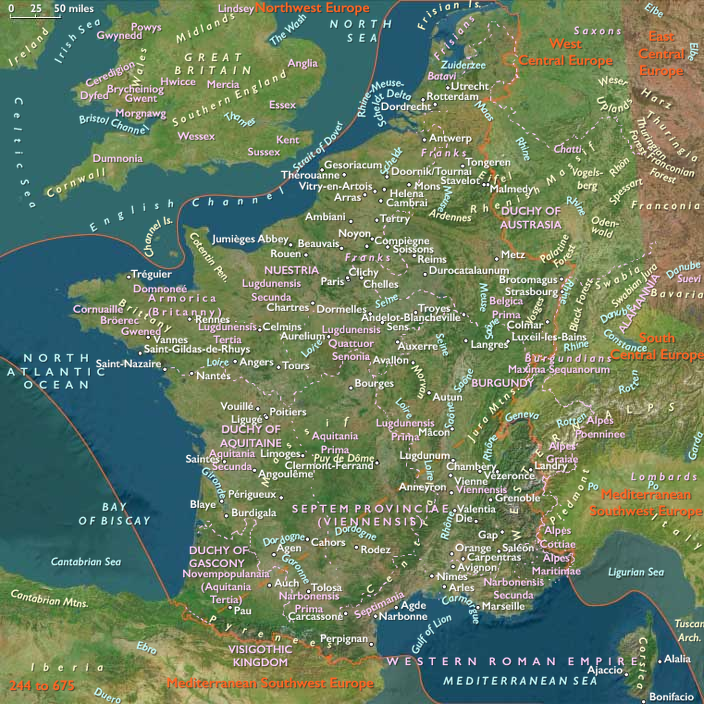
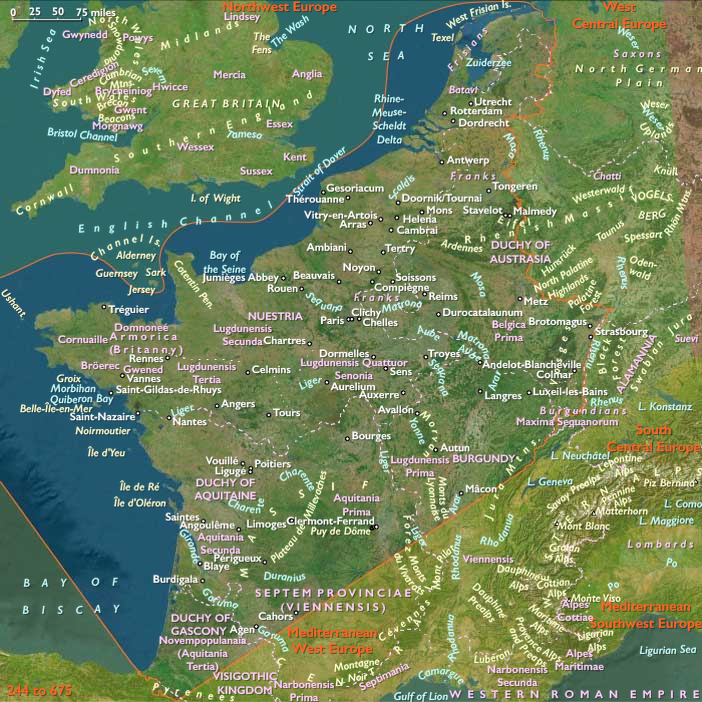
By the mid-fifth century, the Franks, firmly entrenched along the middle Rhine River, begin expanding southwestward into what is now northeastern France. This gradual territorial encroachment brings them deeper into the heart of Roman Gaul, where imperial control is already weakened by internal strife and external pressures.
At this stage, the Franks are still divided into multiple tribal groups, but their influence is steadily growing. They seize strategic locations along the Meuse and Moselle Rivers, pressing into Belgica Secunda, a province that includes major Roman cities such as Reims, Metz, and Trier.
The Franks and the Deterioration of Roman Gaul
The expansion of the Franks coincides with the continued breakdown of Roman defenses in Gaul. While the empire still exercises authority in certain strongholds, Roman commanders increasingly rely on barbarian federates to maintain order. Some Frankish leaders are granted lands as foederati, but others push forward on their own, testing Rome’s limits and exploiting its vulnerabilities.
This southwestern movement of the Franks will ultimately lay the foundation for the Frankish kingdom, which, by the late fifth century under Clovis I, will absorb the last remnants of Roman Gaul and emerge as the dominant power in the region.
Locations
People
Groups
- Franks
- Gallia Belgica (Roman province)
- Gaul, Diocese of
- Gaul, Praetorian prefecture of
- Roman Empire, Western (Ravenna)
Topics
Subjects
Regions
Subregions
Related Events
Filter results
Showing 10 events out of 58872 total
Skirmishing between the Chinese and the Chams continues until 446, when Tonkin’s new governor denounces the ongoing peace talks and lays siege to Ch'u-su, eventually reducing the city and carrying off large quantities of plunder.
His forces then advance on the Cham capital near present Hue, commandeering Champa’s gold, and taking control of the country.
The Lankavatara Sutra, one of the key texts of Mahayana Buddhism, is translated from Sanskrit to Chinese; it figures prominently in the development of Chinese, Tibetan, and Japanese Buddhism.
China’s Southern Dynasty supports Buddhism; China’s Northern Wei Dynasty, which had previously encouraged Buddhism, begins persecuting Buddhists and promoting Confucianism.
Japan adopts dance and musical forms from Korea, Manchuria, China, and India.
East Central Europe (436–447 CE): Attila’s Sole Leadership and Hunnic Empire at its Peak
Between 436 and 447 CE, East Central Europe—including Poland, Czechia, Slovakia, Hungary, and those portions of Germany and Austria lying east of 10°E and north of a line stretching from roughly 48.2°N at 10°E southeastward to the Austro-Slovenian border near 46.7°N, 15.4°E—witnessed the apex of Hunnic power under the sole leadership of Attila the Hun, who assumed full control following his brother Bleda’s death around 445 CE. Attila’s reign represented the height of Hunnic influence, reshaping regional politics, intensifying pressure on the fragmented Roman frontier provinces, and solidifying Hunnic dominance. Amidst these profound shifts, the Rugii retained their diplomatic stability, while the proto-Slavic communities persisted in their resilience and cautious adaptation to these challenging conditions.
Political and Military Developments
Attila’s Consolidation of Power
-
Following the death of his brother Bleda (c. 445 CE), Attila became the uncontested leader of the Huns, swiftly consolidating power, significantly expanding the Hunnic Empire, and intensifying military pressure on neighboring territories, including Roman provinces along the Danube.
-
Attila’s dominance reshaped alliances and increased demands for tribute, effectively reducing Roman frontier authority to symbolic levels in provinces such as Pannonia Prima, Secunda, Savia, and Valeria.
Continued Decline of Roman Frontier Control
-
Roman administrative and military structures along the Danube weakened severely under sustained Hunnic pressures, losing effective control and increasingly relying on tribal diplomacy and fragile alliances with local leaders, including the Rugii and other regional groups.
Rugian Diplomatic Stability
-
Despite Attila’s overarching dominance, the Rugii adeptly navigated the political landscape, sustaining their settlements along the upper Tisza through skillful diplomatic engagement and strategic neutrality.
Economic and Technological Developments
Economic Adaptation to Hunnic Dominance
-
Under intense Hunnic pressure, regional economies adapted further, emphasizing local agricultural production, livestock raising, and community-scale trade networks resilient enough to endure regional instability.
Deterioration of Roman Infrastructure
-
Roman-built infrastructure and defensive fortifications continued to deteriorate due to reduced investment and the constant threat of Hunnic aggression, reflecting the collapse of centralized Roman administrative authority.
Cultural and Artistic Developments
Cultural Fusion under Hunnic Influence
-
Artistic and cultural production increasingly displayed a pronounced Hunnic influence, integrating Germanic, Roman, and local traditions into a unique regional hybrid style evident in decorative metalwork, jewelry, pottery, and weaponry.
Proto-Slavic Cultural Resilience
-
Proto-Slavic populations maintained their traditional cultural expressions and stable social organization, carefully adapting to intensified external pressures while preserving their distinctive communal identities.
Settlement and Urban Development
Decline of Roman Frontier Settlements
-
Former Roman urban centers (Carnuntum, Vindobona, Aquincum) continued to lose population and economic vitality, reduced to small-scale military garrisons and fortifications struggling to manage increasing regional instability.
Stability of Rugian Communities
-
Rugian settlements along the upper Tisza region sustained relative prosperity and stability, providing localized economic hubs and acting as diplomatic intermediaries within Attila’s sphere of influence.
Social and Religious Developments
Rugian Leadership Adaptation
-
Rugian tribal elites demonstrated continued diplomatic agility, effectively managing relations with Attila’s powerful empire and fragmented Roman remnants, maintaining their autonomy and internal cohesion.
Proto-Slavic Social Stability
-
Proto-Slavic communities persisted in their strong internal social structures and religious traditions, ensuring communal solidarity amid external instability and Hunnic dominance.
Long-Term Consequences and Historical Significance
The era 436–447 CE marked the zenith of Hunnic power under Attila’s sole leadership, reshaping East Central Europe’s geopolitical, social, and cultural landscape profoundly. The continued decline of Roman frontier control and the adaptive diplomatic strategies of groups like the Rugii, coupled with proto-Slavic resilience, underscored the region’s shifting power dynamics and cultural interactions. These developments set crucial precedents for subsequent transformations, profoundly influencing the historical trajectory of East Central Europe for generations.
The Theodosian Code and the Legal Marginalization of Jews
With the promulgation of the Theodosian Code, the Roman Empire intensifies its restrictions on Jewish communities, placing social, economic, and legal limitations on them. This imperial legislation, compiled under Emperor Theodosius II and formally issued in 438 CE, codifies a range of anti-Jewish measures that had been accumulating over the previous century as Christianity became the dominant state religion.
Among the most consequential provisions:
- Exclusion from Public Office – Jews are barred from holding official positions within the imperial administration, limiting their influence in government and public affairs.
- Restrictions on Synagogue Construction – New synagogues may not be built, effectively curbing the expansion of Jewish communities within the empire.
- Prohibition on Slave Ownership – Jews are forbidden from owning Christian slaves, a restriction that effectively excludes them from agricultural production, as slave labor was central to Roman farming estates. This measure further marginalizes Jewish landowners, forcing many into urban professions such as trade, finance, and craftsmanship.
- Extraordinary Taxation – Jews are subjected to additional taxes, further differentiating them from the general population and increasing their economic burdens.
The Broader Context: Christianity and Imperial Policy
These laws reflect the broader transformation of the Roman world as the empire, once religiously pluralistic, becomes increasingly aligned with Nicene Christianity. Church authorities, particularly figures like Ambrose of Milan and Cyril of Alexandria, play key roles in shaping imperial policy against non-Christian groups, including Jews and pagans.
While Jewish communities persist across the Mediterranean, their legal status deteriorates, and their ability to participate in public and economic life becomes increasingly restricted. Over time, these imperial decrees will set a precedent for further discrimination and exclusion, influencing medieval and early modern attitudes toward Jewish communities in both the Byzantine and Latin Christian worlds.
Eastern Southeast Europe (436–447 CE): Turmoil, Defensive Adaptation, and Cultural Resilience
Settlement and Migration Patterns
Intensified Hun Invasions
Between 436 and 447 CE, Eastern Southeast Europe faced intensified invasions, notably from the Huns under Attila, significantly impacting regional stability and demographics. Heightened pressure led to substantial population movements and settlement disruptions.
Strengthened Urban Defenses
In response, major urban centers such as Constantinople and Philippopolis notably enhanced their defensive fortifications. Urban populations adapted to heightened security demands by reinforcing city walls, fortresses, and garrisons, ensuring sustained urban resilience.
Economic and Technological Developments
Economic Strains and Adaptations
Continuous invasions and security threats imposed considerable economic strain, yet regional economies demonstrated resilience through sustained agricultural production, safeguarded trade routes, and adaptive urban management.
Military Innovations
Technological advancements primarily focused on military defense, encompassing fortified infrastructure, improved weaponry, and efficient logistics. These measures ensured regional military preparedness against persistent external threats.
Cultural and Artistic Developments
Resilient Artistic Expression
Despite external pressures, cultural life robustly persisted, continuing traditions of public art, religious architecture, and monumental constructions. Artistic endeavors incorporated classical motifs alongside emerging Christian themes, expressing societal resilience and regional identity.
Intellectual Preservation
Educational and scholarly institutions actively preserved classical knowledge, maintaining intellectual vitality and adapting academic traditions to evolving socio-political circumstances.
Social and Religious Developments
Adaptive Governance
Provincial governance structures effectively adapted to escalating military threats, emphasizing localized control and enhanced defensive capacities. Effective administrative adjustments sustained societal stability and coherence amid turmoil.
Christianity’s Strengthened Role
Christianity further entrenched its role within society, becoming deeply intertwined with regional cultural, political, and community structures. Religious institutions expanded, offering spiritual guidance and fostering communal resilience during turbulent times.
Long-Term Consequences and Historical Significance
The period from 436 to 447 CE represented a pivotal era marked by intense external pressures, significant defensive adaptations, and enduring cultural and social resilience. These developments profoundly shaped regional stability and continuity, influencing Eastern Southeast Europe's progression toward established Byzantine dominance.
The Fragmentation of the Roman World
By the mid-fifth century, the Roman Empire is rapidly losing control over vast portions of its territory as barbarian powers consolidate their rule. The empire, once the unchallenged hegemon of the Mediterranean world, now faces multiple existential threats on several fronts.
- The Huns in the Balkans – Under the leadership of Ruga and later Attila, the Huns overrun large swaths of the Balkans, devastating Thrace, Illyricum, and Moesia. The Eastern Roman Empire, despite its wealth and strong defenses, is forced to pay heavy tribute to the Huns to stave off further invasions.
- The Vandal Kingdom in North Africa – The Vandals, having crossed into North Africa in 429 CE, establish a kingdom centered in Carthage under King Gaiseric. By 439 CE, they seize control of the Roman fleet and Mediterranean trade routes, cutting off vital grain supplies to Italy and posing a direct threat to Rome itself.
- The Fracturing of Western Europe – Across Gaul, Hispania, and Britain, a variety of tribal kingdoms continue to expand at the empire’s expense:
- The Visigoths, having settled in Aquitania, expand their domain into southern Gaul and Iberia, weakening Roman authority there.
- The Franks, under Chlodio, consolidate their rule in northern Gaul, laying the foundation for future Frankish expansion.
- The Burgundians establish a foothold along the Rhône Valley, carving out their own kingdom within former imperial lands.
- Roman Britain, abandoned by the imperial government, falls into political fragmentation, leaving it vulnerable to Saxon and Pictish incursions.
The Unraveling of Roman Authority
The simultaneous rise of Hunnic dominance in the East, Vandal naval supremacy in the South, and the emergence of new Germanic kingdoms in the West signals the irreversible fragmentation of the Western Roman Empire. By the mid-fifth century, imperial control is largely nominal outside of Italy, and even the heartland of Rome itself is now under constant threat from external powers.
The Middle East: 436–447 CE
Renewed Religious Persecutions and Cultural Flourishing
The period from 436 to 447 CE in the Middle East is marked by renewed religious persecutions within the Sassanian Empire. Initially tolerant of diverse religious practices, the Sassanian ruler Yazdegerd II (reigns 438–457 CE) initiates renewed persecution against Christians and Jews around 438 CE. This policy shift likely stems from increased zeal for Zoroastrian orthodoxy, temporarily destabilizing religious harmony within Persian-controlled territories.
Armenia: Religious Turmoil and Continued Cultural Resilience
In Armenia, these persecutions further complicate the complex religious and political landscape following the earlier deposition of the Arsacid monarchy. Despite political subjugation under Persian governance, Armenia maintains its robust cultural identity, deeply rooted in Christianity. The Armenian Church, already firmly established since its adoption as the state religion in 314 CE, continues to serve as a cultural anchor against external pressures, fostering unity through continued literary and religious achievements.
Jewish Communities: Messianic Expectations and Rabbinical Responses
The era sees heightened religious fervor among Jewish communities in Babylonia and Palestine. The prevalence of "False Messiahs," figures claiming messianic roles and promoting apocalyptic expectations, becomes increasingly widespread. This phenomenon prompts most rabbis to forbid predictions regarding the Messiah's arrival, recognizing the risk that disappointment might lead disillusioned believers away from Judaism.
Rabbinical leaders reinforce spiritual cohesion through the creation and dissemination of ethical and theological narratives in the form of Hagadah texts. These literary works embellish the Talmud’s discourses, providing engaging anecdotes, legends, and moral lessons that strengthen Jewish communal and spiritual bonds amid uncertainty and external threats.
Cultural Flourishing under the Sassanians
Amidst these religious tensions, the Sassanian Empire experiences notable cultural developments. Bahram V (died 438 CE), whose reign becomes legendary for his patronage of the arts, notably music, leaves behind a cultural legacy celebrated in numerous heroic tales. Instrumentation such as the lute, mouth organ, and trumpet flourish during this period, reflecting a vibrant musical culture.
Following Bahram V, Yazdegerd II, despite his earlier persecution of religious minorities, eventually negotiates peace with the Roman Empire around 441 CE after a brief conflict. Under the terms of this peace, Christians and Jews within the Persian empire regain the freedom to practice their religions without further interference from Sassanian authorities.
Continued Roman–Sassanian Stability
Though marked by intermittent conflict and skirmishes, Roman and Persian empires largely maintain their established frontiers throughout this period, ensuring relative stability along their borders. This stability allows for continued prosperity and cultural development within the major urban centers of the region, particularly in Roman Syria.
Thus, 436 to 447 CE represents a period of renewed religious persecution tempered by eventual accommodation, significant cultural developments within the Sassanian Empire, and sustained efforts within Jewish and Armenian communities to preserve and enhance their distinctive religious and cultural identities amid ongoing regional tensions.
Music flourishes in Sassanid Persia, together with the development of such instruments as the lute, mouth organ, and trumpet.
The “False Messiah” phenomenon has become so widespread among Jews that most rabbis forbid predictions of the coming of the Messiah, since often people bereft of hope convert after grave disappointment.
Years: 436 - 447
Locations
People
Groups
- Franks
- Gallia Belgica (Roman province)
- Gaul, Diocese of
- Gaul, Praetorian prefecture of
- Roman Empire, Western (Ravenna)
