
The Emergence of the Frankish Identity (3rd …
Years: 249 - 249
The Emergence of the Frankish Identity (3rd Century CE)
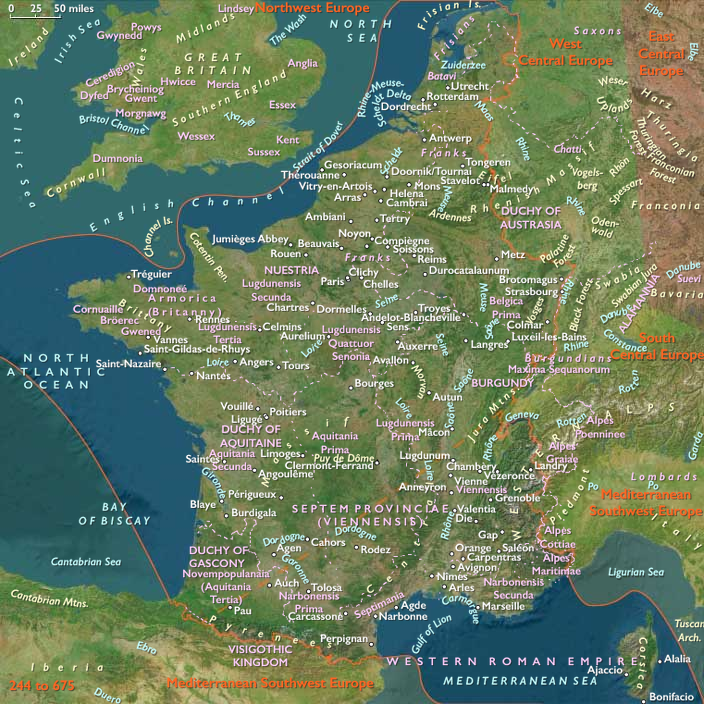
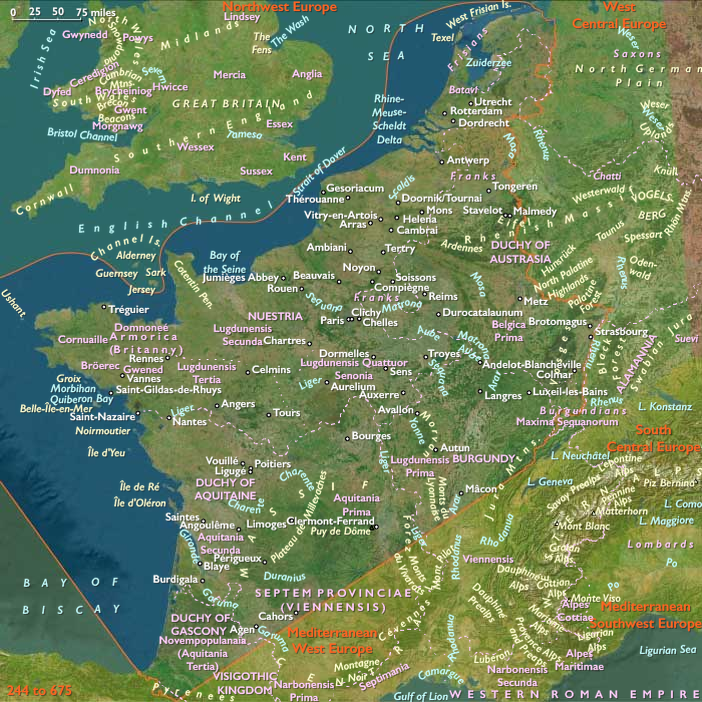
By the first half of the third century CE, the Frankish identity emerged as a fusion of various earlier Germanic groups inhabiting the Lower Rhine valley and adjacent lands to the east. This development was not a single political event but a gradual social transformation, as distinct tribes such as the Chatti, Sicambri, Chamavi, and Bructeri came together under a shared identity.
The Franks: A Fluid and Evolving Ethnicity
- The Frankish identity was dynamic, evolving through alliances, warfare, and interaction with Rome.
- Contemporary sources vary in how they define the Franks, making it unclear whether all individuals labeled as Franks identified themselves as such.
- Their ethnic and social composition likely shifted over time, with new groups incorporating into the Frankish confederation.
The Franks in Roman Texts: Both Enemies and Allies
- The Franks were first identified in the 3rd century CE, described by Roman authors as a distinct ethnic group living north and east of the Lower Rhine.
- They appear in Roman records alternately as:
- Enemies, conducting raids into Roman Gaul.
- Allies, serving as foederati (federated troops), laeti (semi-independent settlers), or dediticii (surrendered peoples under Roman rule).
Significance of the Frankish Formation
- The Franks played a crucial role in the later transformation of the Roman Empire, eventually establishing powerful post-Roman kingdoms.
- They laid the foundation for the Frankish Kingdom, which under the Merovingians and later Carolingians, became the dominant power in Western Europe.
- Their dual role as both foes and auxiliaries of Rome reflected the broader trend of Germanic integration into the Roman military and political system, which would eventually contribute to the fall of the Western Roman Empire and the rise of medieval European states.
The Frankish identity, though initially a loose confederation of Germanic tribes, evolved into one of the most powerful political entities of the post-Roman world, shaping the course of European history for centuries to come.
Locations
Groups
- Sicambri (Germanic tribe)
- Germania
- Franks
- Chatti (Germanic tribe)
- Bructeri (Germanic tribe)
- Gallia Belgica (Roman province)
- Chamavi
- Roman Empire (Rome): Non-dynastic
Topics
- Classical antiquity
- Roman Age Optimum
- Crisis of the Third Century (Roman Civil “War” of 235-84)
- Roman Gothic War, First
Commodoties
Subjects
Regions
Subregions
Related Events
Showing 10 events out of 60399 total
Years: 249 - 249
Locations
Groups
- Sicambri (Germanic tribe)
- Germania
- Franks
- Chatti (Germanic tribe)
- Bructeri (Germanic tribe)
- Gallia Belgica (Roman province)
- Chamavi
- Roman Empire (Rome): Non-dynastic
Topics
- Classical antiquity
- Roman Age Optimum
- Crisis of the Third Century (Roman Civil “War” of 235-84)
- Roman Gothic War, First
Commodoties
Subjects
Regions
Subregions