
Atlantic West Europe (388–531): From Roman Gaul …
Years: 388 - 531
Atlantic West Europe (388–531): From Roman Gaul to Frankish Dominance
Between 388 and 531, Atlantic West Europe—covering the regions of northern and central France, including Aquitaine, Burgundy, Alsace, the Low Countries, and the Franche-Comté—underwent profound transformations. This period marked the decline of Roman authority, the migration and settlement of Germanic peoples, the rise of powerful Frankish kingdoms, and the increasing influence of the Catholic Church.
Political and Military Transformations
-
Late Roman Authority (388–410)
-
Stability under Emperor Theodosius I (r. 379–395) gave way to political uncertainty following his death.
-
The usurper Constantine III temporarily seized control of Gaul, leading to weakened Roman defenses and vulnerability to barbarian incursions.
-
-
Barbarian Migrations and Kingdoms (411–450)
-
Visigoths, Burgundians, and Franks established independent realms within former Roman territories.
-
The Visigoths, granted territory as Roman foederati, expanded into Aquitaine and established Toulouse as their capital.
-
The Burgundians established themselves along the Rhône Valley, creating a kingdom centered at Lyon.
-
-
The Rise of the Merovingians (451–481)
-
The Battle of the Catalaunian Plains (451), led by Roman general Aetius with Visigothic and Frankish allies, halted Attila the Hun’s westward advance.
-
Merovingian Franks under Childeric I consolidated power around Tournai, laying the groundwork for Frankish dominance.
-
-
Frankish Consolidation under Clovis (482–511)
-
Clovis united the Frankish tribes, defeated Syagrius, the last Roman ruler in Gaul (486), and expanded his territory significantly.
-
His conversion to Catholicism (c. 496) secured the support of the Gallo-Roman populace and the Catholic Church.
-
The decisive defeat of the Visigoths at Vouillé (507) significantly expanded Frankish control into Aquitaine.
-
-
Division and Expansion (512–531)
-
Upon Clovis’s death in 511, his sons—Theuderic, Chlodomer, Childebert, and Chlothar—divided the Frankish kingdom, each ruling semi-autonomous territories.
-
Continued Frankish expansion culminated in the conquest and integration of Burgundy by 534.
-
Economic and Social Developments
-
Decline and Transformation of Urban Life
-
Roman urban centers deteriorated; trade networks weakened as imperial structures collapsed.
-
Increasing ruralization occurred, with populations moving toward countryside estates and fortifications, heralding medieval rural feudal society.
-
-
Shifts in Economic Foundations
-
A transition from Roman monetary economy to more localized, agrarian economies took place, emphasizing landholdings and agricultural production.
-
The foundation for medieval manorial systems was established as local elites consolidated rural power.
-
Religious and Cultural Developments
-
Growth of Ecclesiastical Authority
-
Bishops, notably figures like Sidonius Apollinaris (bishop of Clermont), assumed greater civil and religious authority, managing civic affairs amid declining Roman administration.
-
Councils, such as the Council of Agde (506), standardized ecclesiastical practices and reinforced Catholic dominance in the region.
-
-
Spread and Consolidation of Catholicism
-
The collapse of Arian Visigothic power in Gaul solidified Catholicism’s religious supremacy.
-
Monasticism expanded, preserving classical texts and cultural traditions, laying foundations for medieval intellectual life.
-
Legacy and Significance
By 531, Atlantic West Europe had fundamentally shifted from Roman governance to fragmented barbarian kingdoms and ultimately to consolidated Frankish rule under the Merovingians. Clovis's unification efforts and strategic religious alignment firmly established the Catholic Frankish kingdom as the predominant power, creating cultural and political legacies that defined medieval European history.
People
- Attila
- Childebert I
- Childeric I
- Chlodomer
- Chlothar I
- Clovis I
- Constantine III
- Flavius Aëtius
- Sidonius Apollinaris
- Syagrius
- Theodosius I
- Theuderic I
Groups
- Polytheism (“paganism”)
- Franks
- Gallo-Roman culture
- Gallia Lugdunensis (Roman province)
- Gallia Belgica (Roman province)
- Gallia Aquitania (Roman province)
- Suebi (Suevi), Realms of the
- Burgundians (East Germanic tribe)
- Alamanni (Germanic tribal alliance)
- Christianity, Arian
- Christianity, Nicene
- Breton people
- Roman Empire: Valentinian dynasty (Rome)
- Hunnic Empire
- Roman Empire: Theodosian dynasty (Constantinople)
- Visigoths, Realm of the
- Roman Empire, Western (Milan)
- Roman Empire, Western (Ravenna)
- Burgundians, (first) Kingdom of the
- Visigothic Kingdom of Toulouse
- Burgundians, (second) Kingdom of the
- Christianity, Chalcedonian
- Frisians
- Visigothic Kingdom of Spain
- Orléans (eventually Burgundy), Frankish Kingdom of
- Soissons (eventually Neustria), Frankish Kingdom of
- Paris, Frankish Kingdom of
- Reims, Frankish Kingdom of
- Basque people
Topics
- Migration Period
- Crossing of the Rhine
- Migration Period Pessimum
- Catalaunian Plains, Battle of the
- Soissons, Battle of
- Vouillé, Battle of
Commodoties
Subjects
Regions
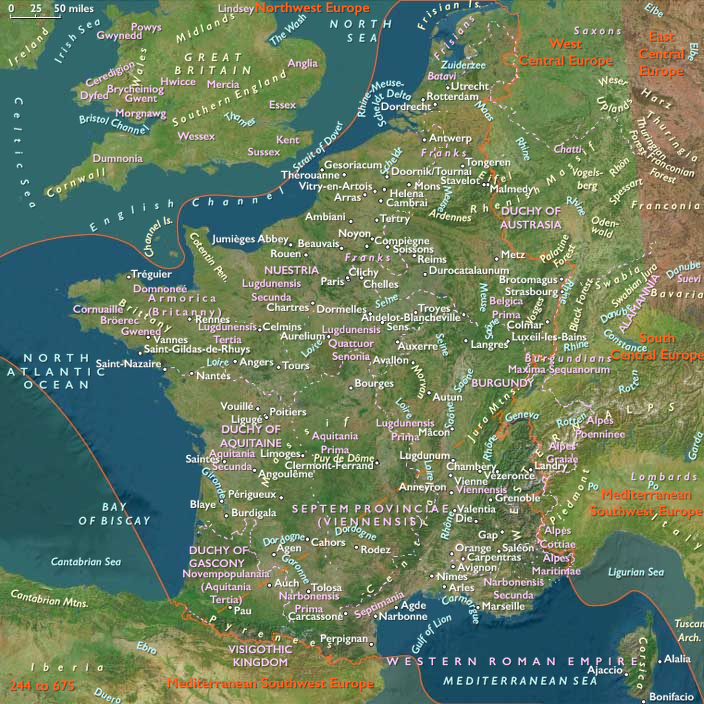
Subregions
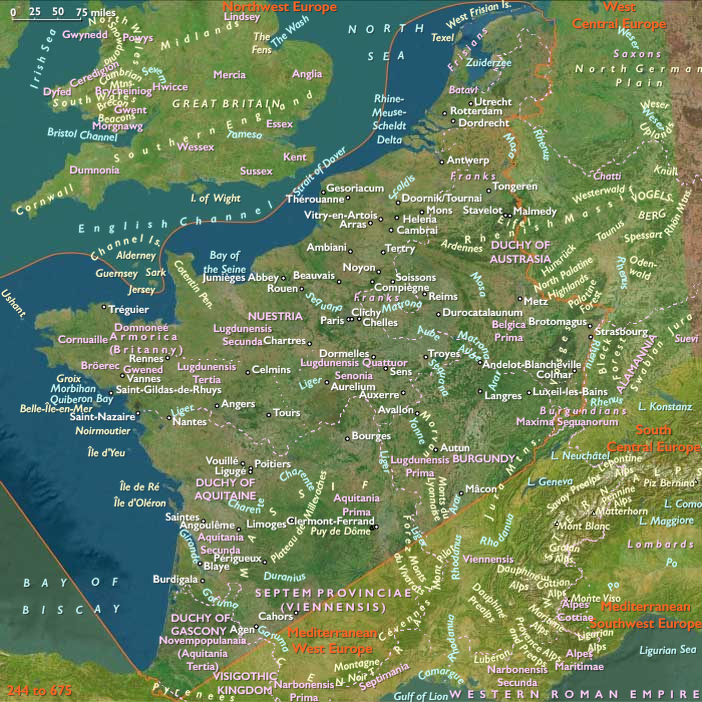
Related Events
Showing 10 events out of 59517 total
Years: 388 - 531
People
- Attila
- Childebert I
- Childeric I
- Chlodomer
- Chlothar I
- Clovis I
- Constantine III
- Flavius Aëtius
- Sidonius Apollinaris
- Syagrius
- Theodosius I
- Theuderic I
Groups
- Polytheism (“paganism”)
- Franks
- Gallo-Roman culture
- Gallia Lugdunensis (Roman province)
- Gallia Belgica (Roman province)
- Gallia Aquitania (Roman province)
- Suebi (Suevi), Realms of the
- Burgundians (East Germanic tribe)
- Alamanni (Germanic tribal alliance)
- Christianity, Arian
- Christianity, Nicene
- Breton people
- Roman Empire: Valentinian dynasty (Rome)
- Hunnic Empire
- Roman Empire: Theodosian dynasty (Constantinople)
- Visigoths, Realm of the
- Roman Empire, Western (Milan)
- Roman Empire, Western (Ravenna)
- Burgundians, (first) Kingdom of the
- Visigothic Kingdom of Toulouse
- Burgundians, (second) Kingdom of the
- Christianity, Chalcedonian
- Frisians
- Visigothic Kingdom of Spain
- Orléans (eventually Burgundy), Frankish Kingdom of
- Soissons (eventually Neustria), Frankish Kingdom of
- Paris, Frankish Kingdom of
- Reims, Frankish Kingdom of
- Basque people
Topics
- Migration Period
- Crossing of the Rhine
- Migration Period Pessimum
- Catalaunian Plains, Battle of the
- Soissons, Battle of
- Vouillé, Battle of
Commodoties
Subjects
Regions
Subregions