
Atlantic West Europe (532–675): From Merovingian Ascendancy …
Years: 532 - 675
Atlantic West Europe (532–675): From Merovingian Ascendancy to Aristocratic Dominance and Monastic Influence
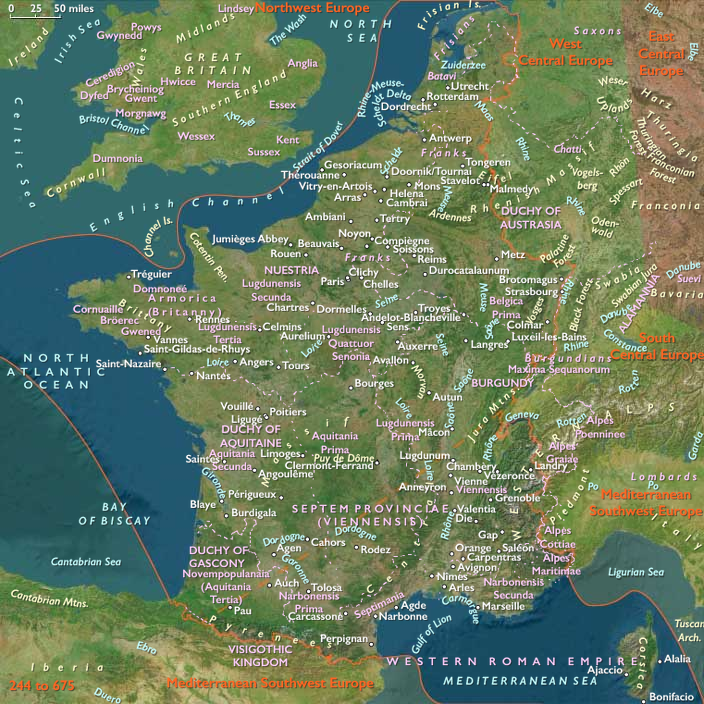
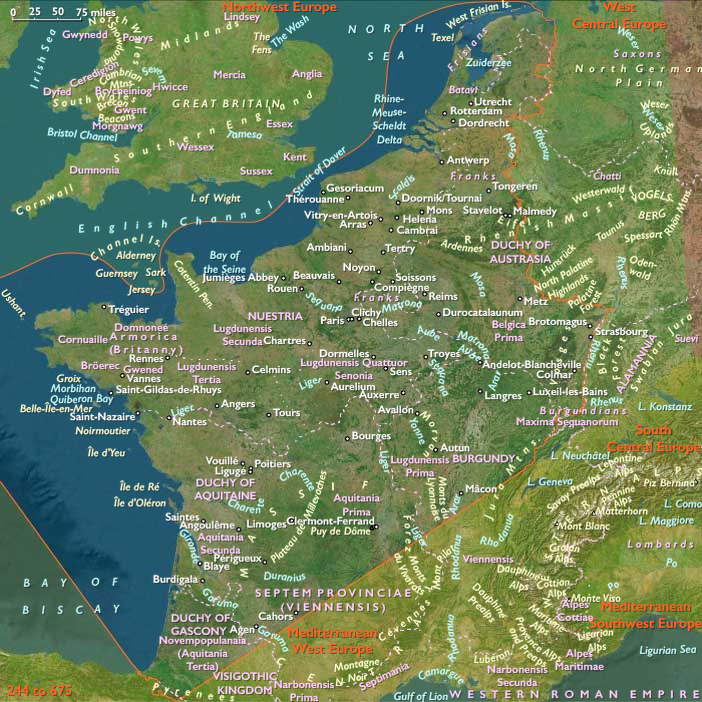
Between 532 and 675, Atlantic West Europe—spanning Neustria, Austrasia, Aquitaine, Burgundy, Brittany, and surrounding regions—experienced profound transformations. This era began with the height of Merovingian rule, characterized by territorial unification, and ended with the rise of powerful aristocratic factions, the growing influence of the Church, and the foundations of the future Carolingian dynasty.
Political and Military Developments
Merovingian Unification and Expansion (532–561)
-
Chlothar I (r. 511–561) reunified the Frankish kingdoms, extending Merovingian control over Neustria, Austrasia, Burgundy, and Aquitaine.
-
The conquest of Burgundy (532–534) was a critical step, integrating the Rhône-Saône region into Frankish domains and ensuring long-term Frankish influence there.
Fragmentation and Internal Rivalries (561–613)
-
Following Chlothar I’s death (561), Frankish unity fractured into multiple kingdoms (Neustria, Austrasia, Burgundy, Aquitaine), each ruled by Chlothar’s descendants.
-
Intense rivalry between Neustrian and Austrasian factions led to frequent warfare, weakening central authority but fostering strong regional identities.
-
Brunhilda of Austrasia (d. 613) emerged as a formidable political figure, leading to extensive power struggles with Neustria’s Queen Fredegund.
Reunification Under Chlothar II and Dagobert I (613–639)
-
Chlothar II (r. 613–629) reestablished Merovingian unity, stabilizing royal governance by issuing the Edict of Paris (614), enhancing aristocratic and episcopal power.
-
His son, Dagobert I (r. 629–639), strengthened Frankish control, notably in Aquitaine, Brittany, and along the Rhine, marking the height of Merovingian royal prestige.
Aristocratic Dominance and Royal Decline (639–675)
-
Dagobert’s successors faced rapid decline in royal authority, overshadowed by aristocratic factions led by mayors of the palace.
-
Ebroin, Neustrian mayor (658–673, 675–680), wielded enormous power, while in Austrasia, Pepin of Herstalrose (from 675), laying the groundwork for Carolingian ascendancy.
-
Brittany and Aquitaine drifted into semi-autonomy, ruled by regional dukes and princes, further weakening Merovingian control.
Economic and Social Developments
Agricultural Expansion and Landholding Patterns
-
Increased cultivation and land-clearance activities, particularly in the Loire and Seine valleys, boosted agricultural productivity.
-
Powerful aristocratic families dominated vast estates, forming the precursors of later feudal lordships.
Trade and Urban Networks
-
Trade continued along the Loire, Rhine, and Seine rivers, connecting inland markets with coastal trade hubs.
-
Brittany and Aquitaine fostered maritime trade connections with the British Isles and Iberia, enhancing regional economies.
Rise of Aristocratic Estates
-
The proliferation of large, self-sufficient villae (estates) reinforced the local power of aristocratic landowners.
-
These estates became significant economic and political centers, especially as royal authority waned.
Religious and Cultural Developments
Expansion of Christianity and Monasticism
-
Monastic movements, inspired initially by Columbanus and Irish missionaries, led to the founding of influential monasteries such as Luxeuil (c.590), Saint-Denis, Saint-Wandrille, and Corbie.
-
Monasteries played crucial roles as centers of education, manuscript production, and cultural preservation.
Church Influence and Synods
-
Church councils, such as Council of Orléans (511, 533) and Council of Paris (614), shaped ecclesiastical law and governance, significantly influencing secular affairs.
-
Bishops and abbots increasingly exerted political authority, reinforcing the Church's role as a stable institution amid political upheaval.
Art, Architecture, and Intellectual Life
-
Merovingian art flourished, blending Gallo-Roman and Germanic traditions, especially in metalwork and illuminated manuscripts.
-
Religious architecture, notably basilicas and monasteries, proliferated across the region, laying foundations for the later Carolingian cultural revival.
Long-term Consequences and Significance
By 675, Atlantic West Europe had transitioned significantly:
-
The Merovingian dynasty, having achieved territorial consolidation earlier in the age, had lost much of its political power to dominant aristocratic families.
-
The rise of influential mayors of the palace—particularly in Austrasia—set the stage for the Carolingian dynasty's emergence.
-
Monasticism profoundly reshaped religious, cultural, and intellectual landscapes, preserving classical heritage and facilitating cultural continuity through an era of political turbulence.
-
Economic and social foundations developed through agricultural expansion, trade networks, and powerful regional aristocracies laid essential groundwork for the subsequent Carolingian reforms and the later medieval transformation of Europe.
This transformative era from 532 to 675 thus marked the end of classical late antiquity in Atlantic West Europe, ushering in the structural and cultural developments that defined the early medieval landscape.
People
Groups
- Polytheism (“paganism”)
- Franks
- Goths (East Germanic tribe)
- Thuringii (Germanic tribe)
- Burgundians, (second) Kingdom of the
- Christianity, Chalcedonian
- Frisians
- Visigothic Kingdom of Spain
- Orléans (eventually Burgundy), Frankish Kingdom of
- Soissons (eventually Neustria), Frankish Kingdom of
- Paris, Frankish Kingdom of
- Reims, Frankish Kingdom of
- Frisian Kingdom
- Vasconia, Duchy of
- Austrasia, Frankish Kingdom of
- Neustria and Burgundy, Frankish Kingdom of
- Burgundy, Frankish Kingdom of
- Basque people
Topics
Subjects
Regions
Subregions
Related Events
Showing 10 events out of 58080 total
Years: 532 - 675
People
Groups
- Polytheism (“paganism”)
- Franks
- Goths (East Germanic tribe)
- Thuringii (Germanic tribe)
- Burgundians, (second) Kingdom of the
- Christianity, Chalcedonian
- Frisians
- Visigothic Kingdom of Spain
- Orléans (eventually Burgundy), Frankish Kingdom of
- Soissons (eventually Neustria), Frankish Kingdom of
- Paris, Frankish Kingdom of
- Reims, Frankish Kingdom of
- Frisian Kingdom
- Vasconia, Duchy of
- Austrasia, Frankish Kingdom of
- Neustria and Burgundy, Frankish Kingdom of
- Burgundy, Frankish Kingdom of
- Basque people
Topics
Subjects
Regions
Subregions