The Achaean War is an uprising by …
Years: 153BCE - 142BCE
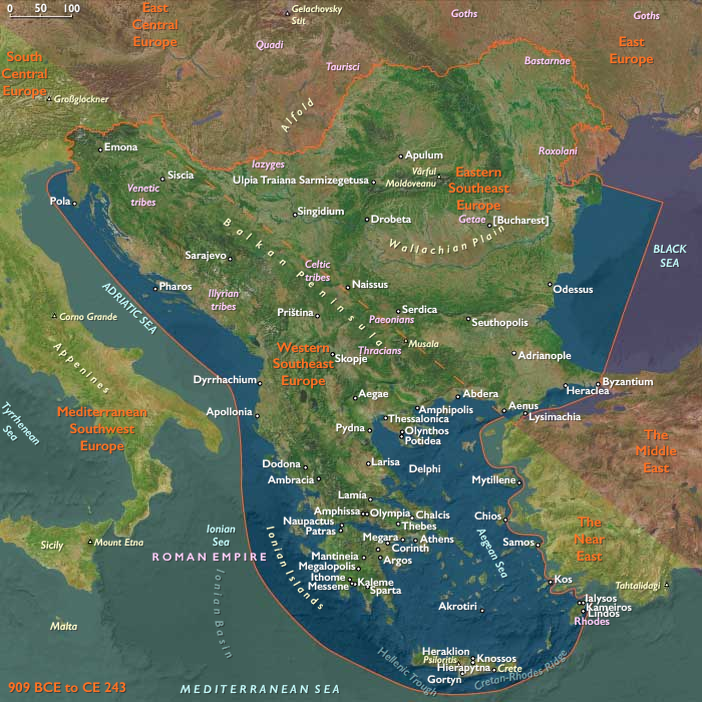
The Achaean War is an uprising by the Greek Achaean League, an alliance of Achaean and other Peloponnesian states in ancient Greece, against the Roman Republic around 146 BCE, just after the Fourth Macedonian War.
Rome defeats the League swiftly, and as a lesson, they destroy the ancient city of Corinth.
The war ends with Greece's independence taken away, and Greece becomes the Roman provinces of Achaea and Epirus.
The nature of Roman domination in the East begins to change decisively after the Macedonian wars: direct rule replaces influence through embassies, arbitration of disputes, and the occasional military incursions.
Groups
- Roman Republic
- Greeks, Hellenistic
- Achaean League, Second
- Greece, Roman
- Macedonian Republics
- Macedonia, Roman
Topics
Subjects
Regions
Subregions
Related Events
Filter results
Showing 10 events out of 63173 total
The Middle East: 153–142 BCE
Consolidation of Jewish Autonomy and Further Seleucid Decline
The era from 153 to 142 BCE sees continued consolidation of Jewish autonomy in Judea under the Hasmonean leadership, notably through the strategic actions of Jonathan Maccabee. Following his installation as high priest, Jonathan proves to be not only a religious leader but also a capable political and military figure, skillfully navigating the complex and turbulent political landscape dominated by competing Seleucid factions.
Jonathan exploits the internal Seleucid struggles to further Jewish autonomy. In 152 BCE, Alexander Balas, a rival claimant to the Seleucid throne, seeks Jonathan’s support against Demetrius I Soter. Recognizing a strategic opportunity, Jonathan aligns with Alexander, who rewards him by confirming his position as high priest and granting additional political privileges, effectively acknowledging Judean autonomy.
In 150 BCE, Jonathan is further elevated when Alexander Balas formally appoints him governor of Judea, thus combining religious and secular authority in his person. This appointment symbolizes a significant diplomatic victory for the Hasmonean dynasty, solidifying Judean independence and significantly expanding Jewish self-rule.
The turbulent Seleucid dynastic conflicts culminate in the Battle of the Oenoparus in 145 BCE, during which Alexander Balas is defeated by Demetrius II. Jonathan adeptly switches allegiance, aligning himself with Demetrius II, who reconfirms his autonomy and expands Judean territories as compensation for his loyalty.
Jonathan’s strategic diplomatic engagements and military actions significantly strengthen Judean autonomy and set the foundations for greater territorial expansion under the Hasmonean dynasty. By 142 BCE, Jonathan’s brother, Simon Maccabee, emerges as a powerful figure, preparing to assume leadership and further expand Judean independence.
Meanwhile, the Seleucid Empire continues to fracture, losing control of its territories due to internal dynastic struggles and external pressures. Seleucid authority in the Middle East becomes increasingly nominal as regions like Judea assert and maintain independent political identities, highlighting the irreversible decline of Seleucid hegemony.
Thus, the period from 153 to 142 BCE is marked by the strategic consolidation of Jewish political autonomy under Hasmonean leadership and the continued fragmentation and weakening of the Seleucid Empire, setting the stage for lasting changes in the regional political structure.

Hindu monarch Pushyamitra Sunga, who dies in 151 or 149 BCE after ruling for thirty-six years, is succeeded by his son Agnimitra, the heroic prince of a famous drama by Kalidasa, one of India's greatest playwrights, composed in the Later Gupta period.
Agnimitra holds court in the city of Vidisa, modern Besnagar in Eastern Malwa.
The Maurya king Asoka may have established the principal stupa of Bharhut, a village in present Madya Pradesh state in north central India, in the third century BCE, but many friezes and other works of art are apparently added during the Sunga period in the second century BCE.
Carved from a fine-grained reddish stone, the rail and gates imitate the form and construction of wooden post-and-rail fences and portals.
Each railing segment is constructed of three rails tenoned into uprights; each of the original four gates is carved to depict a cluster of four poles.
These are tied to create a pier at each side of the opening and support the elaborate structure of a triple lintel.
The elaborately carved faces of rails, uprights, and gates feature a rich variety of Buddhist symbols, floral motifs, heads of rajahs, and narrative references to important incidents in the Buddha's history.
In conformity with the early aniconic phase of Buddhist art, the Buddha is only represented through symbols, such as the Dharma wheel, the Bodhi tree, an empty seat, footprints, or the triratana symbol.
The stupa (now dismantled and reassembled at Kolkata Museum) contains numerous birth stories of the Buddha's previous lives, or Jataka tales.
Many of them are in the shape of large, round medallions.
An unusual feature of Bharhut panels is inclusion of text in the narrative panels, often identifying the individuals.
The style is generally flat (no sculptures in the round), and all characters are depicted wearing the Indian dhoti, except for one foreigner, thought to be an Indo-Greek king, with Buddhist symbolism.
Near East (153–142 BCE): Prosperity, Cultural Influence, and Rising Powers
The era from 153 to 140 BCE witnesses significant economic and political developments in the Near East. The region corresponding to present-day Jordan experiences notable prosperity under Hellenistic influences, especially those of the Seleucid and Ptolemaic dynasties. Enhanced trade routes and urban growth mark this period, exemplified by new and revitalized cities. Among these are Philadelphia—the Greek-renamed Rabbath Ammon—and Gerasa, also known as Antioch-on-the-Chrysorrhoas (modern Jarash).
During this time, northern Jordan occasionally falls under Jewish control as persistent conflicts between the Jewish Maccabees and the Seleucids unfold. Concurrently, the Arab Nabataeans strengthen significantly, extending their kingdom's influence to the north, east, and possibly south along the eastern coast of the Red Sea. This expansion occurs as Seleucid dominance wanes, positioning the Nabataeans as crucial intermediaries in the spice trade and fostering their prominence as skilled potters, metalworkers, stonemasons, and architects.
In the intellectual sphere, this era features prominent cultural exchanges exemplified by Dionysius Thrax, a distinguished Hellenistic grammarian initially trained in Alexandria and later teaching on Rhodes around 144 BCE. Although scholarly debate surrounds the precise authorship of the influential work The Art of Grammar, traditionally attributed to Dionysius, it remains significant as the first comprehensive grammatical treatise on the Greek language. Its systematic approach to morphology, though lacking syntactical analysis, will later profoundly impact linguistic studies, influencing early Christian scholarship through translations into Armenian and Syriac.
Legacy of the Era
The period from 153 to 142 BCE underscores a transition in the Near East marked by increased Hellenistic influence and the emergence of regional powers such as the Nabataeans. The cultural synthesis, economic prosperity, and intellectual achievements of this era lay the groundwork for subsequent developments, shaping the Near East’s enduring historical and cultural identity.
The region of present Jordan has prospered under the Hellenistic rule of the Seleucids and the Ptolemies; trade has increased, and new towns have been built.
The Ptolemies have renamed Rabbath Ammon Philadelphia, and …
…Jarash has become Antioch-on-the-Chrysorrhoas, or Gerasa.
The northern part of Jordan is for a time in Jewish hands, and there are constant struggles between the Jewish Maccabees and the Seleucids.
The Nabataean kingdom extends its frontiers to the north and east and probably to the south along the eastern coast of the Red Sea, increasing in strength as the Seleucid kingdom grows weaker in the second century BCE.
Dionysius Thrax, a Hellenistic grammarian and a pupil of Aristarchus of Samothrace, has lived and worked in Alexandria but later teaches at Rhodes (around 144 BCE).
The brief but comprehensive Art of Grammar, the first extant grammar of Greek, is attributed to him but many scholars today doubt that the work really belongs solely to him due to the difference between the technical approach of most of the work and the more literary approach (similar to the second century's Alexandrian tradition) of the first few sections.
It concerns itself primarily with a morphological description of Greek, concerned with basic word-forming elements and dictating the order in which topics are to be treated, but lacks any treatment of syntax.
The work will be translated into Armenian and Syriac in the early Christian era.
The Fourth Macedonian War, the final war between Rome and Macedon, comes about as a result of the pretender Andriscus's usurpation of the Macedonian throne, pretending to be the son of Perseus, the last King of Macedon, deposed by the Romans after the Third Macedonian War in 168 BCE.
Andriscus, after some early successes, is eventually defeated by the Roman general Quintus Caecilius Metellus Macedonicus at the Battle of Pydna in 148 BCE.
Macedonia becomes a Roman province two years later.
Mediterranean Southwest Europe (153–142 BCE): The Numantine Conflict and Renewed Celtiberian Resistance
The era 153–142 BCE witnesses continued Roman struggles to maintain control over its territories in Hispania Citerior, as hostilities between the Roman Republic and resilient Celtiberian tribes reignite, centering on the defiant city of Numantia.
Prelude and Outbreak of the Numantine War
Following the brief peace established in 151 BCE, tensions between Rome and the Celtiberian tribes intensify. The initial conflict, begun as a localized revolt in Numantia in 154 BCE, had seemingly ended three years later. However, the conditions imposed by Roman authorities and lingering resentment among the Celtiberians quickly set the stage for renewed warfare.
Renewal of Celtiberian Resistance
In 143 BCE, war erupts once more as Numantia defiantly resists Roman authority. This renewed conflict, known as the Numantine War, represents more than a local insurrection. It embodies the Celtiberians' collective determination to preserve their independence against Rome's persistent and aggressive expansion in the Iberian Peninsula. Numantia rapidly becomes a potent symbol of indigenous resistance, uniting various tribes against their common Roman enemy.
Roman Challenges and Indigenous Defiance
Rome’s repeated attempts to suppress the Numantine uprising highlight both its determination to dominate the Iberian tribes and the complexities inherent in subduing fiercely independent peoples. The ongoing resistance at Numantia, emblematic of broader indigenous defiance, tests Roman military capabilities and governance strategies.
This era underscores Rome's continuing struggle to fully pacify the region, foreshadowing further escalation of conflict and leading to protracted engagements that would eventually become legendary within Roman military history.
Years: 153BCE - 142BCE
Groups
- Roman Republic
- Greeks, Hellenistic
- Achaean League, Second
- Greece, Roman
- Macedonian Republics
- Macedonia, Roman