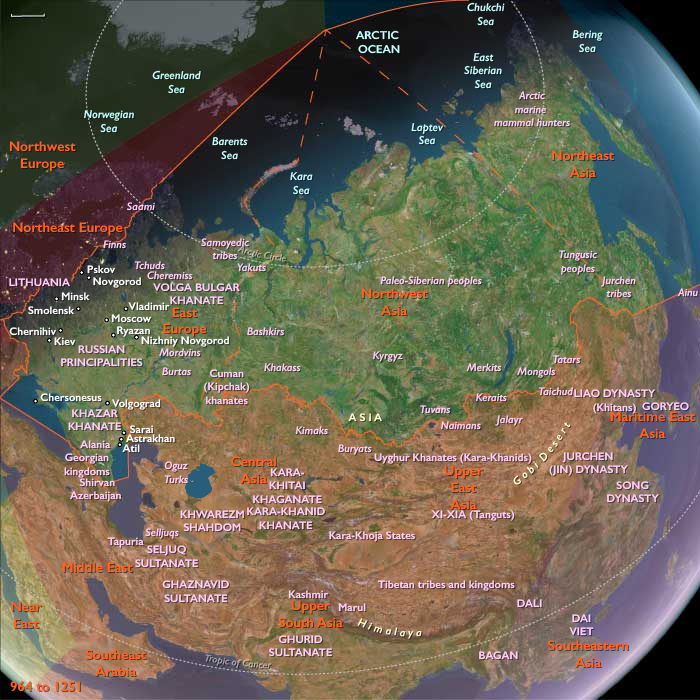
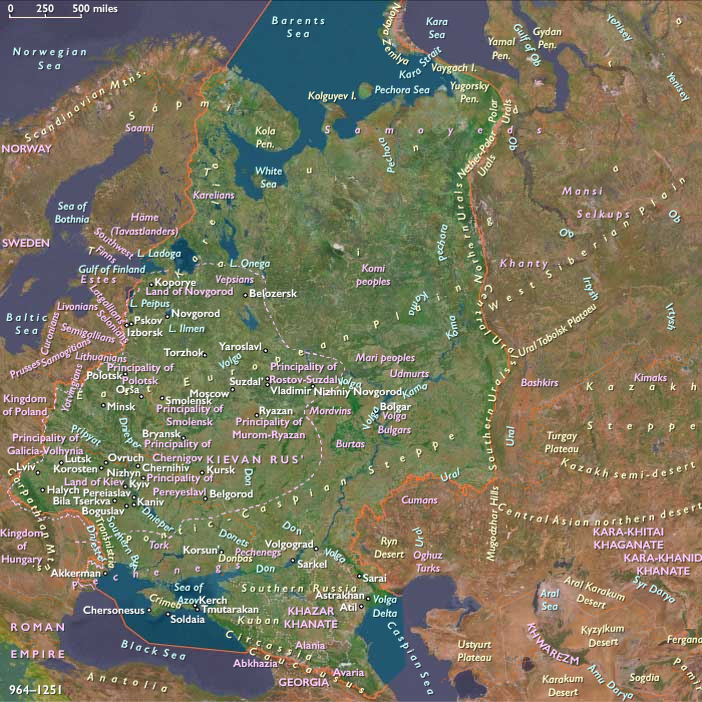
The fortunes of the Rus'-Pecheneg confrontation swung …
Years: 1036 - 1036
The fortunes of the Rus'-Pecheneg confrontation swung during the reign of Vladimir I of Kiev (990–995), who founded the town of Pereyaslav upon the site of his victory over the Pechenegs, followed by the defeat of the Pechenegs during the reign of Yaroslav I the Wise in 1036.
The weakened Pechenegs are soon replaced in the Pontic steppe by other nomadic peoples, the Cumans and the Torkil.
Locations
People
Groups
- Pechenegs, or Patzinaks
- Rus' people
- Kievan Rus', or Kiev, Great Principality of
- Cuman people, or Western Kipchaks, also called Polovtsy, Polovtsians)
- Torkils
Commodoties
Subjects
Regions
Subregions
Related Events
Filter results
Showing 10 events out of 51469 total
The final Rus'-Byzantine War is, in essence, an unsuccessful naval raid against Constantinople in 1043 instigated by Yaroslav I of Kiev and led by his eldest son, Vladimir of Novgorod.
The reasons for the war are disputed, as is its course.
Michael Psellos, an eyewitness of the battle, leaves a hyperbolic account detailing how the invading Kievan Rus' were annihilated by a superior imperial fleet with Greek fire off the Anatolian shore.
(According to the Slavonic chronicles, the Kievan fleet was destroyed by a tempest.)
The East Romans send a squadron of fiurteen ships to pursue the dispersed monoxylae of the Rus'.
They are sunk by the Kievan admiral Ivan Tvorimich, who also manages to rescue Prince Vladimir after the shipwreck.
A six thousand-strong Kievan contingent under the Novgorodan general Vyshata, which does not take part in naval action, is captured and deported to Constantinople.
Eight hundred of the Rus' prisoners are blinded.
Vyshata will be allowed to return to Kiev at the conclusion of the peace treaty three years later.
Under the terms of the peace settlement, Yaroslav's son Vsevolod I is to marry a daughter of Emperor Constantine Monomachus.
Their son will assume his maternal grandfather's name and become known as Vladimir Monomakh.
East Central Europe (1036–1047 CE): Crisis and Fragmentation in Poland, End of Stephen I’s Reign in Hungary, and Přemyslid Consolidation in Bohemia
Between 1036 and 1047 CE, East Central Europe—covering modern-day Poland, Czechia, Slovakia, Hungary, and the eastern regions of Germany and Austria east of 10°E and north of the defined southeastern boundary—underwent significant political realignments marked by internal crises, dynastic transitions, and regional consolidation. Poland entered a period of severe instability following the death of Mieszko II, King Stephen I of Hungary died after a transformative reign, leading to initial uncertainty before renewed stabilization under his successors, while Bohemiaexperienced a period of renewed political strength under the Přemyslid dynasty, solidifying its autonomy within the shifting imperial politics of the Holy Roman Empire.
Political and Military Developments
Crisis and Fragmentation in Poland
-
Following Mieszko II’s death in 1034, Poland descended into a period of severe political fragmentation, internal rebellion, and pagan resurgence (Pagan Reaction, 1034–1038). This instability temporarily undermined central authority, weakened the Piast dynasty, and prompted invasions from Bohemia and neighboring regions.
End of Stephen I’s Reign and Succession Crisis in Hungary
-
King Stephen I’s death in 1038 initially led to instability as rival factions competed for power. The brief rule of his successor, Peter Orseolo (r. 1038–1041), Stephen’s nephew, was followed by rebellions and conflicts over royal succession, temporarily weakening Hungarian political coherence.
Přemyslid Consolidation under Bretislav I in Bohemia
-
Duke Bretislav I of Bohemia (r. 1034–1055) significantly strengthened Přemyslid authority, launching successful military campaigns including a devastating invasion of Poland (1038), capturing significant Polish territories and transferring relics to Prague, enhancing Bohemian prestige and power.
Imperial Influence under Conrad II and Henry III
-
The Holy Roman Emperors Conrad II (r. 1024–1039) and his son Henry III (r. 1039–1056) actively intervened in East Central European affairs, influencing succession struggles in Hungary and Poland, reinforcing imperial influence, and stabilizing regional alignments.
Economic and Technological Developments
Disruption and Realignment of Trade
-
Poland’s internal turmoil disrupted trade temporarily, redirecting economic activity toward more stable regions, notably Bohemia and Hungary, where commerce and urban growth remained relatively strong.
Fortifications and Urban Reconstruction
-
Bohemia and Hungary intensified urban fortifications and administrative infrastructures. Particularly under Bretislav I, Bohemia saw significant investments in fortifications and public works, reflecting increased regional political stability and economic vitality.
Cultural and Artistic Developments
Bohemian Cultural Flourishing under Bretislav I
-
Bretislav I’s patronage fostered cultural vitality, including ecclesiastical building projects, artistic patronage, and the enrichment of Prague’s cathedral and monastic institutions, enhancing Bohemia’s cultural and religious prestige.
Hungarian Cultural Continuity amid Succession Crisis
-
Despite political challenges after Stephen I’s death, Hungary preserved its cultural institutions, royal traditions, and ecclesiastical organization, maintaining Stephen’s legacy of Christian royal identity.
Polish Cultural Resilience
-
Although Poland faced considerable political and social instability, monastic and ecclesiastical centers maintained cultural continuity, preserving literary and religious traditions that allowed rapid recovery in subsequent decades.
Settlement and Urban Development
Reconstruction and Expansion in Bohemia
-
Bretislav I significantly expanded Prague and other major Bohemian centers, fortifying settlements and enhancing administrative and ecclesiastical infrastructure, promoting urban prosperity.
Hungarian Administrative and Royal Centers
-
Despite political uncertainty, major Hungarian towns such as Esztergom, Székesfehérvár, and Veszprém remained important administrative, religious, and economic centers, sustaining their urban growth and prominence.
Polish Urban Decline and Reconstruction
-
Polish towns, notably Gniezno and Poznań, experienced significant setbacks due to invasions and rebellions but began gradual reconstruction, setting the stage for future urban recovery and expansion.
Social and Religious Developments
Revival of Paganism and Christian Response in Poland
-
Poland’s political chaos (1034–1038) briefly witnessed a resurgence of paganism before Christian authorities regained control. This religious instability shaped future ecclesiastical and royal policies aimed at reinforcing Christian orthodoxy and political stability.
Dynastic and Aristocratic Realignments
-
Regional dynastic structures in Bohemia and Hungary further consolidated authority, creating clear social and hierarchical orders. Aristocratic families increasingly asserted influence amid succession crises and shifting alliances.
Long-Term Consequences and Historical Significance
The era 1036–1047 CE significantly reshaped East Central Europe’s medieval trajectory. Poland’s internal turmoil temporarily reduced its regional power, while Bohemia’s Přemyslid dynasty achieved substantial consolidation, asserting regional dominance. Hungary navigated its first major succession crisis following Stephen I’s foundational reign. These dynamics reshaped political boundaries, cultural identities, and social structures, laying the groundwork for future stability and realignment throughout East Central Europe.
German Emperor Conrad II rules firmly and ruthlessly to successfully reestablish the empire’s prestige in Burgundy, Italy and Poland.
Unsympathetic to ecclesiastical reform, Conrad dominates the church through simony and lay investiture, favoring the ministeriales, lay officials of servile origin, who serve him well.
He ingratiates himself to the petty nobles by passing a decree making fiefs heritable, a law that ensures the growth of feudalism in the empire at the expense of central government.
His son Henry III, who, unlike his secularist father, shares the zeal of the spiritual reformers, attempts to reconcile their goals with the needs of the imperial state; he legislates against simony.
A series of events in the Kingdom of Poland in the 1030s culminate in a popular uprising or rebellion, or series of these, which for a time destabilizes the kingdom.
In Hungary, the Vata pagan uprising of 1046 brings about the overthrow of King Peter Urseolo, the martyrdom of St. Gellért and the reinstatement of the Árpád dynasty on the Hungarian throne.
Eastern Southeast Europe (1036–1047 CE): Cultural Revival and Imperial Neglect
Settlement and Migration Patterns
Urban Stability and Aristocratic Influence
Between 1036 and 1047 CE, demographic stability persisted within Eastern Southeast Europe, notably characterized by a cultural renaissance centered in Constantinople. The urban aristocracy played a crucial role in promoting cultural sophistication and intellectual pursuits amid a relatively peaceful interval.
Political and Military Developments
Cultural Renaissance under Constantine IX
Emperor Constantine IX Monomachus significantly impacted cultural and intellectual life by reorganizing the University of Constantinople, fostering an era marked by the efflorescence of learning, literature, and scholarly activity. His patronage helped establish the city as a renowned cultural hub.
Neglect of Imperial Defenses
Despite cultural achievements, Constantine IX notably neglected imperial defenses. His extravagant expenditures on luxuries, grand buildings, and public works, coupled with the serious debasement of coinage, weakened imperial finances and the empire's overall military readiness.
Economic and Technological Developments
Economic Strain from Fiscal Mismanagement
The emperor’s extravagant spending habits and debasement of currency significantly strained the Byzantine economy. These financial practices undermined economic stability, resulting in inflation and reduced fiscal resources necessary for defense and infrastructure.
Fortifications and Defense Decline
During Constantine IX’s reign, critical defensive infrastructure received insufficient attention, compromising the empire’s preparedness against external threats and leaving its borders increasingly vulnerable.
Cultural and Artistic Developments
Flourishing Cultural Activities
Under the patronage of Constantine IX, cultural activities flourished, marking a renaissance in Byzantine learning and the arts. This cultural revival manifested prominently in the reorganization and expansion of the University of Constantinople.
Continued Literary and Intellectual Output
Scholarly and literary endeavors thrived during this period, driven by the reinvigorated University of Constantinople, monastic scriptoria, and ecclesiastical patronage, thereby ensuring continued cultural resilience and intellectual advancement.
Social and Religious Developments
Strengthening of Orthodox Christianity
Orthodox Christianity maintained its significant societal role, continuing to provide stability and cultural cohesion. Ecclesiastical institutions further reinforced their position through sustained influence over cultural and educational initiatives.
Ongoing Presence of Religious Movements
The Bogomil movement continued to influence rural religious life and societal dynamics, representing a persistent alternative to Orthodox ecclesiastical authority and traditional religious practices.
Long-Term Consequences and Historical Significance
The era from 1036 to 1047 CE was distinguished by significant cultural and intellectual achievements, largely due to the efforts of Emperor Constantine IX. However, his financial mismanagement and neglect of military defenses had severe repercussions, undermining imperial security and stability, and setting the stage for future challenges in Eastern Southeast Europe.

Constantinople’s urban aristocracy, reacting against the brutalization of war, strive to make the city a center of culture and sophistication.
Under the auspices of Emperor Constantine IX Monomachus, the University of Constantinople is reorganized, with an efflorescence of learning and letters, However, he neglects imperial defenses, spending extravagant sums on luxuries and magnificent buildings and seriously debasing the coinage.
The Shift of Jewish Cultural Leadership from Babylon to Al-Andalus (1038 CE)
In 1038 CE, the last influential Gaon of Babylonian Jewry passes away, marking the decline of Babylon as the center of Jewish religious and intellectual authority. Meanwhile, new creative centers of Jewish thought emerge, particularly in North Africa and, most notably, in Muslim Spain (Al-Andalus).
Under the relatively tolerant rule of the Muslim dynasties that had conquered southern Spain, Jewish communities experience a revival of scholarship, culture, and economic prosperity. This period, often referred to as the Golden Age of Jewish Culture in Al-Andalus, contrasts sharply with the near-extermination of Iberian Jewry under the Christian Visigoths before the Muslim conquest.
As a result, Jewish intellectual and religious life flourishes, producing renowned scholars, poets, and philosophers who make lasting contributions to Jewish thought and the broader medieval world.
A major Bulgarian rebellion against the Empire, the Uprising of Peter Delyan, takes place in 1040–1041.
It is to be the largest and best-organized attempt to restore the former Bulgarian Empire until the rebellion of Ivan Asen I and Petar IV in 1185.
The Republic of Venice and the kingdom of Croatia struggle to dominate Dalmatia as the power of Constantinople fades, and for a time the Dalmatians pay the Croats tribute to assure safe passage for their galleys through the Adriatic.
Years: 1036 - 1036
Locations
People
Groups
- Pechenegs, or Patzinaks
- Rus' people
- Kievan Rus', or Kiev, Great Principality of
- Cuman people, or Western Kipchaks, also called Polovtsy, Polovtsians)
- Torkils