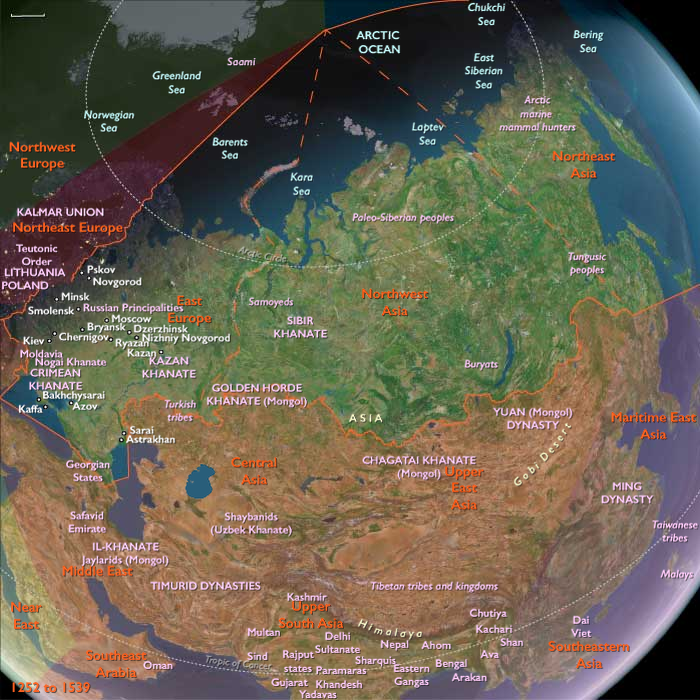
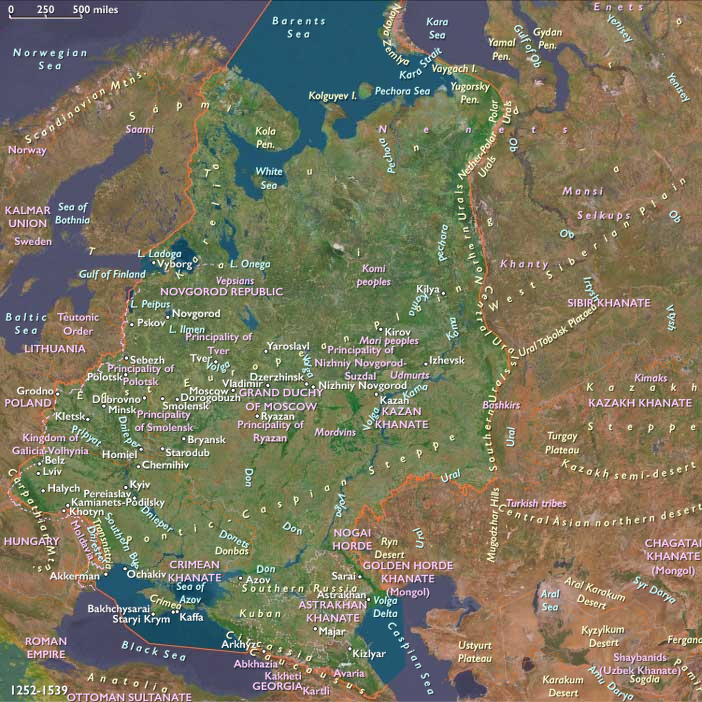
The fortified area of Moscow known as …
Years: 1324 - 1335
The fortified area of Moscow known as the Kremlin (from the Russian kreml, meaning "fortress;” one of the many fortified areas, or kremlins, that still stand in such old Russian cities as Novgorod) is first mentioned in monastic chronicles in 1331 .Ivan I, a descendant of the Rurik line, becomes grand prince of Moscow in 1328.
In this year, the center of Russian-Ukrainian Orthodoxy, initially at Kiev in Ukraine, moves to Moscow when the metropolitan see is transferred here.
Locations
People
Groups
Subjects
Regions
Subregions
Related Events
Filter results
Showing 10 events out of 44704 total
Che Anan’s insurgent Cham forces, aided by the Mongols, finally defeat their Vietnamese overlords in 1326, ending Champa’s forces vassalage to Dai Viet.
Che Anan becomes king of Champa, and peace obtains between the two nations.
The Mongol conquest of China in the thirteenth century had caused a decline in farming and trading, but economic recovery had been observed at the beginning of the fourteenth century.
In the 1330s, however, a large number of natural disasters and plagues lead to widespread famine, starting in 1331, with a deadly plague arriving soon after.
A “terrible mist emitting a fearful stench and infecting the air” precedes China’s plague of 1333.
Japan’s effective rulers for more than a century have been Hojos, through conspiracy and assassination, while they uphold the military virtues on which the shogunate had been founded.
Although no Hojo ever takes the title of shogun, they continue to rule as shikken (regent) from the Bakufu at Kamakura and direct the emperor, installed in Kyoto, in his appointments of puppet shoguns.
By now, however, even the Minamotos, the Hojos’s primary supporters, have become disaffected and distrustful of the Hojo dictatorship.
Agents of the shogunate discover, in 1331, that the Japanese emperor, Go-daigo II, is planning to destroy Kamakura.
The emperor, vainly attempting to resist the troops sent against him, is taken prisoner in 1332 and exiled to the island of Oki.
Escaping in 1333, he returns the mainland and raises his standard, to which warriors flock from all over Japan.
Several of the Bakufu’s most powerful officers desert to the emperor’s side, including the Minamoto general Ashikaga Takauji, who, upon being ordered to lead the Bakufu army against the imperial forces, turns himself and his troops over to the emperor.
Ashikaga and another former Bakufu general then burn Kamakura to the ground, thereby destroying the Kamakura Shogunate and, in 1334, inaugurating the era known as the Kemmu Restoration.
Odoric of Pordenone, returning to Europe from the Chinese capital of the Yüan dynasty, travels overland through Central Asia and probably visits Tibet.
The plague disease, caused by Yersinia pestis, is enzootic (commonly present) in populations of fleas carried by ground rodents, including marmots, in various areas including Central Asia, Kurdistan, Western Asia, Northern India and Uganda.
Nestorian graves dating to 1338–39 near Lake Issyk Kul in Kyrgyzstan have inscriptions referring to plague and are thought by many epidemiologists to mark the outbreak of the epidemic, from which it could easily have spread to China and India.
In October 2010, medical geneticists will suggest that all three of the great waves of the plague originated in China.
East Europe (1324–1335 CE): Increasing Muscovite Autonomy and Regional Dynamics
Political and Military Developments
Golden Horde's Shifting Control
From 1324 to 1335 CE, although the Golden Horde maintained nominal authority, internal struggles within the Horde began affecting its governance. This slight weakening allowed local principalities to exercise greater autonomy, notably in fiscal and administrative matters.
Growth of Muscovite Autonomy
Moscow significantly increased its independence, leveraging internal Horde dynamics and strengthening its governance structures. Muscovite rulers enhanced their political influence, gradually preparing the stage for future full autonomy.
Regional and Ethnic Interactions
Interactions among diverse ethnic groups, including the Mari, Mordvins, Udmurts, Komi, and Vepsians, intensified. These groups further integrated into regional economic and political frameworks, enhancing Muscovy's demographic and cultural landscape.
Economic and Technological Developments
Robust Trade and Economic Independence
Eurasian trade networks continued to thrive, though Muscovy and other regional powers started seeking greater economic independence. Urban centers like Moscow, Tver, and Novgorod benefited substantially from continued commerce and emerging local trade systems.
Advances in Military and Defense Technology
Further technological advances in military equipment and fortification techniques were implemented, building upon earlier Mongol influences. These developments improved Muscovy's defensive and offensive capabilities.
Cultural and Artistic Developments
Cultural Diversification and Synthesis
Cultural diversity deepened, with increasing integration of ethnic artistic traditions. Architectural styles, iconography, and material culture reflected a rich synthesis of Rus', Mongol, and local ethnic influences.
Literary Continuation and Intellectual Endeavors
Chroniclers continued their diligent documentation of historical events, religious traditions, and regional developments, contributing to ongoing literary and intellectual vitality.
Settlement Patterns and Urban Development
Expansion and Stability of Urban Centers
Cities like Moscow, Novgorod, and Vladimir further expanded, reflecting continued economic prosperity and improved governance. Urban infrastructure grew notably, supporting demographic increases and regional stability.
Strengthened Defensive Infrastructure
Urban fortifications expanded and improved, responding strategically to potential threats and enhancing regional security.
Social and Religious Developments
Social Stratification and Ethnic Integration
Societal structures grew increasingly diverse, incorporating various ethnic groups into a broader regional framework. Aristocratic families maintained and expanded their influence, accommodating ethnic diversity within governance structures.
Orthodox Church's Continuing Influence
The Orthodox Church maintained its prominent role, providing social cohesion, cultural continuity, and moral authority. Its influence remained strong in education, community organization, and diplomatic mediation.
Long-Term Consequences and Historical Significance
The period from 1324 to 1335 CE marked a pivotal phase of increased Muscovite autonomy, evolving regional dynamics, and deepening ethnic integration. These developments crucially influenced the trajectory toward Muscovite independence and regional unity.
Hungary-Croatia, under Angevin King Charles I, organizes initiatives to settle Carpathian Rus' with East Slavic farmers and shepherds from neighboring Galicia.
The Decline of Stained-Glass Art After 1330
The use of stained-glass windows, a defining element of Gothic art and architecture since c. 1130, began to fade after 1330. One probable factor in this decline was the exhaustion of the primary known source of cobalt oxide, the mineral responsible for the deep Chartres blue and for the purple hues obtained by mixing cobalt with manganese. With this key material no longer available, the stained-glass artist’s palette was significantly reduced.
After this period, glassmakers were largely limited to:
- Red (from oxidized copper),
- Green (from copper bioxide), and
- Yellow (from a combination of manganese and ferrous oxide).
While stained glass continued to be produced, the loss of Chartres blue altered both the aesthetic and compositional possibilities of the medium. Additionally, changing artistic preferences and the economic strains of the 14th century—particularly in the wake of the Great Famine (1315–1317) and the Black Death (1347–1351)—further contributed to the decline of large-scale stained-glass commissions.
Though stained glass never fully disappeared, it would not regain its former prestige until the Gothic Revival of the 19th century, when interest in medieval craftsmanship and color symbolism was rekindled.
The Emergence of the International Gothic Style
By the late 14th century, Gothic sculpture had evolved into a more refined and elegant form, characterized by an increasing emphasis on grace, fluidity, and decorative intricacy. This artistic refinement manifested in exaggerated drapery, with finely carved, almost mannered folds, lending figures a sense of dainty artificiality and ethereal beauty.
This stylistic shift extended beyond sculpture, influencing painting and manuscript illumination across Europe. The movement, later recognized by historians as the International Gothic style, flourished in courts and artistic centers from France and the Low Countries to Italy, Bohemia, and England.
Key characteristics of International Gothic art include:
- Slender, elongated figures with stylized elegance and courtly refinement.
- Exquisite detailing in drapery, fabrics, and facial expressions.
- A preference for delicate, ornamental compositions over the weightier realism of earlier Gothic styles.
- A blending of naturalism and idealization, particularly in manuscript miniatures and panel painting.
This style would dominate European courtly art from the late 14th to early 15th centuries, reaching its height in works associated with the Valois, Burgundian, and Bohemian courts, before eventually giving way to the more structured perspective and realism of the Early Renaissance.
Northeast Europe (1324–1335 CE): Lithuanian Power, Swedish Territorial Expansion, and Social Progress
Introduction
Between 1324 and 1335 CE, Northeast Europe experienced significant developments characterized by the continued strength of Lithuania, consolidation of crusader states, and notable territorial and social changes in Sweden. Crusader states maintained their dominance amidst persistent Baltic tensions, while Sweden made important territorial gains and progressive social reforms, notably the abolition of slavery.
Lithuanian Strength and Persistent Resistance
During this period, Lithuania continued to emerge as a regional power, effectively resisting crusader incursions and challenging their territorial ambitions. Lithuanian leaders conducted frequent military raids against the Teutonic Knights and the Livonian Confederation, disrupting crusader settlements and fortifications, and firmly resisting forced Christianization efforts. Lithuania's resilience significantly influenced regional power dynamics, ensuring ongoing military preparedness among crusader authorities.
Swedish Expansion and Social Reforms
In a significant territorial acquisition, King Magnus IV of Sweden and Norway purchased the strategically vital southern province of Scania from Denmark in 1332, greatly strengthening Swedish control over the Baltic region and enhancing its economic and political influence.
Moreover, Sweden enacted a major social reform in 1335, becoming one of the first European realms to abolish slavery officially. This progressive measure marked a critical shift in social policy, reflecting evolving attitudes toward personal liberty and human dignity within the Scandinavian context.
Stability in Danish Estonia and the Livonian Confederation
Danish governance over Estonia, centered around Reval (Tallinn), remained stable, with effective administrative oversight and economic growth facilitated by strong military presence and robust fortifications such as the prominent fortress of Castrum Danorum on Toompea Hill.
Similarly, the German-administered Livonian Confederation, headquartered in Riga, enjoyed political and economic stability, reinforced by extensive trade networks, efficient administration, and strengthened ecclesiastical structures. Both territories experienced relative prosperity, despite ongoing regional tensions.
Teutonic Control and Germanization of Prussia
In Prussia, the Teutonic Knights continued consolidating their territorial control, aggressively fortifying strategic sites, notably Königsberg. The Germanic cultural and linguistic influence intensified, driven by the continued influx of settlers from German states, ensuring long-term stability through cultural assimilation and robust defensive infrastructure.
Persistent Baltic Tensions
Localized resistance continued among the remaining Baltic tribes such as the Curonians and isolated Prussian groups, necessitating ongoing military vigilance and occasionally leading to minor uprisings. While major rebellions had largely ceased, this persistent resistance continued to influence regional stability and crusader policies.
Economic Development and Urban Prosperity
The crusader-controlled territories saw significant economic and urban growth. Reval (Tallinn), Riga, and Königsbergthrived as key commercial and cultural centers. Maritime commerce through Visby on Gotland further connected Northeast Europe to broader European trade networks, enhancing regional prosperity and integration.
Ecclesiastical Influence and Cultural Integration
Ecclesiastical structures, particularly those led by the Teutonic Order, expanded their cultural and religious influence. Monastic communities played critical roles in educational and cultural assimilation, embedding Latin Christianity deeply into the governance and daily life of local populations.
Geopolitical Rivalries and Strategic Alignments
This era witnessed increasing geopolitical complexity, marked by Lithuanian assertiveness, Swedish territorial expansion, and ongoing tensions between crusader states and neighboring Russian principalities. These dynamics created shifting alliances and heightened military preparedness, influencing regional interactions significantly.
Legacy of the Era
The period from 1324 to 1335 CE was pivotal in shaping Northeast Europe, featuring notable territorial acquisitions such as Sweden’s purchase of Scania, progressive reforms like Sweden’s abolition of slavery, and sustained Lithuanian resistance. These developments laid the groundwork for lasting political and cultural shifts, profoundly impacting the region's historical trajectory for centuries to follow.