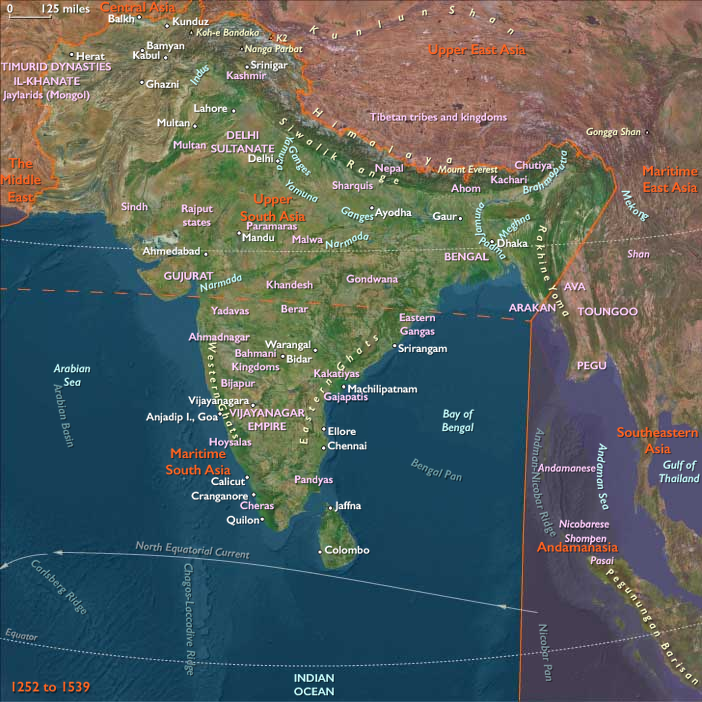
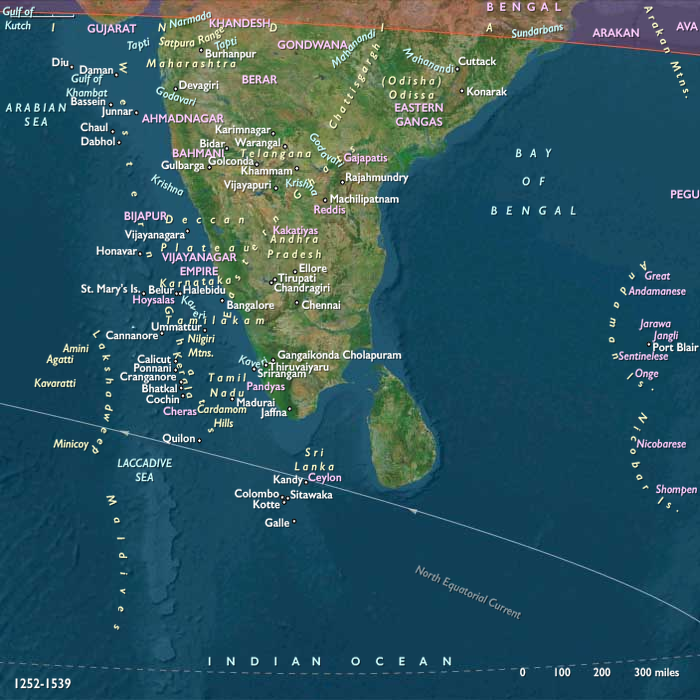
…the fort of Warangal, the Kakatiyan capital, …
Years: 1309 - 1309
…the fort of Warangal, the Kakatiyan capital, after a prolonged seige.
Conquering and gaining rich plunder form the Kakatiya’s ruler, King Pratapa Rudra, the Sultanate again demands annual tribute but leaves native rule intact.
Locations
People
Groups
- Pandyan Dynasty
- Seuna Yadavas of Devagiri
- Kakatiya dynasty
- Hoysala Empire
- Delhi, Sultanate of (Khalji Dynasty)
Topics
Commodoties
Subjects
Regions
Subregions
Related Events
Filter results
Showing 10 events out of 44896 total
Margrave Waldemar of Brandenburg sells his claim to the territory to the Teutonic Order in September 1309, for the sum of ten thousand marks, inaugurating what will be a series of conflicts between Poland and the Teutonic Knights as the Order continues to incorporate territories into its domain.
The synod of the prelates in Buda following the assembly had confirmed the theory of the inviolability of the king; the bishops had also summoned Ladislaus Kán to return the Holy Crown of Hungary to Charles.
The Voivode of Transylvania denies the request, however; the Papal legate therefore has a new crown made for Charles and he is on June 15, 1309, crowned with the new crown by Archbishop Tamás of Esztergom.
The cost of hiring the Catalans, then of repairing the damage that they have done, has to be met by desperate measures.
The face value of the imperial gold coin, the hyperpyron, is lowered when its gold content is reduced to a mere fifty percent; and the people have to bear still greater burdens of taxation-some payable in kind by farmers.
Inflation and rising prices lead to near famine in Constantinople, the population of which is swollen by vast numbers of refugees.
The emperor's use of mercenary troops from Western Europe has caused, and will continue to cause, more damage to his own territory than to that of the Turks.
From Devagiri, Malik Kafur mounts a second raid on the south in 1309, launching an assault on the Kakatiya dynasty and managing to capture the Siripur and Hanumakonda forts and taking …
The military orders in the East can no longer offer a standing nucleus of troops.
The Hospitallers of St. John of Jerusalem, having taken Rhodes in 1308 and established their headquarters here, become known from 1309 as the Order of the Knights of Rhodes.
Thessaly had fallen under the control of the short-lived Kingdom of Thessalonica in the aftermath of the Fourth Crusade, but had been conquered again in 1215 by Theodore Komnenos Doukas of the Despotate of Epirus and become one of the independent territories governed by that family.
The region had remained attached to the domains of Theodore and his successors in Thessalonica until 1239, when the deposed ruler of Thessalonica, Manuel Komnenos Doukas, conquered it from his nephew John Komnenos Doukas and secured its status as a separate section of the family holdings.
His death around 1241 brought the area to the ruler of Epirus, Michael II Komnenos Doukas, upon whose death in about 1268 Thessaly became the holding of a distinct, illegitimate, branch of the family.
Venetian support, the result of a favorable trading relationship (Thessaly exports agricultural produce), has helped maintain Thessalian independence until the arrival in 1309 of the Catalan Grand Company, which has moved into Greece through Thrace and Macedonia, plundering as they go.
Thibault de Chepoy, the deputy of Charles of Valois, ends the leadership of Rocafort, arresting him and sending him to Naples, where he will die of hunger this same year.
Prince William II Villehardouin, a grandnephew of the Fourth Crusade historian Geoffrey of Villehardouin, was the ruler of the Frankish Principality of Achaea, established in 1205 after the conquest of Constantinople during the Fourth Crusade.
William had in 1249 built a strong castle, the "Oriokastro", which is to play an important role in the history of the last centuries of the Eastern Roman Empire.
The Latins in 1261 had ceded Mystras and other forts in the southeastern Peloponnese as ransom for William II, who had been captured in Pelagonia, and Michael VIII Palaeologus had made the city the seat of the new Despotate of Morea.
It has remained the capital of the despotate, ruled by relatives of the Greek emperor, although the Venetians still control the coast and the islands.
Mystras and the rest of Morea have become relatively prosperous since 1261, compared to the rest of the empire.
In an action which ignored the rights of the Villehardouin Princes, Charles of Anjou had been given Achaea in 1267 by the exiled Baldwin II of Constantinople, who hoped Charles could help him restore the Latin Empire.
Charles and his descendants will not rule in Achaea personally, but they will send money and soldiers to help the principality defend against the Greeks.
The principality has since been governed essentially as a province of the Kingdom of Naples.
With the decreasing power and influence of Achaea, the Duchy of Athens has become the most powerful state in Greece.
Charles II of Naples had at first granted the fiefdom of Morea or Achaea to Princess Isabella of Villehardouin, but he had deposed her in 1307 and granted it to his brother, Philip I of Taranto, inaugurating what is to be a three-generations long and sometimes violent succession dispute.

King Charles II of Naples maintains Angevin control in southern Italy, with Naples as his capital, until his death on May 5, 1309; his son Robert of Anjou, known as Robert the Wise, succeeds him as Robert I, his reign being blessed by Clement V who makes him papal vicar in Romagna.
While Robert's nephew Charles Robert of Anjou could have succeeded just as rightfully, being the son of Charles Martel, he is preoccupied with obtaining the Hungarian crown (which he will accomplish in 1310) and does not press his claim to the throne of Naples.
Robert is the heir in proximity of blood.
The Order of Preachers in the thirteenth century had been been the witness to the brilliant development and intense activity of the period.
This last is manifested especially in the work of teaching.
By preaching it had reached all classes of Christian society, fought heresy, schism, and paganism by word and book, and by its missions to the north of Europe, to Africa, and Asia passed beyond the frontiers of Christendom.
Its schools have spread throughout the entire Church; its doctors have written monumental works in all branches of knowledge and two among them, Albertus Magnus, and especially Thomas Aquinas, had founded a school of philosophy and theology which is to rule the ages to come in the life of the Church.
Thomas Aquinas’s doctrine, although initially received coolly outside his own order, is prescribed for the Dominicans in 1309, more than thirty years after his death.
An enormous number of its members have held offices in Church and State—as popes, cardinals, bishops, legates, inquisitors, confessors of princes, ambassadors, and paciarii (enforcers of the peace decreed by popes or councils).
The expansion of the Order is not without its problems.
The Order of Preachers, which should have remained a select body, has developed beyond bounds and absorbed some elements ill-fitted to its form of life.
Jean de Joinville Completes Histoire de Saint Louis (1309): A Crusader’s Chronicle
In 1309, the French chronicler and nobleman Jean de Joinville completed his Histoire de Saint Louis, a richly detailed and personal account of the life and reign of King Louis IX of France (Saint Louis). The work, particularly its main section, provides a vivid narrative of the Seventh Crusade (1248–1254), in which Joinville himself had participated.
Joinville’s Firsthand Perspective
- Jean de Joinville was a close companion of Louis IX, serving as a knight and counselor during the Seventh Crusade.
- Unlike more formal royal biographies, Histoire de Saint Louis offers a personal, engaging, and often entertaining account of the king’s leadership, emphasizing both his piety and his human flaws.
- Joinville describes in lively detail the hardships of crusading life, including battles, diplomacy, and Louis IX’s captivity in Egypt.
The Chronicle’s Significance
- Joinville’s work is one of the most valuable firsthand accounts of medieval crusading expeditions, providing insights into military tactics, courtly life, and medieval religious devotion.
- His portrayal of Louis IX helped shape the king’s posthumous reputation, reinforcing his image as a model Christian ruler.
- The work was commissioned much later, around 1305, by Joan of Navarre, Queen of France, and completed in 1309, decades after Louis IX’s death in 1270.
Legacy
- Histoire de Saint Louis remains a key source for historians studying the Seventh Crusade and the reign of Louis IX.
- Joinville’s storytelling style, full of anecdotes and personal reflections, makes it one of the most engaging medieval chronicles.
- The text was widely circulated, influencing later French historical writing and royal propaganda.
Jean de Joinville’s Histoire de Saint Louis, completed in 1309, stands as a masterpiece of medieval biography and crusader literature, offering a vivid, personal, and historically significant account of one of France’s most revered monarchs.
Years: 1309 - 1309
Locations
People
Groups
- Pandyan Dynasty
- Seuna Yadavas of Devagiri
- Kakatiya dynasty
- Hoysala Empire
- Delhi, Sultanate of (Khalji Dynasty)