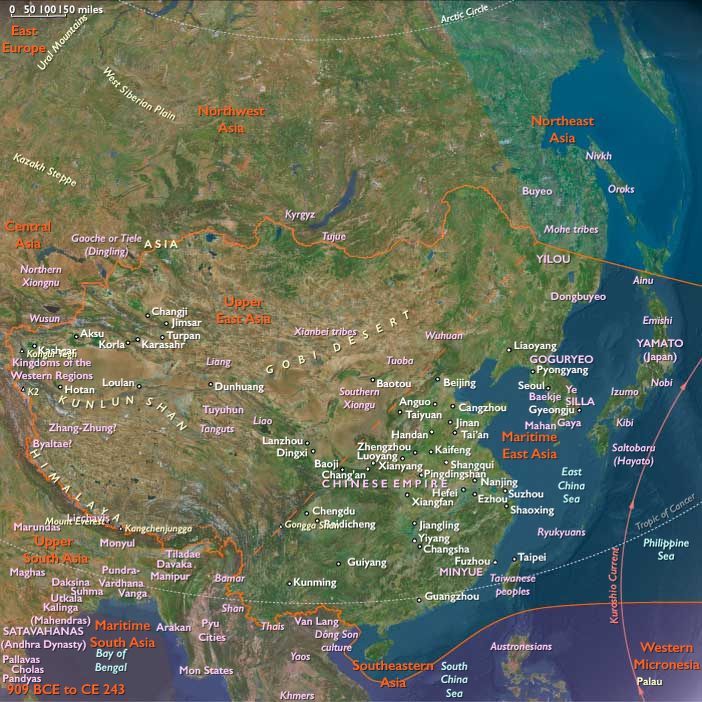
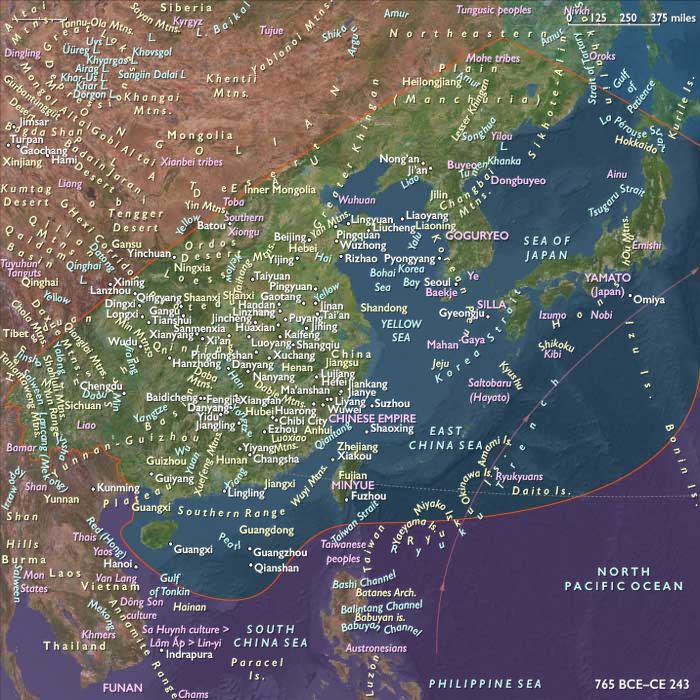
Xu Gong, the former governor of Wu …
Years: 199 - 199
Xu Gong, the former governor of Wu prefecture (south of present-day Suzhou, Jiangsu), has long opposed Sun Ce.
Xu Gong writes to Emperor Xian, recommending that the emperor summon Sun Ce to the capital as he deems Sun Ce to be a hero comparable to Xiang Yu and too dangerous to be allowed to occupy a territory.
However, the letter is intercepted by an official loyal to Sun Ce, who attacks Xu Gong and then has him executed.
Xu Gong's former servants then keep a low profile and wait for a chance at revenge.
Locations
People
Groups
- Taoism
- Chinese (Han) people
- Chinese Empire, Tung (Eastern) Han Dynasty
- Way of the Five Pecks of Rice
Topics
Commodoties
Subjects
Regions
Subregions
Related Events
Filter results
Showing 10 events out of 60789 total
Dong Cheng, as Cao Cao faces a major military confrontation against Yuan Shao in 199, claims to have received a secret edict issued by Emperor Xian (hidden in a jeweled leather belt inside his robe) with a message to execute Cao Cao, and he enters into a conspiracy with people he trusts, including Liu Bei, Zhong Ji, and Wang Fu, to assassinate Cao.
Late in 199, Liu Bei starts a rebellion and waits for Dong Cheng to act in the capital.
Yuan Shu dies in 199 of sickness along with his short-lived dynasty.
His cousin Yuan Yin fears Cao Cao and surrenders Shouchun.
Bearing Yuan Shu's coffin and his former troops, he heads to Huancheng (present-day Qianshan County, Anhui) to seek refuge under Liu Xun.
As he has insufficient food supplies in his realm to support the additional troops, …
…Liu Xun leads a force south to pillage Haihun (east of present-day Yongxiu County, Jiangxi).
Sun Ce is en route to attack Huang Zu, who was Sun Jian's killer, in Xiakou (present-day Hankou District, Wuhan, Hubei) when he receive the news.
He then turns back and captures the poorly defended Huancheng, taking over all of Yuan Shu's thirty thousand former troops.
Hearing that his base city had been taken, Liu Xun heads west and seeks help from Huang Zu, who sends a five thousand-strong naval force to assist him.
Sun Ce presses forward and defeats Liu Xun, who escapes north to Cao Cao.
Sun Ce annexes more than two thousand former troops and one thousand ships of his enemy and comes upon Huang Zu.
Despite reinforcements from Liu Biao, Huang Zu is utterly defeated.
During the battle, Sun Ce slays Liu Biao's officer, Han Xi, and completely routs Huang Zu's son, Huang She.
The victorious Sun Ce in 199 appears poised to take over the entirety of southern China.
As he is threatened by his rival Yuan Shao in the north and cannot divide his attention, Cao Cao attempts to further reinforce the alliance with Sun Ce by marrying the daughter of his relative Cao Ren to Sun Ce's youngest brother Sun Kuang.
Sun Ce in turn agrees to marry Sun Ben's daughter to Cao Cao's son Cao Zhang.
Severus during his time in the east expands the Limes Arabicus, building new fortifications in the Arabian Desert from Basie to ...
…Dumata, the easternmost settlement along the limes.
The physician Ji Ben, while tending to the ill Dong Cheng, overhears Cheng speaking in his sleep of having Cao Cao assassinated.
After Dong awakens, Ji requests that he be allowed to participate in the plot.
Initially, Dong is hesitant, believing that Ji might betray him and his fellow conspirators to Cao Cao.
Such is his hatred of Cao Cao, Ji bites off his finger and signs an oath of allegiance in his own blood to prove his loyalty, winning Dong's trust.
Although Dong now has faith in Ji, many of his allies and comrades have recently been executed or chased away by Cao Cao, leaving him feeling the situation to be hopeless.
Ji, however, had been attending to Cao Cao's increasingly serious headaches for an extended period of time.
As Cao Cao's physician, Ji informs Dong that, upon Cao's next request for treatment, he will simply concoct a poisonous mixture which he will then add to Cao's regular medicinal potion.
Dong praises the physician as a hero.
However, one of Cheng's disgruntled young servants, bitter after being disciplined for conversing with a concubine, meets with Cao Cao, and informs him of his master's plot.
Cao Cao, unsure what to make of these allegations, wishes to test his physician's loyalty, feigning a headache and sending for Ji Ben.
As Ji prepares the remedy, Cao Cao makes an unusual request that his physician first test the mixture to ensure its quality, and that he will then swallow the remainder as per usual.
Ji, sensing that his ploy has been discovered, wrenches Cao Cao's head forward by the ear and attempts to force the deadly substance down his throat.
Cao Cao frantically pushes the poisonous mixture away from his face, where it falls to the floor and spills Cao's guards, who have been awaiting his signal, rush forth and seize Ji, who curses at Cao Cao's trap.
Ji Ben is then tightly bound and brought before Cao Cao once more.
Ji maintains a bold front, refusing to cower or display weakness in the face of his opponent.
Cao Cao offers to spare Ji's life, provided that he betray his coconspirators’ identities.
Ji sneers at this gesture.
Cao Cao, enraged at his would-be assassin's insubordination, orders his troops to beat Ji to within an inch of his life, in an attempt to loosen his tongue.
The guards then beat him for two entire watches, only ceasing when Cao Cao fears that the abuse will kill his prisoner.
It is said that Ji Ben's skin hung in tatters, his flesh was battered beyond repair, and that the blood from his wounds poured down the steps as if water, and yet, Ji refused to betray Dong and his allies.
Cao Cao, although infuriated, orders that the prisoner be allowed to rest somewhat before his next ordeal.
Already aware of Ji's fellow conspirator's names, having been divulged by Dong's servant, Cao Cao orders that a banquet be prepared and invites all involved to attend.
During the feast, Ji is once again brought out before all in attendance, and ordered to relinquish all knowledge of the assassination details.
Refusing to do so, Ji is once again severely beaten by Cao's troops while Dong's allies look on in fear.
After being beaten and revived with ice water several times, and only opening his mouth to further insult Cao Cao and his men, Cao grows tired of Ji.
No longer caring to gather solid evidence to implicate Dong's colleagues in the ploy, Cao has them all seized and imprisoned despite passionate denials by each of the men involved.
Cao Cao then confronts Dong Cheng at his residence, as Dong had claimed to be too ill to attend the banquet.
Cao Cao once again brings forth the broken figure of Ji Ben and orders that he once again be beaten.
However, Cao's troops explain that there was not a single part of Ping's body that can be beaten any further, so Cao orders that his men take a knife and cut off all of Ji's remaining nine fingers.
After this is done, Ji shouts "Still I have a mouth that can swallow a traitor and a tongue that can curse him."
Cao Cao then orders that Ji's tongue be cut out, and after this, Ji finally asks for mercy, requesting that Cao remove his bonds so that he may divulge the plot details.
Upon removing Ji's restraints, the physician rises to his feet, turning to face the Emperor's palace, and bowing down.
He then said "It is Heaven's will that thy servant has been unable to remove the evil."
With all the might left in his body, Ji smashes his head against the ground, killing himself.
Despite Ji's silence, the details of the plot and the pledge signed by each of the conspirators is discovered when Cao's troops ransacked Dong's residence.
Cao has all involved put to death, along with Dong’s family, daughter and others.
Dong's daughter, an imperial consort, is pregnant, and Emperor Xian personally tries to intercede for her, but Cao Cao has her executed anyway.
Liu Bei is later defeated by Cao Cao and forced to flee to Yuan Shao's territory.

Yuan Shao amasses more than one hundred thousand troops in autumn 200 and marches southwards on Xuchang in the name of rescuing the emperor.
Cao gathers twenty thousand men in Guandu, a strategic point on the Yellow River.
The two armies come to a standstill as neither side is able to make much progress.
Cao's lack of men does not allow him to make significant attacks, and Yuan's pride forces him to meet Cao's force head-on.
Despite his overwhelming advantage in terms of manpower, Yuan is unable to make full use of his resources because of his indecisive leadership and Cao's position.
Besides the middle battleground of Guandu, two lines of battle are present.
The eastern line with Yuan Tan of Yuan Shao's army against Zang Ba of Cao's army is a one-sided battle in favor of Cao, as Yuan Tan's poor leadership is no match for Zang's local knowledge of the landscape and his hit-and-run tactics.
On the western front, Yuan Shao's nephew, Gao Gan, performs better against Cao's army and forces several reinforcements from Cao's main camp to maintain the western battle.
Liu Bei, a guest in Yuan Shao's army, suggests that he instigate rebellion in Cao's territories as many followers of Yuan are in Cao's lands.
The tactic is initially successful but Man Chong's diplomatic skills help to resolve the conflict almost immediately.
Man had been placed as an official there for this specific reason, as Cao had foreseen the possibility of insurrection prior to the battle.
Finally, a defector from Yuan Shao's army, Xu You, informs Cao of the location of Yuan's supply depot.
Cao breaks the stalemate by sending a special group of soldiers to burn all the supplies of Yuan's army, thus winning a decisive and seemingly impossible victory.
Liu Zhang, the youngest son of Liu Yan, had spent his early career at the Han court as an assistant to his two eldest brothers, Liu Fan and Liu Dan, serving at the court when it was controlled by the warlords Li Jue and Guo Si.
Liu Zhang had been sent by the court to admonish his father for brutal actions, but upon arriving his father had refused to let him go back to the court.
In 194, following the deaths of his elder brothers and then his father, he had succeeded to the governorship of Yi Province.
During his rule over the province, he shows ambition to expand his territory, but it is said that he was a good ruler and maintained peace in his realm.
In 200, Zhang Lu, who had previously recognized Liu Yan as his master, rebels against Liu Zhang.
Liu Zhang has Zhang Lu's mother, brothers, and other family members executed.
Cao Cao engages in the decisive Battle of Guandu with Yuan Shao along the shores of the Yellow River in the year 200, leaving the capital and his base city Xuchang poorly guarded.
Sun Ce is said to have then plotted to attack Xuchang under the banner of rescuing Emperor Xian, a figurehead held under Cao Cao's control.
Preparations are underway for the military excursion when Sun Ce runs into three former servants of Xu Gong during a solo hunting trip.
One of them manages to plant an arrow into Sun Ce's cheek before Sun Ce's men arrive and slay the assassins.
Many differing accounts of Sun Ce's death exist; one generally accepted scenario is that he died that same night.
Although he is survived by a posthumous son, Sun Shao (as well as at least two, possibly three, daughters, married to Gu Shao and later Zhu Ji, and Lu Xun respectively, Sun Ce passes his legacy to his younger brother Sun Quan.
When Sun Quan declares himself the first emperor of the state of Eastern Wu in 222, he bestows upon Sun Ce the posthumous title of Prince Huan of Changsha.
Sun Shao will bear one son, Sun Feng, who will be executed by Sun Hao for alleged treason due to his popularity.
Lydda, an ancient city on the Plain of Sharon southeast of Jaffa, is mentioned several times in the Bible as a well-known center of Jewish scholars and merchants from the fifth century BCE until the Roman conquest in CE 70.
In a New Testament account (Acts 9:32), the apostle Peter healed the paralytic at Lod.
Emperor Septimius Severus in CE 200, elevates the town to the status of a city, calling it Colonia Lucia Septimia Severa Diospolis.
The name Diospolis ("city of gods") may have been bestowed earlier, possibly by Hadrian.
Most of its inhabitants at this point are Christian.
Years: 199 - 199
Locations
People
Groups
- Taoism
- Chinese (Han) people
- Chinese Empire, Tung (Eastern) Han Dynasty
- Way of the Five Pecks of Rice