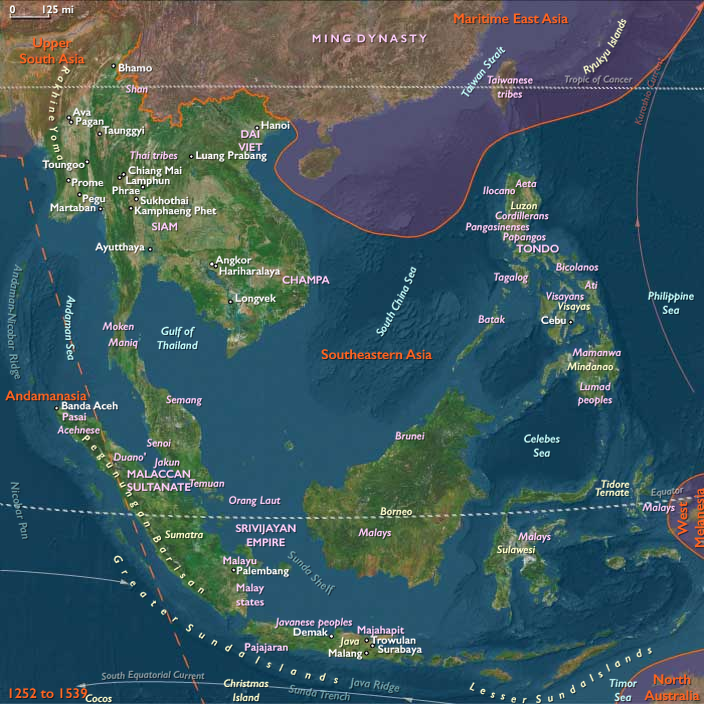
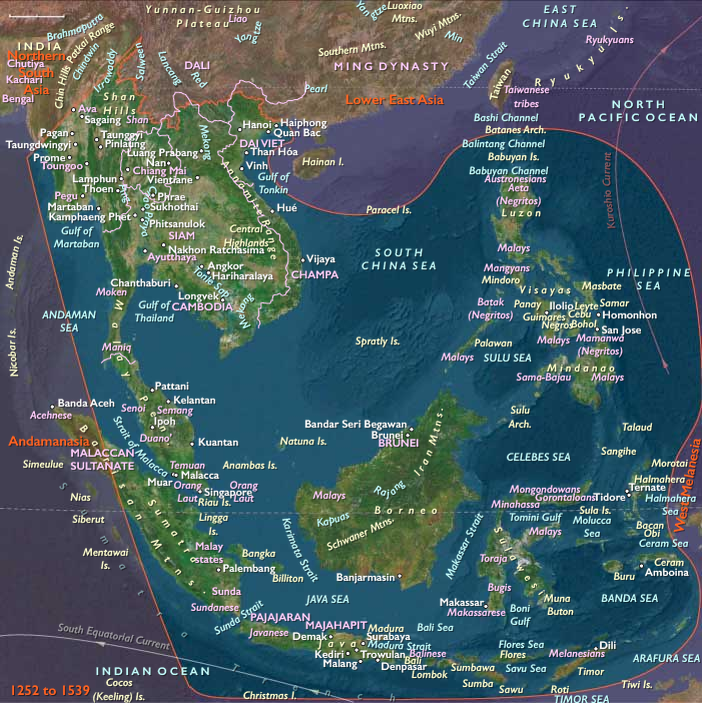
The forces of Chiang Mai, after five …
Years: 1515 - 1515
The forces of Chiang Mai, after five years of skirmishing with the Ayutthayans, …
Locations
People
Groups
Topics
Commodoties
Subjects
Regions
Subregions
Related Events
Filter results
Showing 10 events out of 39125 total
…attack Sukhothai and …
…Kamphaeng Phet to the south in 1515.
Ayutthaya’s King Ramathibodi II, with two of his sons, launches a strong counteroffensive, expelling Chiang Mai troops from Ayutthayan territory and rolling them back into Chiang Mai as far as the Wang River, near Lampang.
Victorious in battle there, Ramathibodi plunders Lampang and carries away a valuable Buddha.
Hetman Konstanty Ostrogski had entered Vilnius in triumph in December 1514.
To commemorate the victory over the Muscovites, two Orthodox churches are erected: the Church of the Holy Trinity and the Church of Saint Nicholas, which remain among the most impressive examples of Orthodox Church architecture in Lithuania.
Immediately after the victory, the Polish–Lithuanian state starts to exploit the battle for its propaganda aimed at other nations in Europe, with the intent of improving the image of Poland-Lithuania abroad.
Several panegyrical accounts of the battle are sent to Rome.
Maximilian, in order to reduce the growing pressures on the Empire brought about by treaties between the rulers of France, Poland, Hungary, Bohemia, and Russia, as well as to secure Bohemia and Hungary for the Habsburgs, meets with the Jagiellonian kings Ladislaus II of Hungary and Bohemia and Sigismund I of Poland at the First Congress of Vienna on July 22, 1515.
Here they arrange for Maximilian's granddaughter Mary to marry Louis, the son of Ladislaus, and for Anne (the sister of Louis) to marry Maximilian's grandson Ferdinand (both grandchildren being the children of Philip the Handsome, Maximilian's son, and Joanna of Castile.
The broad coalition against Lithuania and Poland ceases, but the war between the Grand Duchy of Lithuania and Grand Duchy of Moscow will last until 1520.
Wallpaper, using the printmaking technique of woodcut, had arrived in Europe from China at the beginning of the fifteenth century, gaining popularity in Renaissance Europe among the emerging gentry.
The elite of society are accustomed to hanging large tapestries on the walls of their homes, a tradition from the Middle Ages.
These tapestries add color to the room as well as providing an insulating layer between the stone walls and the room, thus retaining heat in the room.
However, tapestries are extremely expensive and so only the very rich can afford them.
Less well-off members of the elite, unable to buy tapestries due either to prices or wars preventing international trade, turn to wallpaper to brighten up their rooms.
Early wallpaper features scenes similar to those depicted on tapestries, and large sheets of the paper are sometimes hung loose on the walls, in the style of tapestries, and sometimes pasted as today.
Prints are very often pasted to walls, instead of being framed and hung, and the largest sizes of prints, which come in several sheets, are probably mainly intended to be pasted to walls.
Some important artists make such pieces, notably Albrecht Dürer, who works on both large picture prints and also ornament prints intended for wall-hanging.
The largest picture print is The Triumphal Arch commissioned by the Holy Roman Emperor Maximilian I and completed in 1515.
This measures a colossal 3.57 by 2.95 meters, made up of 192 sheets, and is printed in a first edition of seven hundred copies, intended to be hung in palaces and, in particular, town halls, after hand-coloring.
Very few samples of the earliest repeating pattern wallpapers survive, but there are a large number of old master prints, often in engraving of repeating or repeatable decorative patterns.
These are called ornament prints and were intended as models for wallpaper makers, among other uses.
The etchings produced by Albrecht Dürer from about 1515 are among the earliest important examples of the art, also practiced with great refinement by Altdorfer.
Selim's forces capture the great fortress of Kamakh and establish control over Kurdistan, formerly a Persian vassal, which is now incorporated into the Ottoman Empire.
Andrea del Sarto was born Andrea d'Agnolo di Francesco di Luca di Paolo del Migliore in Florence on July 16, 1486.
Since his father, Agnolo, was a tailor (sarto), he became known as "del Sarto" ("tailor's son").
Since 1677 some have attributed the surname Vannucchi with little documentation.
By 1494 Andrea was apprenticed to a goldsmith, and then to a woodcarver and painter named Gian Barile, with whom he remained until 1498.
According to Vasari, he then apprenticed to Piero di Cosimo, and later with Raffaellino del Garbo (Carli).
Andrea and an older friend, Franciabigio, decided in 1508 to open a joint studio at a lodging together in the Piazza del Grano.
The first product of their partnership may have been the Baptism of Christ for the Florentine Compagnia dello Scalzo, the beginning of a monochrome fresco series.
By the time the partnership was dissolved, Sarto's style bore the stamp of individuality.
From 1509 to 1514 the brotherhood of the Servites had employed Sarto, Franciabigio, and Andrea Feltrini in a program of frescoes at Basilica della Santissima Annunziata di Firenze.
Sarto completed three frescoes in the portico of the Servite convent illustrating the Life of Filippo Benizzi, a Servite saint who died in 1285.
He executed them rapidly, depicting the saint sharing his cloak with a leper, cursing some gamblers, and restoring a girl possessed with a devil.
These paintings have met with respect, the correctness of the contours being particularly admired, and earned for Sarto the nickname of "Andrea senza errori" (Andrea the perfect).
After these, the painter depicted in two frescoes the death of S. Filippo and then children cured by touching his garment; all five works were completed before the close of 1510.
The Servites engaged him to do two more frescoes in the forecourt of the Annunziata: a Procession of the Magi (or Adoration, containing a self-portrait) finished in 1511.
Towards 1512 he painted an Annunciation in the monastery of S. Gallo and a Marriage of Saint Catherine (Dresden).
Andrea had finished his last two frescoes by 1514, including his masterpiece, the Birth of the Virgin, which fuses the influence of Leonardo, Ghirlandaio and Fra Bartolomeo.
By November 1515 he had finished at the Scalzo the Allegory of Justice and the Baptist preaching in the desert.

The subject of La velata, or La donna velata ("The woman with the veil"), one of the most famous portraits by Raphael, appears in another portrait, La Fornarina, and is traditionally identified as the fornarina (bakeress) Margherita Luti, Raphael's Roman mistress.