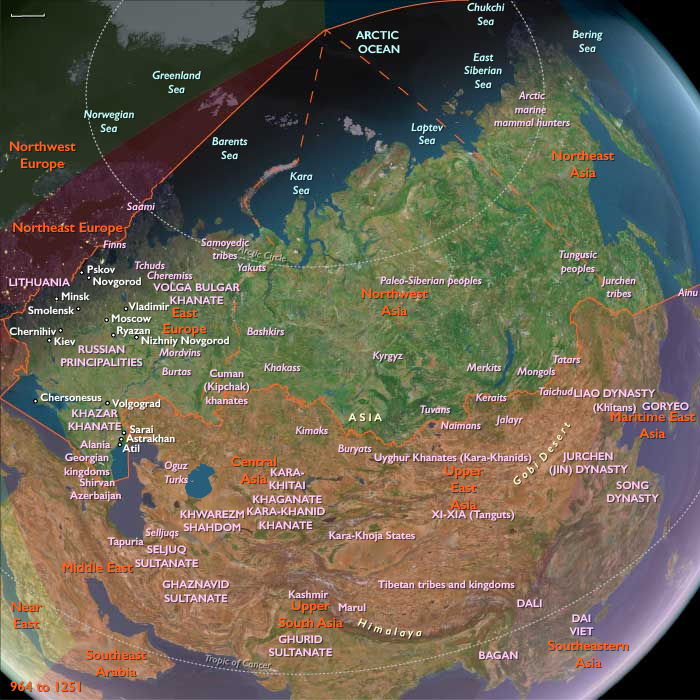
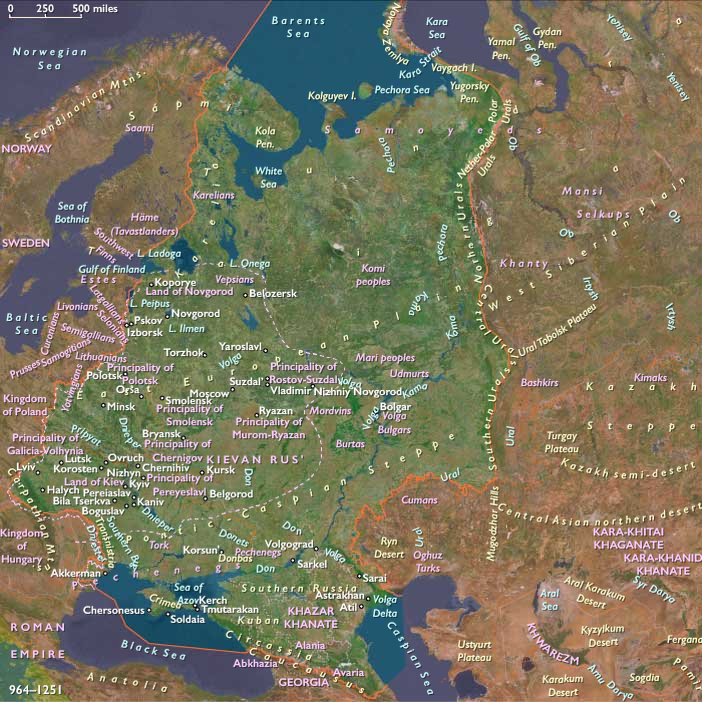
The first written mention of Bryansk is …
Years: 1146 - 1146
The first written mention of Bryansk is in 1146, in the Hypatian Codex, as Debryansk.
Its name is derived from a Slavic word for "ditch", "lowland" or "dense woodland"; the area is known for its dense woods, of which very little remains today.
Local authorities and archaeologists, however, believe that the town had existed as early as 985 as a fortified settlement on the right bank of the Desna River.
Bryansk is today an important center for steel and machinery manufacturing, and is home to many large factories.
Related Events
Filter results
Showing 10 events out of 48826 total
Vsevolod II of Kiev has two sons, but his chosen successor is his brother, Igor, and he has obtained pledges from his subjects to accept Igor as his heir.
According to one account, Vsevolod even had the Kievans kiss the Holy Cross and swear loyalty to Igor, which they resented.
Shortly before his death in 1146, Vsevolod becomes a monk under the name Gavriil.
Igor II and his family, the Olgovichi, are unpopular and there is resistance against his accession.
The chroniclers accuse Igor of being dishonest, greedy, scheming, and violent.
He has reigned less than two weeks before the Kievans invite his cousin and rival, Iziaslav Msistislavich, the oldest son of Mstislav Vladimirovich, Kniaz' (Prince) of Novgorod, to be their prince.
Reneging on a promise he had made not to seek power, Iziaslav attacks and defeats Igor and his brother Svyatoslav.
Svyatoslav escapes, but Igor becomes entrapped in some marshes and is unable to flee because of an infirmity in his legs.
He is captured, and Iziaslav has him thrown into a pit, where he languishes until autumn 1146, when, desperately ill, he requests permission to become a monk.
Iziaslav releases him, but Igor is so weak he has to be carried from the pit and nearly dies of illness.
He becomes a monk at the monastery of St. Feodor in Kiev under the name Ignati.
Iziaslav, who is already Prince of Pereyaslav (1132), Prince of Turov (1132-1134), Prince of Rostov, (1134- ), Prince of Vladimir and Volyn (1134—1142), and Prince of Pereyaslavl (1143-1145), now becomes Velikiy Kniaz (Grand Prince) of Kiev.
Denmark seems to have been a stable country during the kingship of Eric III Håkønssøn Lam, ruling from 1137, and some contemporary sources speak very highly of him.
The first Danish king who seems to have been strongly influenced by German culture, he had spent his early youth among German knights whose ideals have marked most of his later life.
Also his queen, Lutgard of Salzwedel, is a German.
The reasons for his abdication (the only one by a Danish king) are unknown; he enters a convent in 1146 and dies this same year, and the illness that has killed him may well have been the main reason.
At the abdication of Eric, Sweyn Grathe, the illegitimate son of Erik II Emune and a mistress, has been elected a king on the large island of Zealand (Sjaelland) but for the next years he will have to fight against his rival …
…Canute (Knud Magnussen), son of Prince Magnus who was the son of King Niels, who rules in Jutland.
A third claimant is …
…Valdemar, the son of Canute Lavard, a chivalrous and popular Danish prince, who had been the eldest son of Eric I of Denmark.
Valdemar’s father had been murdered days before his birth; his mother, Ingeborg, daughter of Mstislav I of Kiev, had named him after her grandfather, Vladimir Monomakh of Kiev.
(Vladimir's father-in-law had been King Harold Godwinson of England; Vladimir 's grandfather had been Emperor Constantine Monomachus of Constantinople.)
As an heir to the throne, and with his rivals quickly gaining power, Valdemar has been raised in the court of Asser Rig of Fjenneslev, together with Asser's sons, Absalon and Esbern Snare, who are to become his trusted friends and ministers.
Valdemar holds southern Jutland as his possession.
The ensuing civil war will last the better part of ten years.
The island of Rügen, located in the Baltic Sea off the German coast, had been first populated about 4000 BCE.
The migrants were probably members of the Funnelbeaker culture, which exploited Rügen's flint deposits.
In the beginning of the first millennium, the island and the surrounding continental areas were settled by the Germanic Rugians, who might have come from Scandinavia or evolved from autochtone tribes and gave their name to the island.
In the seventh century, West Slavic R(uj)ani settled Rügen, assimilating the Germanic population which had not migrated southward in the Migration period, thereby adopting their name (Rugians --> Rujanes).
Many traces of their life can be found today.
Rügen has become a Slavic principality, stretching from the Recknitz to the Ryck River, with the political center in the ancient town of Charenza, and a religious center in the fortified temple of Svantevit at Cape Arkona, the northernmost point of Rügen.
The Rani of Rügen continually harass Danish and German coastal areas with piratical acts while the Danes are preoccupied with their civil war.
Manuel, who has transformed the austere, conservative court of his father into a gay setting for tournaments and festivities imported from medieval Western Europe, had at the beginning of his reign devoted himself to affairs in the West.
Practically ignoring the growing Turkish threat on the plains of Anatolia, he has renewed his alliances in the West against his Norman rivals in both Sicily and Antioch, alarmed above all by the possibility of an attack by Roger of Sicily.
In anticipation of the arrival of the western armies of the Second Crusade and more aware than they of the delicate power balance in the Levant, he makes peace in 1146 with the Seljuqs of Iconium.
Manuel will assist the crusaders with guides and supplies but will contribute no troops.
Zengi is killed on his return to Iraq to repress a revolt in 1146, while besieging the fortress of Qal Ja'bari held by a Frankish slave named Yarankash who bears him a personal grudge.
Zengi’s forces are scattered, but Zengi's two sons are able to regain control and to divide informally the empire.
Yaranqash had stabbed the atabeg numerous times and then fled to the fortress of Dawsar, and then from there to Damascus.
The governor, Mu'in ad-Din Unur, had had him arrested and sent him to Zengi's son Nur ad-Din in Aleppo.
Nur ad-Din sends him along to …
…his elder brother Saif ad-Din Ghazi I in Mosul, who has him executed.
Saif ad-Din had first to fight to secure his position in Mosul.
Two years before, the Seljuq sultan Ghiyath ad-Din Mas'ud had named his cadet son Alp-Suleiman-Shah b. Muhammad b. Malik Shah as overlord of Zengi, but the latter had neutralized him and carried with him at the siege.
At Zengi's death, Alp-Suleiman-Shah had tried to exploit the ensuing disorder to gain the power in Mosul.
Two of Zengi's advisors, the head of the diwan al-Din Muhammad Jemal and hajab Amir Salah al-Din Muhammad al-Yaghisiyani, took the side of Saif ad-Din: taking advantage of the inexperience of the young Seljuc, giving Saif ad-Din the time necessary to take control of Mosul.
When Alp-Suleiman-Shah appeared in Mosul, he had been arrested and imprisoned in the citadel, where he will remain a prisoner until 1160.
Ildeniz, a Kipchak by origin, formerly a freedman of Seljuq sultan Mehmed I's (1118-1131) vizier Kamal Din al-Simirumi, had attained to the post of governor of Arran under Sultan Mas'ud (1134-1152).
His ascendancy to a position with the most powerful peripheral emirs of the Seljuq empire is aided by the necessity of having a large army against the frequent incursions from the neighboring kingdom of Georgia.
He makes himself the virtually independent ruler of the territory of present Azerbaijan by 1146.
Count Amadeus III of Savoy, despite his marriage to Mahaut of Albon in 1134, had still fought against his brother-in-law Guigues IV, who had been killed at the Battle of Montmeillan in 1142.
Following this, King Louis VII of France, whose mother was Amadeus' sister Adélaide de Maurienne, had attempted to confiscate Savoy.
Amadeus is saved by his promise to participate in Louis' planned crusade.
Years: 1146 - 1146
Locations
Groups
- Kievan Rus', or Kiev, Great Principality of
- Chernigov (Chernihiv), Principality of
- Novgorod Republic
- Ryazan, Principality of