
Debal is the first town assaulted upon …
Years: 711 - 711
Debal is the first town assaulted upon the orders of Al-Hajjaj, who exacts a bloody retribution on Debal by giving no quarter to its residents or priests and destroying its great temple.
From Debal, the Arab army then marches north taking towns such as Nerun and Sadusan (Sehwan) peacefully, often incorporating their military components; additionally, one-fifth of the booty, including slaves, is dispatched to Hajjaj and the Caliph.
The conquest of these towns is accomplished easily; however, Raja Dahir's armies being prepared on the other side of the Indus, are yet to be fought.
In preparation to meet them, Muhammad bin Qasim moves back to Nerun to resupply and receive reinforcements sent by Hajjaj.
Camped on the east bank of the Indus, Qasim sends emissaries and bargains with the river Jats and boatmen.
Upon securing the aid of Mokah Basayah, "the King of the island of Bet", Muhammad bin Qasim crosses over the river where he is joined by the forces of the Thakore of Bhatta and the western Jats.
At Ar-rur (Rohri), he is met by Dahir's forces and the eastern Jats in battle.
Dahir dies in the battle, his forces are defeated and a triumphant Muhammad bin Qasim takes control of Sindh.
In the wake of the battle, enemy soldiers are put to death—but not artisans, merchants or farmers—and Dahir and his chiefs, the "daughters of princes" and the usual fifth of the booty and slaves are sent on to Hajjaj.
Soon, the capitals of the other provinces, Brahmanabad, Alor (Aror) and Multan, are captured alongside other in-between towns with only light Muslim casualties.
Usually after a siege of a few weeks or months the Arabs gain a city through the intervention of heads of mercantile houses with whom subsequent treaties and agreements would be settled.
The general populace is encouraged to carry on with their trades and taxes and tributes settled.
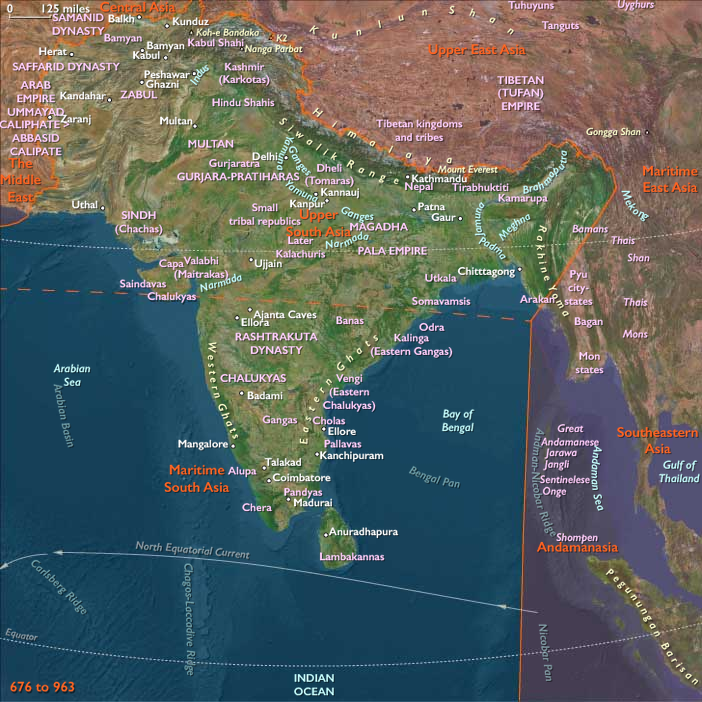
With Sindh secured, Qasim sends expeditions to Surashtra, where his generals make peaceful treaty settlements with the Rashtrakuta.
Muhammad bin Qasim writes out letters to "kings of Hind" to surrender and accept Islam, and subsequently ten thousand cavalry are sent to Kannauj asking them to submit and pay tribute before his abrupt recall ends the campaign.
Locations
People
Groups
Topics
Commodoties
Subjects
Regions
Subregions

Years: 711 - 711
Locations
People
Groups
Topics
Commodoties
Subjects
Regions
Subregions