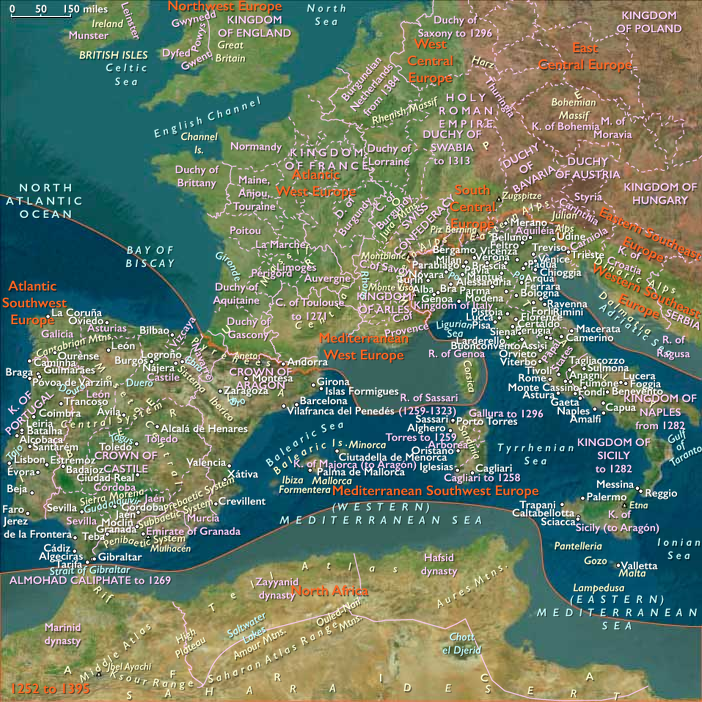
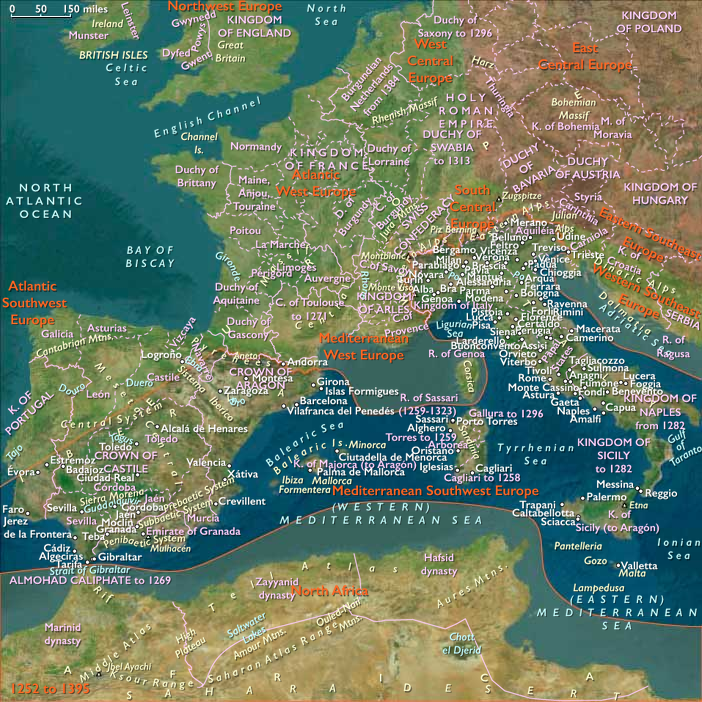
The first parts of the Doge’s Palace …
Years: 1294 - 1294
The first parts of the Doge’s Palace in Genoa had been built between 1251 and 1275, during the flourishing period of the Republican history of Genoa.
The palace originates from the acquisition by the commune of Genoa of houses of the Doria between San Matteo and San Lorenzo churches (1291), after which the construction of an annexed new building is started.
To this, in 1294, a tower of the Fieschi family is added.
Locations
Groups
Topics
Subjects
Regions
Subregions
Related Events
Filter results
Showing 10 events out of 45250 total
Kublai, a recluse since the death of his favorite wife and the son he had chosen as heir, dies at seventy-nine in February 1294, his control over the other khanates greatly diminished.
By this time, the separation of the four khanates of the Mongol Empire (the Chagatai Khanate in Central Asia, the Golden Horde in Russia, the Ilkhanate in Persia, and the Yuan Dynasty in China) have deepened.
Temür was born the third son of Zhenjin of the Borjigin and Kökejin (Bairam-Egechi) of the Khunggirad on October 15, 1265.
Because Kublai's first son Dorji died early, his second son and Temür's father, Zhenjin, became the crown prince.
However, he died in 1286 when Temür was twenty-one years old.
Kublai remained close to Zhenjin's widow Kökejin, who was high in his favor.
Like his grandfather Kublai, Temür is a follower of Buddhism.
Temür had followed his grandfather Kublai to suppress the rebellion of Nayan (Naiyan) and other rival relatives in 1287, after which he and Kublai's official, Oz-Temür, came to guard the Liao River area and Liaodong in the east from Nayan's ally, Qadaan, and defeated him.
Kublai had appointed Temür the princely overseer of Karakorum and surrounding areas in July 1293.
Three Chagatai princes submitted to him while he was defending Mongolia.
After Kublai Khan diesin 1294, Kublai's old officials urge the court to summon a kurultai in Shangdu.
Because Zhenjin's second son Darmabala had already died in 1292, only his two sons, Gammala and Temür, are left to succeed.
It is proposed that they hold a competition over who has better knowledge of Genghis Khan's sayings.
Temür wins and is declared the emperor.
John of Montecorvino, traveling by sea from Nestorian Meliapur in Bengal, reaches China in 1294, appearing in the capital "Cambaliech" (now Beijing), only to find that Kúblaí Khan had just died, and Temür had succeeded to the Mongol throne.
Though the latter does apparently not embrace Christianity, he throws no obstacles in the way of the zealous missionary, who soon wins the confidence of the ruler in spite of the opposition of the Nestorians already settled here.

Plzen (or Pilsen), located about ninety kilometers (fifty-five miles) southwest of Prague and first chronicled in the tenth century, is chartered in 1294 by Wenceslaus, who builds its first fortifications.
Wenceslaus establishes a new town site, some ten kilometers (six miles) away from the original settlement, which is the current town of Starý Plzenec.
It will quickly become an important town on trade routes leading to Nuremberg and Regensburg.
The Mansouri Great Mosque, a mosque in Tripoli, Lebanon, also known simply as the Great Mosque of Tripoli, will be built from 1294 to 1314 around the remains of a Crusader Church of St. Mary.
The mosque is named after Mamluk sultan al-Mansur Qalawun, who had conquered Tripoli from the Crusaders in 1289.
The mosque itself is erected by his two sons, al-Ashraf Khalil, who had ordered its construction in 1293, and al-Nasir Muhammad, who will have the arcade built around the courtyard in 1314.
Located on the site of what was once a Crusaders' suburb at the foot of the Citadel of Tripoli, the mosque will often be mistaken for a remodeled Christian church by medieval travelers and modern historians alike.
Two elements, the door and the minaret, probably do belong to an earlier, Christian structure that is incorporated into the mosque when it is built, but the building—comprising its court, arcades, fountain, and prayer hall—is essentially a Muslim creation.
In any case, the two Christian elements in no way detract from the traditional Muslim nature of this great royal mosque, the first building erected in Mamluk Tripoli.
The Nestorian Christian monk Rabban Bar Sauma, who had arrived in Europe from China in 1288 as an emissary of Kublai Khan, has visited Rome, Genoa, and Florence and met England's Edward I and France's Philip IV, as well as Pope Nicholas IV.
He dies in Baghdad in 1294.
Kublai's great-nephew, then ruler of Persia, had sent representatives to China in search of a potential wife in 1292, and they had asked the Polos to accompany them, so they had been permitted to return to Persia with the wedding party—which left that same year from Zaitun in southern China on a fleet of fourteen junks.
The party had sailed to the port of Singapore, traveled north to Sumatra, then sailed west to the [Point Pedro] port of Jaffna under Savakanmaindan and to Pandyan of Tamilakkam.
Eventually Polo crosses the Arabian Sea to Hormuz.
The two-year voyage has been a perilous one—of the six hundred people (not including the crew) in the convoy only eighteen have survived (including all three Polos).
The Polos leave the wedding party after reaching Hormuz and travel overland to the port of Trebizond on the Black Sea, the present day Trabzon, then make their way home to Venice by sea.
Al-Nasir is only a nominal Sultan.
Kitbugha and al-Shuja'i are the actual rulers of Egypt.
The two Emirs, Kitbugha who is of Mongol origin, and al-Shuja'i, are rivals and have bad relation with each other.
Al-Shujai, with the support of the Burji Mamluks, plans to arrest Kitbugha and assassinate his Emirs but Kitbugha besieges the Citadel and the conflict endes by the murder of al-Shuja'i and the removal of the Burjis from the Citadel.
When Emir Hossam ad-Din Lajin, who had fled after the murder of Al-Ashraf Khalil, shows up in Cairo, the Burji Mamluks who ware called al-Mamalik al-Ashrafiyah Khalil (Mamluks of al-Ashraf Khalil and who had been removed from the Citadel by Kitbugha, rebel and go on rampage in Cairo as Lajin is not arrested and punished for his involvement in the murder of their benefactor Sultan al-Ashraf Khalil.
The Ashrafiyah are defeated and many of them are killed and executed.
Lajin convinces Kitbugha to depose Al-Nassir Muhammed and install himself as Sultan after he warns him that the Ashrafiyah and later Al-Nassir himself will seek revenge for the murder of Khalil, in which Kitbugha also was involved.
Kitbugha deposes Al-Nassir Muhammed and installs himself Sultan with Lajin as his vice-Sultan.
Al-Nassir, who is by now ten years old, is removed with his mother to another section in the palace, where they will stay until they are sent in 1294 to Al Karak, thus ending the first reign of Al-Nassir Muhammad.
The Venetians have gradually found their way back to partial favor in Constantinople through a series of treaties.
When the last of the crusader strongholds in Syria falls to the Muslims in 1291, Venetian merchants thus dispossessed have moved north to dispute the Black Sea trade with the Genoese, the suppliers and defenders of Constantinople by sea.
This has excited the jealousy of the Venetians to the pitch of war.
Venice, allied to Pisa, challenges Genoa's control of spice trade routes in the Black Sea.
The Genoese in 1294 defeat a combined Venetian-Pisan fleet in the Gulf of Alexandretta, then sack the Venetian port of Canea (Khania) on Crete, destroying the Venetians' spice fleet here.
Bern, an Imperial Free City, is a de facto independent city-state republic.
Her traditional constitution, which will remained largely unchanged until 1798, is established in 1294 and provides for a Grosser Rat (Grand Council) of two hundred members and a Kleiner Rat (Small Council) of twenty-seven members.
The latter includes the Schultheiss (mayor) as chief executive and the holders of other public offices such as guild representatives, Stadtschreiber (city clerk), Seckelmeister (bursar) and Grossweibel (Grand Bailiff).