
Maritime East Asia (2637–2494 BCE): Legendary Foundations …
Years: 2637BCE - 2494BCE
Maritime East Asia (2637–2494 BCE): Legendary Foundations and Cultural Innovations
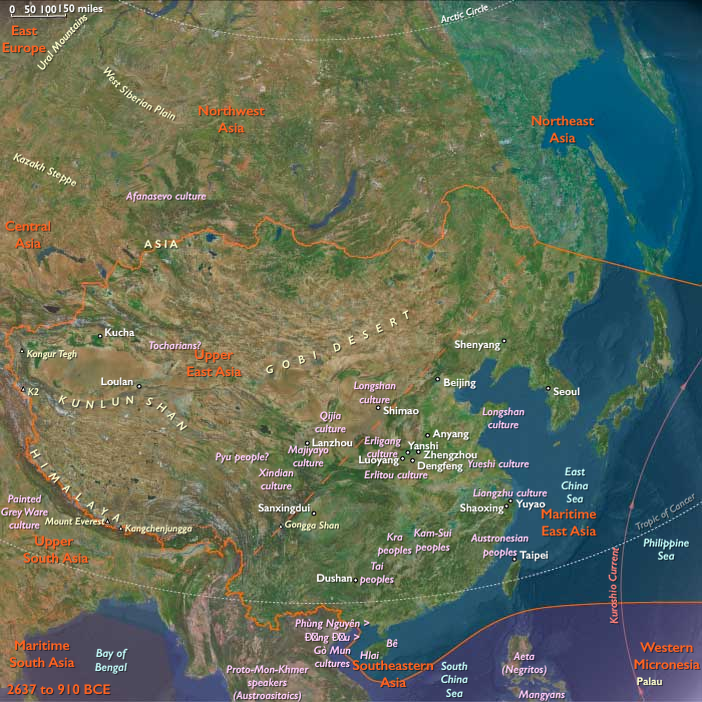
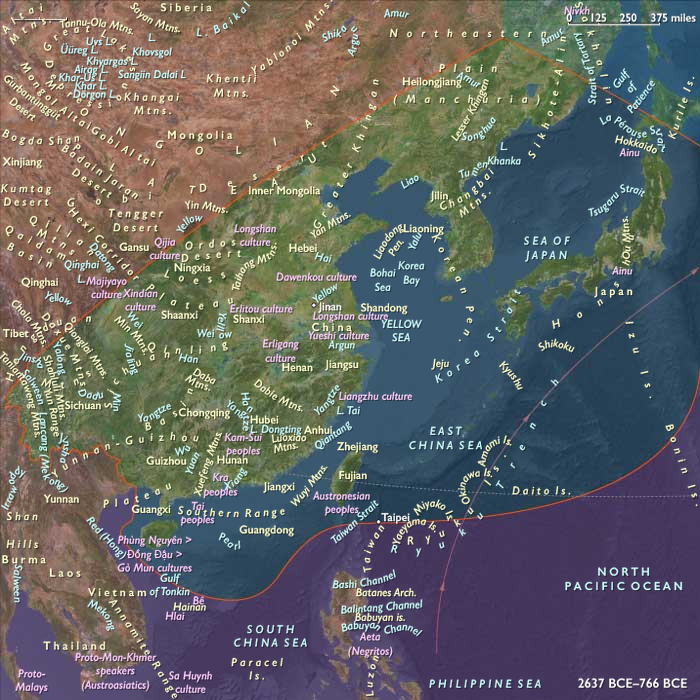
Between 2637 BCE and 2494 BCE, Maritime East Asia—comprising lower Primorsky Krai, the Korean Peninsula, the Japanese Archipelago below northern Hokkaido, Taiwan, and southern, central, and northeastern China—witnesses critical advancements, legendary foundations, and key cultural innovations that lay essential groundwork for later civilizations. This age is traditionally dominated by Chinese legendary figures, such as the celebrated Yellow Emperor (Huangdi), and marked by significant Neolithic cultural advances, notably the refined pottery of the Longshan Culture in China, the expansion of settled agriculture, early sericulture, developments in divination practices, and intricate Jōmon pottery traditions in Japan.
Legendary Reign of the Yellow Emperor (Huangdi)
The era is strongly influenced by the legendary reign of the Yellow Emperor (Huangdi), regarded by Chinese tradition as the first of the "Five Emperors." According to historian Sima Qian (writing much later in the Shiji), Huangdi rules from 2697 BCE until his death in 2598 BCE, initiating profound cultural and technological transformations. He is traditionally credited with essential inventions, including the principles of traditional Chinese medicine, significantly influencing subsequent Chinese medical practices and theories.
Under his legendary administration, Huangdi’s young wife, Xilingji, traditionally receives credit for the discovery and refinement of silk culture—or sericulture—around the third millennium BCE. Early silk production, involving domesticated silkworms (Bombyx mori), initially operates on a small, closely guarded scale, laying the foundations for what becomes one of China's most enduring and coveted secrets.
Additionally, legend attributes to Cangjie, a bureaucrat serving under Huangdi, the invention of the first Chinese characters (zì) around 2650 BCE. Inspired by observing the vein patterns on a tortoise at Mount Yangxu (modern Shanxi Province), Cangjie supposedly develops an intricate symbolic writing system based on nature’s patterns. Tradition dramatically states that this event was so transformative that demons mourned and grains fell like rain, symbolizing the dawn of civilization itself.
Longshan Culture: Pottery, Urbanization, and Agriculture
Simultaneously, during the late Chinese Neolithic, the prosperous Longshan Culture emerges along the central and lower Yellow River (Huang He), with origins traced back to around 3000 BCE and continuing prominently through this period. Named after the archaeological site at Longshan, Shandong Province, the culture is renowned for its highly polished, thin-walled black pottery (often termed "egg-shell pottery"), characterized by wheel-turned production methods that represent a significant technological advancement from earlier Yangshao ceramics.
Longshan pottery, used extensively for rituals and burials, signifies increasing sophistication in craft specialization and cultural expression. Remarkably, this pottery tradition expands widely across regions, reaching the Yangzi River valley and even the southeastern coastal areas, illustrating a broadening cultural exchange and migration within ancient China.
Longshan settlements evolve significantly during this period, demonstrating early urban characteristics, including fortified cities enclosed by substantial rammed-earth walls and moats. Notably, the site at Taosi, located in today's Shanxi Province, emerges as the largest walled Longshan settlement, exemplifying the nascent urbanization process.
Expansion of Agricultural Practices
Agricultural practices become increasingly sophisticated and widespread, with permanent farming settlements expanding extensively into the eastern plains of China, Manchuria, and southern regions. By this age, rice cultivation is securely established, particularly in the Yangzi River basin, ensuring long-term demographic growth, economic stability, and cultural continuity across Lower East Asia.
Early Chinese Divination Practices
In conjunction with cultural and agricultural innovations, archaeological evidence from this era suggests the practice of early forms of divination in China. These ritual practices involve interpreting crack patterns formed in heated cattle bones—methods that later evolve into sophisticated oracle bone inscriptions central to Chinese divination and early historical record-keeping.
Japan: Middle Jōmon Cultural Flourishing
Meanwhile, in southern Japan (south of an imaginary line from modern Hokkaido through northern Honshu), the Middle Jōmon period (approximately 3000 BCE onward) sees a remarkable demographic expansion, evidenced by numerous archaeological sites. Potters in central Japan produce elaborately decorated and sculptural pottery, distinctively differing from earlier, simpler conical and cylindrical ceramics of northern Japan.
This period is especially notable for the manufacture of intricate clay figurines (dogū), likely associated with fertility and funerary rituals, reflecting early spiritual and social practices. The distinct regional pottery styles underscore Japan's early cultural diversity and sophisticated artisanal traditions, laying foundations for subsequent Jōmon cultural developments.
Legacy of the Age: Cultural Foundations and Technological Innovations
Thus, the age 2637–2494 BCE profoundly shapes the foundational cultural landscape of Maritime East Asia. Legendary Chinese rulers and heroes symbolize essential cultural and technological advances, notably traditional medicine, silk production, and early writing systems. Simultaneously, significant pottery innovations and the early steps toward urbanization mark the Longshan period in China, while the Jōmon pottery tradition flourishes in Japan, indicating complex cultural and social dynamics.
These developments together establish enduring cultural, technological, and societal frameworks, fundamentally influencing subsequent historical trajectories across Lower East Asia into the ensuing ages.
People
Groups
Topics
Commodoties
Subjects
Regions
Subregions
Related Events
Showing 10 events out of 68553 total
Years: 2637BCE - 2494BCE
People
Groups
Topics
Commodoties
Subjects
Regions
Subregions