
Iberians were the first historical inhabitants in …
Years: 785 - 785
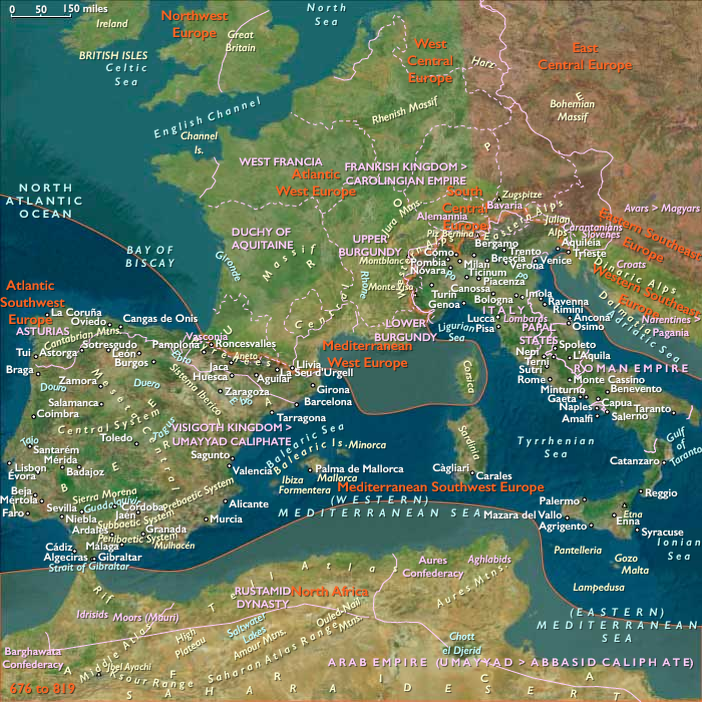
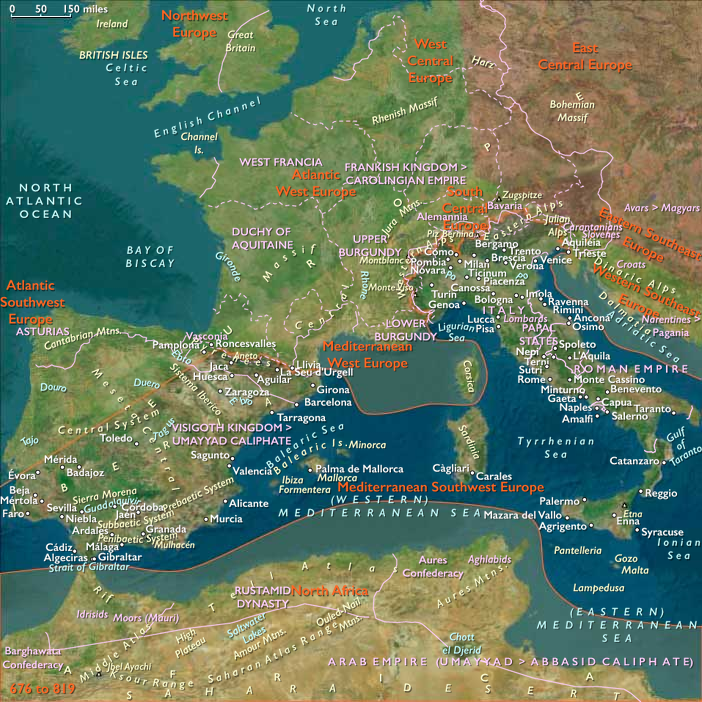
Iberians were the first historical inhabitants in the region of present Girona, at at the confluence of the rivers Ter, Onyar, Galligants, and Güell; Girona is the ancient Gerunda, a city of the Ausetani.
The Romans later built a citadel there, which was given the name of Gerunda.
The Visigoths ruled in Girona until it was conquered by the Moors.
Finally, Charles of the Franks reconquers it in 785 and makes it one of the fourteen original countships of Catalonia.
Locations
People
Groups
Topics
Commodoties
Subjects
Regions
Subregions
Related Events
Filter results
Showing 10 events out of 55006 total
A successful paddlewheel warship design is made in China by Prince Li Gao in 784, during an imperial examination of the provinces by the Tang Dynasty emperor, Dezong.
The teenaged Harun, second son of Calph al-Mahdi, had been nominal leader of expeditions against Constantinople in 780 and 782, although there is no doubt that the experienced generals accompanying him made the military decisions.
The expedition of 782 had reached the Bosporus, opposite Constantinople, and peace had been concluded on terms favorable to the Muslims.
For this success, Harun had received the honorific title of ar-Rashid, “the one following the right path”, and had been named second in succession to the throne and appointed governor of Tunisia, Egypt, Syria, Armenia, and Azerbaijan, with his tutor Yahya acting as actual administrator.
His mother is al-Khayzuran, a formerly enslaved Yemeni, and a woman of strong personality who greatly influences affairs of state in the reigns of her husband and will continue to do so in the reign of hers sons.
Al-Khayzuran an Yahya presumably the engineers behind these moves, are even said to have induced al-Mahdi to make Harun his immediate successor, but al-Mahdi, poisoned by one of his concubines, dies in August 785 without officially changing the succession.
Al-Hadi, the eldest son of Al-Mahdi and al-Khayzuran, becomes caliph and Harun acquiesces.
Al-Hadi is, like his father, very open to the people of his empire and allows citizens to visit him in the palace at Baghdad to address him.
As such, he is considered an "enlightened ruler", and continues the progressive moves of his Abbasid predecessors.
Widukind’s Surrender and the End of the Saxon Uprising (782–785)
Between 782 and 784, battles between the Saxons and the Franks occurred annually as Widukind, the Saxon leader, waged guerrilla warfare against Charlemagne’s forces. Seeking further support, Widukind allied himself with the Frisians, but despite this, Charlemagne’s relentless winter campaigns of 784–785 forced the Saxon and Frisian resistance back into their homelands.
Widukind’s Surrender and Baptism (785)
By 785, realizing that Saxon resistance was becoming untenable, Widukind agrees to surrender in the Bardengauunder the condition that he and his allies would suffer no bodily harm. He and his leading Saxon nobles accept baptism, possibly in Attigny, with Charlemagne himself serving as Widukind’s godfather.
This symbolic act of submission not only marked the end of active Saxon resistance but also served as a formal acknowledgment of Saxon noble status under Frankish rule. Through this agreement, Widukind effectively integrated Saxony into the Carolingian Empire, as conversion to Christianity was a key condition for Frankish acceptance of conquered elites.
Widukind’s Fate: Prison, Administration, or Further Campaigns?
No contemporary sources record Widukind’s life or death after his baptism, leading to various interpretations:
- Monastic Imprisonment – Many deposed rulers under Charlemagne were sent to monasteries, and it has been suggested that Widukind may have been confined at Reichenau Abbey or another Frankish monastery.
- Administrative Role – Some historians speculate that he may have been granted a role in the governance of occupied Saxony, similar to other noble converts.
- Military Service – The Vita Liudgeri, a biography of Saint Ludger, mentions Widukind accompanying Charlemagne on a campaign against the Veleti, indicating he may have continued in a military capacity under Frankish rule.
- Assassination – A later 12th-century account in the Kaiserchronik states that Widukind was slain by Charlemagne’s brother-in-law, Gerold of Baar (d. 799), though this claim is not corroborated by earlier sources.
Legacy of Widukind
Although Widukind disappears from historical records, his symbolic resistance to Frankish conquest made him a legendary figure in later German history. His submission and baptism marked the final consolidation of Saxonyinto Charlemagne’s empire, completing the Frankish-Christian expansion into northern Germany. Over time, Widukind’s memory evolved into myth, with later medieval chroniclers elevating him to a heroic defender of Saxon independence.
Empress Irene favors the restoration of the use, in religious devotion, of pictorial representation of saints or of the Trinity, prohibited by imperial decree since 730.
In 784, the imperial secretary Patriarch Tarasius, on of Irene’s supporters, had been appointed successor to the Patriarch Paul IV—he had accepted on the condition that intercommunion with the other churches should be reestablished; that is, that the images should be restored.
However, a council, claiming to be ecumenical, had abolished the veneration of icons, so psychologically another ecumenical council is necessary for its restoration, to rule on the use.
Pope Adrian I, who had been invited to participate, had gladly accepted.
However, the invitation intended for the oriental patriarchs could not even be delivered to them.
The Roman legates were an archbishop and an abbot, both named Peter.
In 786, the council meets in the Church of the Holy Apostles in Constantinople.
However, soldiers in collusion with the opposition enter the church, and break up the assembly.
As a result, the government resorts to a stratagem.
Under the pretext of a campaign, the iconoclastic bodyguard is sent away from the capital—disarmed and disbanded.
Al-Hadi's persecution of the 'Alids precipitates revolts in Medina, Egypt, and Iraq, all of which are put down brutally.
The revolt of Husayn ibn Ali ibn Hasan broke out when Husayn declared himself caliph in Medina.
Al-Hadi had crushed the rebellion and killed Husayn and many of his followers, but Idris bin Abdallah, a cousin of Husayn, had escaped to reach Morocco, where some years later he will found the Idrisi state.
Al-Hadi also crushes a Kharijite rebellion as well as faces an invasion by the forces of Constantinople.
However, the imperial forces are turned back.
Throughout his short reign, he has struggled with the question of succession, attempting to annul the rights of his brother.
Yahya has dissuaded the Caliph several times from proclaiming his own son as heir instead of Harun.
He eventually does so, and jails Yahya.
Al-Hadi moves his capital from Baghdad to …
…Haditha shortly before his mysterious death in September 786, which may have been a murder.
Al-Tabari notes varying accounts of this death, e.g.
an abdominal ulcer or assassination.
Rumor suggests that al-Khayzuran was behind al-Hadi's death, because he had resisted her domination.
Al-Tabari (v. 30 p. 42f) notes al-Hadi's assertion of independence from his mother, his forbidding her further involvement in public affairs and his threatening the succession of his younger brother, who is at first imprisoned and soon is released to assume the caliphate.
Harun ar-Rashid thus becomes caliph on September 14, 786, succeeding to the rule of an empire reaching from the western Mediterranean to India.
He makes Yahya his vizier, or chief minister.
With Yahya are associated his sons al-Fa'l and Ja'far, for the vizier at this period is not only an initiator of policy but also has attached to himself a corps of administrators to carry out his decisions.
Al-Khayzuran will have a considerable influence over the government until her death in 789.
The Caliphate's forces have undertaken regular, almost annual raids into imperially held Asia Minor since the failure of the last Arab attempt to conquer the imperil capital Constantinople.
In 782, a major invasion, led by the Abbasid heir apparent, the future Harun al-Rashid, had resulted in a humiliating settlement for the Empire, which had been forced to sue for a truce in exchange for an annual payment of one hundred and sixty thousand gold nomismata.
In 785, Empress-regent Irene had resolved to cease the payment of the tribute, and warfare had recommenced.
The Arabs raided the Armeniac Theme, but in early 786, the Empire retaliated by sacking and razing to the ground the fortress town of Hadath in Cilicia, which the Abbasids had spent the last five years turning into a major stronghold and military base for their cross-border expeditions.
The construction of the Prayer Hall of the Great Mosque of Córdoba begins in 785-786.
Beatus of Liébana: Scholar, Theologian, and Symbol of Christian Resistance
Beatus of Liébana is best remembered for his Commentary on the Apocalypse, originally written in 776 CE and later revised in 784 and again in 786. Though not highly original, the work serves as a Christian cultural and religious focal point, compiling long extracts from the Fathers and Doctors of the Church, particularly:
- Augustine of Hippo,
- Ambrose of Milan,
- Tyconius,
- Irenaeus of Lyon, and
- Isidore of Seville.
Additionally, Beatus incorporates Jerome of Stridon’s commentary on the Book of Daniel, further enriching his theological synthesis.
Theological Influence and the Adoptionist Controversy
Beatus corresponds with Alcuin of York and plays a prominent role in the Adoptionist controversy, opposing the views of Felix of Urgel and Elipandus of Toledo, who argue that Christ was the adoptive son of God in his human nature. His staunch Nicene orthodoxy reinforces Asturian resistance to theological influences from Muslim-controlled Toledo.
As confessor to Queen Adosinda, wife of King Silo of Asturias, and as the teacher of Alcuin and Etherius of Osma, Beatus holds considerable influence in the Christian intellectual world.
Beatus’s Legacy and Symbolism
Over time, his Commentary on the Apocalypse becomes a symbol of Christian resistance against the Muslim Arabs who dominate much of Iberia during the early Middle Ages. The Beatus manuscripts, with their illuminated illustrations, will later be reproduced across medieval Europe, preserving and spreading the apocalyptic vision of Christian triumph over Islam and heresy.
Charles conquers Bavaria in 787-88, absorbing the duchy in 788.
