
The first dry crossing of Venice’s Grand …
Years: 1591 - 1591
The first dry crossing of Venice’s Grand Canal had been a pontoon bridge built in 1181 by Nicolò Barattieri and called the Ponte della Moneta, presumably because of the mint that stood near its eastern entrance.
The development and importance of the Rialto market on the eastern bank had increased traffic on the floating bridge, so it was replaced in 1255 by a wooden bridge.
This structure had two inclined ramps meeting at a movable central section, that could be raised to allow the passage of tall ships.
The connection with the market eventually led to a change of name for the bridge.
Two rows of shops had been built during the first half of the fifteenth century along the sides of the bridge.
The rents bring an income to the State Treasury, which helps maintain the bridge.
Maintenance was vital for the timber bridge, which had partly burnt in the revolt led by Bajamonte Tiepolo in 1310.
It had collapsed in 1444 under the weight of a crowd watching a boat parade and it again in 1524.
The idea of rebuilding the bridge in stone had been first proposed in 1503, with several projects considered over the following decades: the authorities had in 1551 requested proposals for the renewal of the Rialto Bridge, among other things.
Plans were offered by famous architects such as Jacopo Sansovino, Palladio and Vignola, but all involved a Classical approach with several arches, which was judged inappropriate to the situation.
Even the great Michelangelo was considered as designer of the bridge.
Antonio da Ponte wins a competition in 1587 for a design for a permanent bridge over the Grand Canal at the busy Rialto.
The earlier works of the Venetian architect-engineer are entirely unknown to us, though he has undoubtedly been the builder of many previous structures.
His broad, single-arch span, covered with arcaded shops, at once becomes one of the city's foremost monuments, renowned as an architectural and engineering achievement of the Renaissance.
Finally completed in 1591, it is remarkably similar to the wooden bridge it succeeded: two inclined ramps lead up to a central portico, and on either side of the portico the covered ramps carry rows of shops.
In the construction of this work Antonio is helped by his nephew Antonio Contino, who will also later design the famous Bridge of Sighs (Ponte dei Sospiri).
The engineering of the bridge is considered so audacious that architect Vincenzo Scamozzi predicts future ruin.
The bridge, the oldest of the four bridges spanning the Grand Canal, has defied its critics to become one of the architectural icons of Venice.
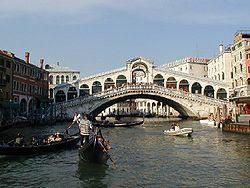
The Rialto Bridge (Photo by Warofdreams, 2004)
Locations
People
Groups
Topics
Subjects
Regions
Subregions
Related Events
Showing 10 events out of 34418 total
Years: 1591 - 1591
The Rialto Bridge (Photo by Warofdreams, 2004)
Locations
People
Groups
Topics
Subjects
Regions
Subregions