
The first account of Jews in England, …
Years: 691 - 691
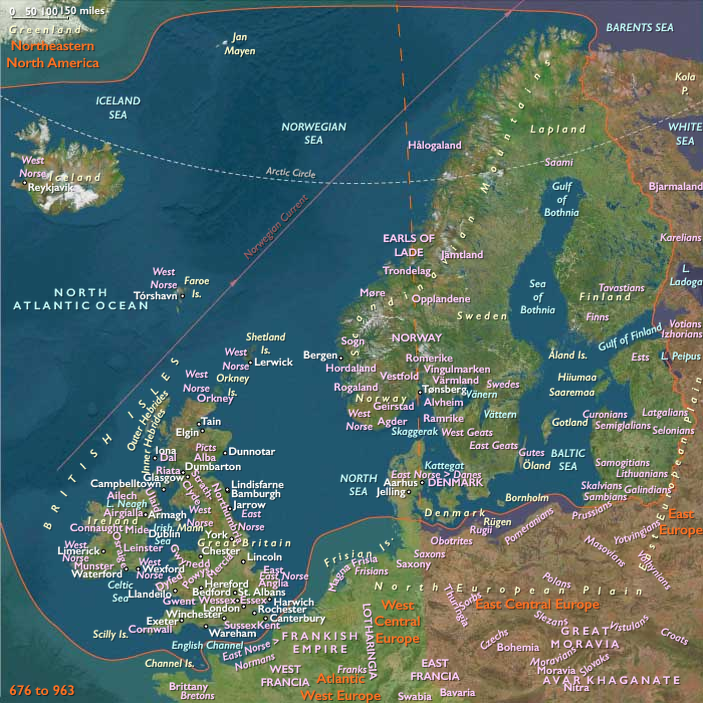
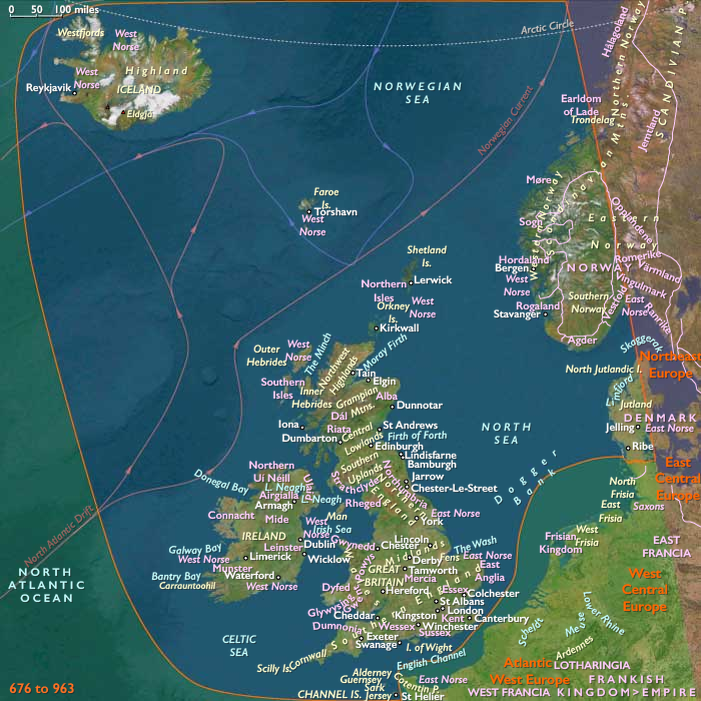
The first account of Jews in England, mostly traders from northern France, appears in 691 (although some may have come to England with the Romans, reports indicate no permanent Jewish settlement prior to the eleventh century).
Locations
People
Groups
- Jews
- Anglo-Saxons
- Christianity, Chalcedonian
- Kent, Kingdom of
- Sussex, Kingdom of
- Wessex, English Kingdom of
- Mercia, Kingdom of
- Essex, Kingdom of
- Britain, Medieval
- Northumbria, Kingdom of
- Francia (mayors of the palaces of Austrasia and Neustria)
Topics
Subjects
Regions
Subregions
Related Events
Filter results
Showing 10 events out of 55939 total
Wu Zetian, shortly after taking the throne, had elevated the status of Buddhism to be above Taoism, officially sanctioning the religion by building temples named Dayun Temple in each prefecture belonging to the capital regions of the two capitals Luoyang and Chang'an, and also created nine senior monks dukes.
She also enshrines seven generations of Wu ancestors at the imperial ancestral temple, although she also continues to offer sacrifices to the Tang emperors Gaozu, Taizong, and Gaozong.
She faces the issue of succession.
At the time she took the throne, she had created Li Dan, the former Emperor Ruizong, crown prince, and bestowed the name of Wu on him.
However, the official Zhang Jiafu had instigated the commoner Wang Qingzhi into starting a petition drive to make her nephew Wu Chengsi crown prince, arguing that an emperor named Wu should pass the throne to a member of the Wu clan.
Wu Zetian is tempted to do so, and when the chancellors Cen Changqian and Ge Fuyuan oppose strongly, they, along with fellow chancellor Ouyang Tong, are executed.
Nevertheless, she declines Wang's request to make Wu Chengsi crown prince, but for a time allows Wang to freely enter the palace to see her.
On one occasion, however, when Wang angers her by coming to the palace too much, she asks the official Li Zhaode to batter Wang—and Li Zhaode takes the opportunity to batter Wang to death, and his group of petitioners scatters.
Li Zhaode then persuades Wu Zetian to keep Li Dan as crown prince—pointing out that a son is closer in relations than a nephew, and also that if Wu Chengsi became emperor, Emperor Gaozong would never again be worshiped.
Wu Zetian agrees, and for some time will not again consider the matter.
Further, at Li Zhaode's warning that Wu Chengsi is becoming too powerful, Wu Zetian strips Wu Chengsi of his chancellor authority and bestows on him largely honorific titles without actual authority.
Abd al-Malik is finally able to face Mus'ab only after the defeat of the northern Arab tribes in 691.
The decisive battle takes place at Dayr al-Ja Thaliq.
The forces of Mus'ab are weakened by their wars against the Kharijites, and 'Abd al-Malik bribes many of them to desert Mus'ab, who is then killed in battle.
The whole of Iraq now falls into his hands.
Subsequent Paulician leaders imitate the duality of names.
Symeon, the leader of the imperial force sent against the Paulicians in 685, had become a convert to Paulicianism, and has taken as his second name that of Saint Titus, a disciple of St. Paul, for whom he was secretary.
Symeon-Titus is himself martyred, burned alive in 690 when Emperor Justinian sends a second imperial expedition to suppress the heresy.
Palestine under the Umayyads, forms, with Syria, one of the main provinces of the empire.
An emir assisted by a financial officer administers each jund. (This pattern will continue, in general, up to the time of Ottoman rule.)
The Umayyads for various reasons pay special attention to Palestine, where the process of Arabization and Islamization is gaining momentum.
It is one of the mainstays of Umayyad power and important in their struggle against both Iraq and the Arabian Peninsula.
Caliph 'Abd al-Malik between 685 and 691 has erected a magnificent mosque (eventually known as the Dome of the Rock) on the site of the destroyed great Temple of Jerusalem, which is also the alleged nocturnal resting place of the Prophet Muhammad on his nocturnal journey to heaven.
Constructed not as a mosque for public worship but rather as a mashhad, a shrine for pilgrims, it is virtually the first monumental building in Islamic history (and the earliest Muslim monument still extant.)
The Church of San Pedro de la Nave: A Lasting Legacy of Visigothic Architecture
In 691 CE, during the reign of King Egica, construction begins on the Church of San Pedro de la Nave, one of the last major works of Visigothic architecture.
Located in Campillo, Zamora, on the banks of the Esla River, the church's original design follows a Roman cross plan, reflecting late Visigothic architectural traditions.
San Pedro de la Nave stands as a testament to the enduring artistic and religious heritage of the Visigothic kingdom, even as its political power wanes in the face of the coming Islamic conquest.
Wilfrid has spent the past few years in Selsey, where he has founded an episcopal see and converted the pagan inhabitants of the Kingdom of Sussex to Christianity.
Theodore and Wilfrid have settled their differences, and Theodore has urged the new Northumbrian king, Aldfrith, to allow Wilfrid's return.
Aldfrith had agreed to do so, but in 691 he expels Wilfrid again.
Wilfrid goes to Mercia, where he helps missionaries and acts as bishop for the Mercian king.
Wu Zetian has Crown Princess Liu and Consort Dou killed after Wu Zetian's trusted lady in waiting Wei Tuan'er, who hates Li Dan (the reason why she did so is lost to history), falsely accuses Li Dan's wife Crown Princess Liu and Consort Dou of using witchcraft in 693.
Li Dan, fearful that he is to be next, does not dare to speak of them.
When Wei further plans to falsely accuse Li Dan, however, someone else informs on her, and she is executed.
Wu Zetian nevertheless has Li Dan's sons demoted in their princely titles, and when the officials Pei Feigong and Fan Yunxian are accused of secretly meeting Li Dan, she executes Pei and Fan and further bars officials from meeting Li Dan.
There follow accusations that Li Dan is plotting treason, and under Wu Zetian's direction, Lai launches an investigation.
Lai arrests Li Dan's servants and tortures them—and the torture is such that many of them are ready to falsely implicate themselves and Li Dan.
One of Li Dan's servants, An Jinzang, however, proclaim Li Dan's innocence and cuts his own belly open to swear to that fact.
When Wu Zetian hears of what An did, she has doctors attend to An and barely saves his life, then orders Lai to end the investigation, thus saving Li Dan.
Emperor Taizong of Tang in 640 had launched a campaign against the Western Regions and the Kingdom of Khotan had submitted to the Tang emperor.
The Four Garrisons of Anxi had been established, one of them at Khotan.
The Tibetans had subsequently defeated the Chinese and had taken control of the Four Garrisons, and the Khotanese had helped the Tibetans to conquer Aksu.
Tang China under Empress Wu in 692 regains control.
Khotan is made a protectorate.
The Emperor's bloody persecution of the Manichaeans and suppression of popular traditions of non-Orthodox origin has meanwhile caused dissension within the Church.
In 692, Justinian convenes the so-called Quinisext Council at Constantinople to to issue disciplinary decrees related to the second and third councils of Constantinople (held in 553 and 680-681).
Also called the Council in Trullo (after the palace hall in Constantinople where it meets), the Council expands and clarifies the rulings of the Fifth and Sixth ecumenical councils (hence the name Quinisext), but by highlighting differences between the Eastern and Western observances (such as the marriage of priests and the Roman practice of fasting on Saturdays), the council compromises imperial relations with the Roman Church.
The two ecumenical councils had dealt only with doctrinal matters.
The Quinisext Council, which officially accepts as normative the decretal letters of twelve Fathers of the Church, prepares 102 canons, many of which are directed against Western Church customs and legislation.
In collections called “Nomocanons,” the council also includes, with canons of councils, imperial laws having to do with church affairs.
The Western Church and the Pope are not represented at the council.
Justinian, however, wants the Pope as well as the Eastern bishops to sign the canons.
The emperor orders Pope Sergius I arrested, but the militias of Rome and Ravenna rebel and take the Pope's side.
The Quinisext Council lays the foundation for Orthodox Canon Law, but the canons will never be fully accepted by the Western Church.
Justinian, emboldened by the increase of his forces in Asia Minor, now renews the war against the Arabs, provoking them into attacking the eastern frontier over a disagreement concerning Cypriot policy.
The Umayyad army is led by Muhammad ibn Marwan, brother of the Caliph, and included the minister of defense, the famously known Al-Hajjaj ibn Yusuf.
The imperial forcers are led by Leontios and include a "special army" of thirty thousand resettled Slavs under their leader Neboulos.
Justinian’s new troops help him to win a battle against the Caliphate in Armenia in 691, but they are soon bribed to revolt by the Arabs.
The Umayyads, incensed at the breaking of the treaty, use copies of its texts in the place of a flag.
Although the battle seems to be tilting to the imperial advantage, the defection of upwards of twenty thousand Slavs ensures a Roman defeat.
Years: 691 - 691
Locations
People
Groups
- Jews
- Anglo-Saxons
- Christianity, Chalcedonian
- Kent, Kingdom of
- Sussex, Kingdom of
- Wessex, English Kingdom of
- Mercia, Kingdom of
- Essex, Kingdom of
- Britain, Medieval
- Northumbria, Kingdom of
- Francia (mayors of the palaces of Austrasia and Neustria)
