
The "fiorino d'oro" of the …
Years: 1300 - 1300
The "fiorino d'oro" of the Republic of Florence is the first European gold coin struck in sufficient quantities to play a significant commercial role since the seventh century.
As many Florentine banks are international supercompanies with branches across Europe, the florin quickly has by 1300 become the dominant trade coin of Western Europe for large scale transactions, replacing silver bars in multiples of the mark (a weight unit equal to eight ounces).
Locations
Groups
Commodoties
Subjects
Regions
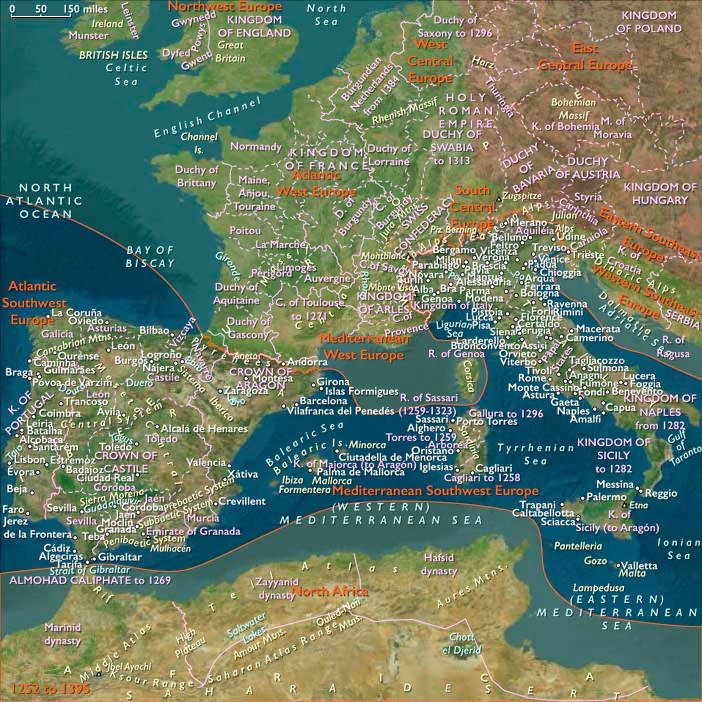
Subregions
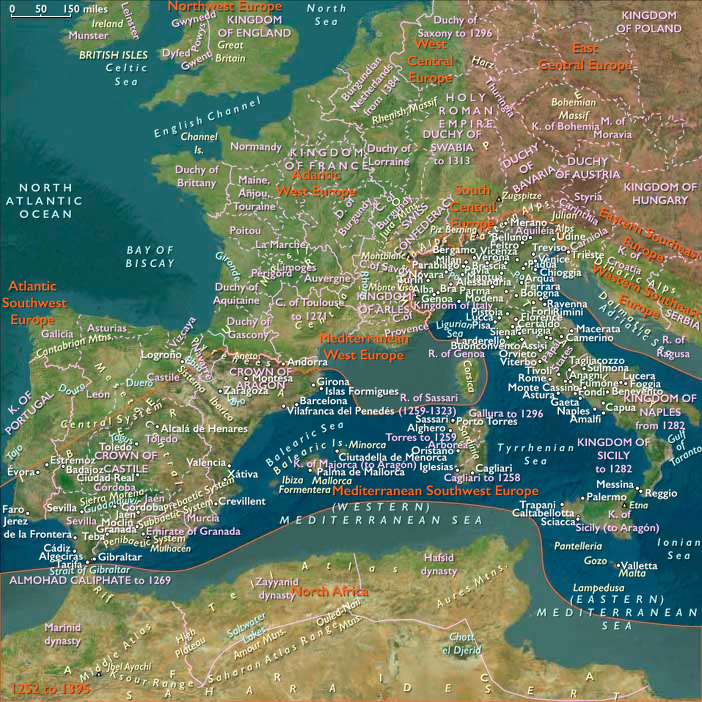
Related Events
Filter results
Showing 10 events out of 45143 total
The millennia-long eastward migration of the oceanic Austronesian speakers ends in about 1300 with the arrival of the Maoris in New Zealand.
Archaeological and linguistic evidence (Sutton 1994) suggests that several waves of migration have come from Eastern Polynesia to New Zealand between 800 and 1300.
Māori oral history describes the arrival of ancestors from Hawaiki (a mythical homeland in tropical Polynesia) in large oceangoing canoes.
Migration accounts vary among tribes (iwi), whose members may identify with several waka in their genealogies or whakapapa.
No credible evidence exists of human settlement in New Zealand prior to the Polynesian voyagers; on the other hand, compelling evidence from archaeology, linguistics, and physical anthropology indicates that the first settlers came from East Polynesia and became the Māori.
The Māori have come to New Zealand as Eastern Polynesians voyaging, most likely, from the area of the Cook Islands or from the Society Islands, in seagoing canoes—possibly double-hulled and probably sail-rigged.
These Polynesian settlers probably arrive no later than about 1300.
The fierce, belligerent Tangata Whenua, “people of the land” (the so-called Classic Maori) establish fortified villages, engage in internecine warfare and practice cannibalism.
The Mongol invasions of the late thirteenth century had been a drain on Japan’s economy, and new taxes had had to be levied to maintain defensive preparations for the future.
The invasions had also caused disaffection among those who expected recompense for their help in defeating the Mongols.
There were no lands or other rewards to be given, however, and such disaffection, combined with overextension and the increasing defense costs, has led to a decline of the Kamakura bakufu.
Additionally, inheritances have divided family properties, and landowners increasingly have to turn to moneylenders for support.
Roving bands of ronin further threaten the stability of the shogunate.
The dominant Hōjō clan that controls the shogunate has reacted to the ensuing chaos by trying to place more power among the various great family clans.
To further weaken the Kyoto court, the bakufu has decided to allow two contending imperial lines—known as the Southern Court or junior line and the Northern Court or senior line—to alternate on the throne.
The Introduction of the Compass and Rudder in Europe: Transforming Ocean Navigation
The adoption of the magnetic compass and the stern-mounted rudder in medieval Europe revolutionized oceanic transportation, significantly enhancing navigation, ship maneuverability, and long-distance maritime trade.
The Magnetic Compass: A Breakthrough in Navigation
- The magnetic compass was introduced to Europe from China, likely via the Arab world or through direct contact during the Crusades.
- By the late 12th and early 13th centuries, European sailors had adapted the compass for maritime use, allowing for accurate open-sea navigation even when the sun and stars were obscured.
- The compass allowed for:
- More reliable route planning across the Atlantic and Mediterranean.
- Longer voyages beyond coastal waters.
- The expansion of trade networks, enabling direct maritime routes between Europe, Africa, and Asia.
The Stern-Post Rudder: Enhancing Ship Maneuverability
- The stern-mounted rudder replaced earlier side-mounted steering oars, which had limited control in rough seas.
- Likely introduced from China via the Islamic world, the stern rudder appeared in European ship designs by the 12th century and became widespread by the 13th–14th centuries.
- It enabled:
- Better steering in deep waters, making ships more stable in open seas.
- Larger vessels, such as carracks and caravels, which became the backbone of European exploration and trade.
- Greater efficiency in navigation, allowing ships to handle strong ocean currents and winds more effectively.
Impact on European Maritime Expansion
The combination of the compass and stern rudder laid the technological foundation for:
- The rise of European naval powers, particularly Portugal and Spain, in the Age of Exploration.
- More precise cartography and improved sea routes, increasing trade with Africa, the Middle East, and Asia.
- The ability to undertake longer transoceanic voyages, eventually leading to the discovery of new lands and the establishment of global trade networks.
Thus, these innovations transformed medieval European seafaring, making oceanic travel more efficient, safer, and strategically viable, setting the stage for the maritime dominance of Europe in the centuries to come.
East Europe (1300–1311 CE): Muscovite Growth and Ethnic Diversification
Political and Military Developments
Ongoing Dominance of the Golden Horde
Between 1300 and 1311 CE, the Golden Horde maintained its authority over East Europe through established tribute relationships, relying on local principalities for governance. This stable, albeit rigid, political framework defined regional politics.
Muscovite Territorial Expansion
Moscow continued to strengthen its political and territorial presence, consolidating control over neighboring lands and strategically positioning itself as the primary intermediary with the Mongols. Moscow's growth influenced regional power dynamics significantly.
Emergence and Integration of Ethnic Communities
This era saw increasing interactions and integration among diverse ethnic groups such as the Mordvins, Mari peoples, Udmurts, Vepsians, and Komi peoples. These communities, residing primarily in northern and eastern territories, began to integrate more significantly into the Rus' political and economic spheres.
Economic and Technological Developments
Sustained Eurasian Trade Networks
Trade between East Europe, Central Asia, and the Middle East continued robustly, reinforcing economic stability. Cities, particularly Moscow and Novgorod, profited substantially from commerce involving luxury goods, furs, honey, and wax.
Military Innovations and Adaptations
East European principalities, particularly Moscow, enhanced their military capabilities through further adoption of Mongol tactics and technologies. These innovations strengthened their strategic defenses and offensive capacities.
Cultural and Artistic Developments
Deepening Cultural Interaction and Synthesis
Cultural exchanges between Mongol rulers and diverse local ethnic groups intensified, fostering unique artistic traditions. The integration of ethnic communities such as the Mordvins, Mari, and Komi into broader Rus' culture enriched artistic and architectural styles.
Continued Literary Flourishing
Literary and historical writings continued, focusing on chronicling regional histories, genealogies, and cultural narratives. These intellectual pursuits supported cultural identity preservation amidst external political dominance.
Settlement Patterns and Urban Development
Urban Expansion and Economic Stability
Cities like Moscow, Novgorod, and regional centers associated with ethnic groups expanded economically and demographically. Trade prosperity fostered urban development and population growth, significantly shaping regional settlement patterns.
Fortifications and Defensive Infrastructure
Cities reinforced and expanded fortifications, responding proactively to regional tensions and potential threats. Defensive infrastructure became critical in maintaining economic and political stability.
Social and Religious Developments
Ethnic Diversity and Social Integration
Increasing interactions among Rus', Mordvin, Mari, Komi, Udmurt, and Vepsian communities led to diverse social structures, incorporating various ethnic groups into broader political and social frameworks.
Orthodox Church and Multicultural Dynamics
The Orthodox Church remained a critical cultural and social institution, facilitating integration and cohesion among diverse communities. However, local ethnic traditions and beliefs also persisted, resulting in complex religious and social dynamics.
Long-Term Consequences and Historical Significance
The era from 1300 to 1311 CE was significant for Muscovite territorial consolidation, increased ethnic integration, and sustained economic prosperity under Mongol oversight. These developments laid essential groundwork for future political centralization and cultural diversity in East Europe.
Northeast Europe (1300–1311 CE): Stabilization of Crusader Authority, Lithuanian Resistance, and Cultural Transformation
Introduction
Between 1300 and 1311 CE, Northeast Europe entered a period marked by the stabilization and cultural consolidation of crusader territories, robust resistance from the emerging Lithuanian state, and ongoing Swedish expansion in Finland. This era solidified Germanic dominance in formerly Baltic lands, particularly in Prussia, profoundly reshaping the region's political and cultural landscape.
Final Consolidation of Teutonic Rule in Prussia
With the final suppression of the last significant Prussian uprisings at the close of the previous century, the Teutonic Knights successfully established lasting control over Prussia, turning it decisively into a German-speaking territory. Waves of settlers from various German states, along with other European migrants, arrived, permanently altering the region's demographic and cultural character. By 1311, Prussia had effectively completed its transition into a thoroughly Germanized territory, deeply embedded within the broader Germanic cultural sphere.
Stability in Danish Estonia and Livonian Confederation
The Danish administration of Estonia, centered on Reval (Tallinn) and anchored by the fortress Castrum Danorum atop Toompea Hill, continued to thrive economically and politically. Danish rule provided relative peace, enabling urban prosperity and the steady growth of trade networks.
Simultaneously, the German-dominated Livonian Confederation, governed from Riga, further strengthened its administrative structures, achieving a stable political environment. Economic development accelerated as Riga emerged as a prominent commercial center, solidifying the confederation's influence over the Baltic region.
Continued Swedish Expansion into Finland
Sweden maintained its vigorous colonization and integration efforts in southern Finland, consolidating administrative control, developing fortified settlements, and expanding ecclesiastical networks. The deepening Swedish presence permanently differentiated Finland's cultural and political trajectory from the increasingly Germanized and Danish-influenced Baltic regions to the south.
Lithuanian Resistance and Regional Power
Throughout this period, Lithuania remained a major source of resistance against crusader expansion, demonstrating considerable military and political strength. Lithuanian leaders conducted frequent raids into Livonian and Prussian territories, asserting independence and vigorously resisting Christianization. Lithuania's growing power and continued defiance posed a significant strategic challenge, forcing crusader states into persistent defensive stances.
Economic Prosperity and Urbanization
Urban centers continued to flourish across crusader territories. Economic hubs such as Reval (Tallinn), Riga, and Königsberg expanded significantly, benefiting from increased trade and commerce. The maritime city of Visby on Gotland remained vital, reinforcing the region’s economic ties with broader European markets.
Ecclesiastical and Cultural Integration
The ecclesiastical authorities, especially the Teutonic Knights and associated monastic orders, played central roles in governing, educating, and culturally assimilating local populations. The establishment of German-language schools, ecclesiastical courts, and widespread churches further cemented Latin Christianity and Germanic cultural norms within conquered Baltic territories.
Regional Rivalries and Geopolitical Dynamics
Growing geopolitical tensions characterized this era, particularly along the borders of Lithuania and various Russian principalities. Crusader states increasingly faced threats from the well-organized Lithuanian forces and neighboring powers, resulting in fortified borders, defensive alliances, and heightened military preparedness.
Legacy of the Era
The years 1300–1311 CE significantly transformed Northeast Europe, finalizing the Germanization of Prussia, stabilizing crusader dominion, and solidifying the regional prominence of Lithuanian resistance. These developments permanently altered cultural identities, political boundaries, and regional dynamics, setting a framework that shaped the subsequent historical trajectory of Northeast Europe for generations to come.
East Central Europe (1300–1311 CE): Bohemian Expansion under Wenceslaus II, Hungarian Interregnum, Polish-Czech Realignment, and Strengthened Position of the Teutonic Order
Between 1300 and 1311 CE, East Central Europe—comprising modern-day Poland, Czechia, Slovakia, Hungary, and eastern parts of Germany and Austria east of 10°E and north of the defined southeastern boundary—experienced notable geopolitical realignments. This era witnessed the ambitious expansion of Bohemian power under Wenceslaus II Přemysl, significant instability in Hungary following the extinction of the Árpád dynasty, the continued political fragmentation of Poland tempered by Bohemian influence, the consolidation of the Teutonic Order’s State in Prussia, and sustained economic and cultural vitality in urban and ecclesiastical centers.
Political and Military Developments
Bohemian Dominance and Expansion under Wenceslaus II
-
Wenceslaus II (r. 1278–1305), King of Bohemia, significantly expanded his influence, assuming the crown of Poland in 1300. This event unified Bohemia and much of Poland (particularly Lesser Poland and Kraków) under Přemyslid rule, substantially shifting regional power balances.
-
Wenceslaus II effectively centralized administration, enhancing royal authority, and promoting stability and prosperity in Bohemia and his Polish territories.
Polish-Bohemian Realignment and Fragmentation
-
Despite Bohemian dominance under Wenceslaus II, Poland’s internal fragmentation persisted, especially among the powerful Silesian duchies, Mazovia, and Greater Poland, each maintaining significant autonomy.
-
Wenceslaus’s influence stabilized southern and central Polish lands briefly, yet regional rivalries and political divisions continued to limit long-term unity.
Hungarian Interregnum and Dynastic Crisis
-
The death of Hungary’s last Árpád king, Andrew III, in 1301, triggered a dynastic crisis and interregnum. Multiple contenders, including Charles Robert of Anjou, Otto of Bavaria, and Wenceslaus III of Bohemia, vied for the Hungarian throne, plunging the kingdom into deep political turmoil and prolonged instability.
-
Hungarian magnates capitalized on the crisis, further weakening royal authority and exacerbating internal divisions.
Rise and Consolidation of the Teutonic Order’s State in Prussia
-
During this period, the Teutonic Order further solidified its control over Prussia, aggressively expanding territorial claims against pagan Lithuanians and regional Baltic peoples. The Order strengthened fortifications, founded new settlements, and increased economic and military capabilities in the Baltic region, significantly shaping regional geopolitics.
Habsburg Stabilization in Austria
-
The House of Habsburg, under Albert I (r. 1282–1308), continued consolidating control of Austria, fortifying urban centers and integrating Austrian territories more deeply into imperial politics. Vienna further developed as a critical administrative, economic, and cultural center.
Economic and Technological Developments
Continued Economic Prosperity and Urban Expansion
-
Cities such as Prague, Vienna, Kraków, Wrocław, Nuremberg, Augsburg, Lübeck, Hamburg, Ulm, and Regensburg thrived economically, driven by extensive trade routes connecting the Baltic, Mediterranean, and Western European regions.
-
Urban growth intensified, accompanied by sophisticated city planning, improved infrastructure, and significant demographic expansion.
Technological and Agricultural Innovation
-
Agricultural advancements continued with increased utilization of the heavy plow, improved harness systems, three-field crop rotation, and systematic land cultivation. These innovations sustained demographic growth and urban prosperity.
Cultural and Artistic Developments
Flourishing Bohemian Court Culture under Wenceslaus II
-
Wenceslaus II’s court in Prague emerged as a significant cultural and artistic hub, supporting Gothic architecture, literature, manuscript illumination, and music, profoundly influencing regional cultural standards.
Cultural Vitality in Ecclesiastical Territories
-
Ecclesiastical polities such as the Archbishopric of Salzburg and influential bishoprics (notably Passau, Bamberg, Regensburg, and Kammin) actively patronized arts, literature, architecture, and education, enriching cultural life across East Central Europe.
Growth of Urban Cultural Life
-
Imperial Free Cities like Nuremberg, Augsburg, Lübeck, and Hamburg expanded cultural patronage, architectural projects, and educational institutions, contributing significantly to regional cultural and intellectual vibrancy.
Settlement and Urban Development
Bohemian and Austrian Urban Growth
-
Prague under Wenceslaus II and Vienna under Albert I underwent significant urban expansion, infrastructure improvements, and fortification enhancements, strengthening their political, economic, and cultural prominence.
Polish and Silesian Town Prosperity
-
Polish and Silesian cities such as Wrocław, Kraków, Legnica, and Poznań thrived economically and culturally, benefiting from vibrant trade networks, Germanic immigration (Ostsiedlung), and stable local governance.
Continued Germanic Settlement (Ostsiedlung)
-
German settlers continued transforming the demographic and economic landscapes of Silesia, Brandenburg, Mecklenburg, Lusatia, and Polish and Hungarian territories, reinforcing urban prosperity and agricultural productivity.
Social and Religious Developments
Noble Dominance and Aristocratic Power
-
Powerful aristocratic factions significantly shaped regional politics, especially evident in Hungary’s interregnum crisis and Polish internal divisions. Noble authority limited centralized royal governance, influencing political stability and societal organization.
Increasing Influence of Ecclesiastical Institutions
-
Ecclesiastical institutions such as the Archbishopric of Salzburg and influential bishoprics like Passau, Bamberg, Kammin, and Regensburg continued expanding their social influence, strengthening regional cultural identity and societal cohesion through religious practices, educational initiatives, and charitable works.
Long-Term Consequences and Historical Significance
The era 1300–1311 CE represented a pivotal moment of geopolitical realignment and dynastic transition in East Central Europe. The ambitious expansion under Bohemia’s Wenceslaus II temporarily unified significant parts of Poland and Czech lands, reshaping regional dynamics. Hungary’s dynastic crisis profoundly undermined royal stability, setting the stage for foreign influences and internal aristocratic dominance. The Teutonic Order’s increasing strength in Prussia laid groundwork for future conflicts and the emergence of regional identities in the Baltic sphere. Economically vibrant urban centers, flourishing ecclesiastical polities, and continued cultural prosperity established enduring foundations for medieval societal structures. These transformative developments critically influenced the region’s historical trajectory, setting the stage for subsequent political, economic, and cultural evolutions.
Eastern Southeast Europe (1300–1311 CE): Byzantine Cultural Revival and Regional Fragmentation
Settlement and Migration Patterns
Stabilization of Byzantine Territories
Between 1300 and 1311, the Byzantine Empire, under Emperor Andronikos II Palaiologos (1282–1328), maintained relative territorial stability within its European holdings, though its Anatolian territories continued suffering Turkish incursions. This contributed to demographic shifts, with Greek-speaking populations increasingly concentrated around urban centers such as Constantinople and Adrianople.
Bulgarian Political Instability
The Second Bulgarian Empire, led by Tsar Theodore Svetoslav (1300–1321), underwent internal stabilization after a prolonged period of turmoil. Svetoslav reestablished central control, reasserting authority over feuding boyars and briefly restoring Bulgarian influence along the lower Danube and Black Sea coast.
Political Dynamics and Regional Rivalries
Byzantine Cultural Patronage and Diplomacy
Emperor Andronikos II emphasized cultural revival as part of his strategy to consolidate imperial authority amid geopolitical decline. He sponsored intellectual and artistic pursuits, significantly rejuvenating Byzantine culture and fostering diplomatic ties to mitigate threats from Serbian, Bulgarian, and Turkish expansion.
Bulgarian Centralization and Rivalry
Tsar Theodore Svetoslav’s reign marked renewed centralized control, temporarily strengthening Bulgaria’s internal coherence. This consolidation prompted cautious relations with the Byzantines, marked by occasional tensions over Thracian territories and Black Sea trade routes.
Economic and Technological Developments
Byzantine Economic Resilience
Despite persistent military pressures, the Byzantine economy remained functional, benefiting from stable trade routes connecting Constantinople to the Mediterranean, Black Sea, and European interior. Genoese merchants continued playing essential roles in maritime commerce, further embedding Western economic influences in Byzantine territories.
Bulgarian Economic Recovery
Bulgaria experienced moderate economic recovery under Theodore Svetoslav, bolstered by improved internal stability, expanded agricultural production, and revitalized trade via the Danube and Black Sea ports. The renewed central authority facilitated smoother taxation and trade regulation.
Cultural and Artistic Developments
Byzantine Cultural Revival
Andronikos II’s reign witnessed a significant cultural revival in Constantinople, characterized by patronage of the arts, literature, philosophy, and religious scholarship. Intellectuals like Theodore Metochites and artistically significant projects, including illuminated manuscripts and religious frescoes, underscored the vitality of this renaissance.
Bulgarian Literary and Religious Continuity
Bulgarian cultural activity persisted robustly, with a sustained tradition of manuscript production and religious iconography. Monastic communities around Turnovo continued as crucial cultural centers, nurturing Bulgarian literary traditions and Orthodox spirituality.
Social and Religious Developments
Byzantine Orthodoxy and Cultural Identity
Orthodox Christianity maintained a pivotal role in Byzantine society, strengthened by cultural patronage from Andronikos II. The Church, supported by imperial authority, reinforced social cohesion and cultural continuity, especially amid political and military challenges.
Bulgarian Ecclesiastical Stability
The Bulgarian Orthodox Church, now stabilized and closely aligned with Theodore Svetoslav’s regime, reinforced national identity and societal cohesion. Ecclesiastical authorities played vital roles in governance, culture, and diplomacy, reflecting the Church’s entrenched influence.
Long-Term Consequences and Historical Significance
The era 1300–1311 CE marked a notable phase of Byzantine cultural renaissance and Bulgarian internal stabilization. These developments influenced regional dynamics, strengthening cultural identities and institutional coherence, significantly shaping the trajectory of Eastern Southeast Europe in subsequent decades.
Creativity is on the ascendant in Constantinople, where Emperor Andronikos II Palaiologos sponsors a revival of Greek art and culture.
The Middle East: 1300–1311 CE
Ottoman Consolidation in Anatolia
During 1300–1311 CE, the Ottoman principality under Osman I significantly strengthens its territorial and administrative foundations in northwestern Anatolia. Osman's forces successfully besiege and eventually capture Bursa, a strategically vital Byzantine city, though its surrender occurs shortly after this period. The city's siege, initiated during these years, symbolizes the Ottomans' emerging role as a dominant regional power.
This period sees Osman’s principality shift from a frontier warrior state into a structured territorial polity, characterized by the settlement and integration of diverse populations and the beginnings of stable governance.
Fragmentation and Mongol Decline
Throughout Anatolia and the broader Middle East, Mongol authority under the Il-Khanate continues to wane. Internal divisions, succession crises, and regional rebellions diminish Mongol control, further empowering local rulers and Turkmen beyliks like the Ottomans, Karamanids, and Germiyanids.
The decline of centralized Mongol power enables regional leaders to establish independent authority, setting the stage for enduring political fragmentation across the Middle East, including in regions of Iraq, Persia, and eastern Anatolia.
The Mamluk Dominance and Stability in Egypt and Syria
The Mamluk Sultanate of Egypt continues to provide relative political stability and military strength, maintaining control over Egypt, the Levant, and the Islamic holy cities of Mecca and Medina. Under Sultan Al-Nasir Muhammad (whose intermittent reign spans from 1293–1341, notably consolidating power around 1310), the Mamluks reinforce their position, administering efficient trade networks, protecting Islamic scholarship, and actively opposing Mongol incursions from the east.
Continued Cultural and Intellectual Flourishing
Cultural exchange and intellectual activity persist despite political turbulence. Cities such as Damascus, Aleppo, Baghdad, and Cairo serve as critical centers of Islamic learning. Prominent scholars and historians, continuing traditions exemplified by earlier figures like Gregory Bar Hebraeus, actively contribute to the scientific, theological, and philosophical discourses bridging Islamic and Christian communities.
Decline and Isolation of Crusader States
The Crusader territories remain under siege, increasingly isolated by the rising power of the Ottomans and strengthened Muslim sultanates. While some strongholds, such as Krak des Chevaliers, remain under Crusader control, their overall presence in the Levant continues to diminish dramatically, highlighting the near-complete decline of the crusading era and foreshadowing their eventual expulsion.
This era sets the stage for enduring shifts in the Middle Eastern power structure, characterized by the definitive decline of Mongol influence, the rise of Ottoman power, sustained Mamluk authority, and the final waning of Crusader influence.
The East Romans, called Byzantines by historians, war with with the Ottoman Turks from 1302.
The imperial government hires the Catalan Company after a defeat in the Battle of Bapheus.
The Catalans follow a series of victories against the Turks by turning against Constantinople following the murder of their leader.
The Company proceeds to devastate the regions of Thrace and Macedonia for the next two years, including an attack on Thessalonica by land and sea, and raids against the monasteries on Mount Athos.
The Athonite monks had allowed no Catalans on the Athos peninsula until recently, but this situation has change in the past few year following the payment of reparations by the Catalan government.
The Catalans, haarassed by the imperial army under the general Chandrenos, eventually leave Macedonia and make for Thessaly.
They take control of the duchy of Athens and conquer the city of Thebes by 1311.
Years: 1300 - 1300
Locations
Groups
Commodoties
Subjects
Regions
Subregions