
The Final Suppression of the Jacquerie at …
Years: 1358 - 1358
The Final Suppression of the Jacquerie at Meaux (June–August 1358)
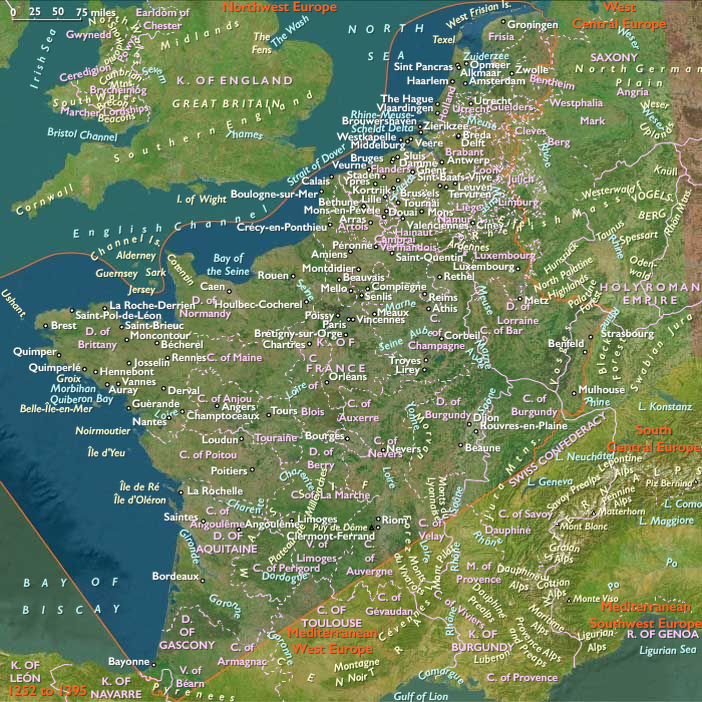
The final chapter of the Jacquerie revolt unfolded at Meaux, where a fortified citadel held a gathering of knights and their noble families, seeking refuge from the peasant and urban uprisings. On June 9, 1358, a force of about 800 armed commoners from Paris, led by Étienne Marcel, marched toward Meaux to support the rebellion. However, their assault ended in disaster, triggering a brutal noble counteroffensive that crushed the revolt and led to widespread massacres across northern France.
The Siege of Meaux and the Peasant Assault (June 9, 1358)
- The Parisian force, unlike the peasant bands, was well-organized and armed, believing themselves to be acting in the name of the imprisoned King John II.
- Upon reaching Meaux, they were welcomed by the discontented townspeople, who fed and sheltered them, allowing them to prepare for a siege against the noble-held fortress.
- However, the fortress itself, separate from the town, was heavily defended and remained unassailable.
The Noble Counterattack: The Arrival of Gaston de Foix and the Captal de Buch
- The besieged nobles were reinforced by two renowned Gascon captains returning from a crusade against the pagans in Prussia:
- Gaston Phoebus, Count of Foix
- Jean III de Grailly, Captal de Buch
- Their arrival with well-armed cavalrymen emboldened the nobles inside the citadel, who launched a devastating counterattack.
- The Parisian force was routed, suffering heavy casualties.
Massacre and Destruction of Meaux
- The nobles set fire to the nearest suburb, trapping many of the burghers and commoners in the flames.
- The mayor of Meaux and other prominent townspeople were hanged as an example.
- Once the uprising was crushed, the noble forces pillaged the town and churches, setting Meaux ablaze for two weeks.
- The countryside surrounding the city was overrun, with peasant homes, barns, and farms burned, and any remaining rebels brutally slaughtered.
Widespread Noble Reprisals (July–August 1358)
- The Jacquerie revolt was fully suppressed by July, but reprisals continued throughout northern France:
- Massacres were carried out in Reims, a city that had remained loyal to the monarchy.
- Senlis resisted the counterattacks, but many towns fell to noble forces.
- Knights from Hainaut, Flanders, and Brabant joined the massacre of peasants, treating the revolt as an opportunity for vengeance and plunder.
Aftermath: Amnesty, Heavy Fines, and Mass Flight
- On August 10, 1358, the Regent Charles (later Charles V) issued an official amnesty, ending the immediate reprisals.
- However, regions that had supported the Jacquerie were fined so heavily that thousands of peasants fled their lands to escape taxation and punishment.
- The countryside was left depopulated and devastated, further weakening France’s economy and agricultural production.
The Jacquerie in Historical Perspective
- Barbara Tuchman, in A Distant Mirror, describes the inevitable failure of the revolt:
"Like every insurrection of the century, it was smashed, as soon as the rulers recovered their nerve, by weight of steel, and the advantages of the man on horseback, and the psychological inferiority of the insurgents."
- The brutal suppression of the Jacquerie reinforced the power of the nobility, but also exposed the deep divisions within French society.
- Though crushed, peasant discontent remained—the Jacquerie was a warning sign of future uprisings against feudal oppression.
The final defeat at Meaux (June 9, 1358) and the ensuing noble terror throughout France marked the violent end of the Jacquerie, ensuring that peasant rebellion would not threaten the feudal order again for generations—but leaving lasting scars on French society.
Locations
People
Groups
- Navarre, Kingdom of
- Flanders, County of
- Normandy, Duchy of
- Hainaut, County of
- England, (Plantagenet, Angevin) Kingdom of
- Brabant, Duchy of
- France, (Valois) Kingdom of
Topics
Commodoties
Subjects
Regions

Subregions
Years: 1358 - 1358
Locations
People
Groups
- Navarre, Kingdom of
- Flanders, County of
- Normandy, Duchy of
- Hainaut, County of
- England, (Plantagenet, Angevin) Kingdom of
- Brabant, Duchy of
- France, (Valois) Kingdom of
Topics
Commodoties
Subjects
Regions
Subregions