The Filipino nationalist movement led by general …
Years: 1896 - 1896
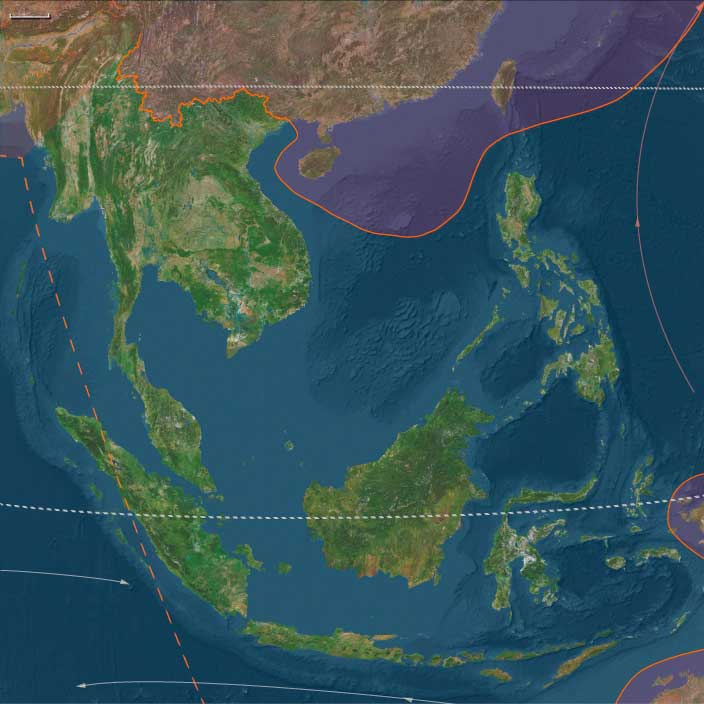
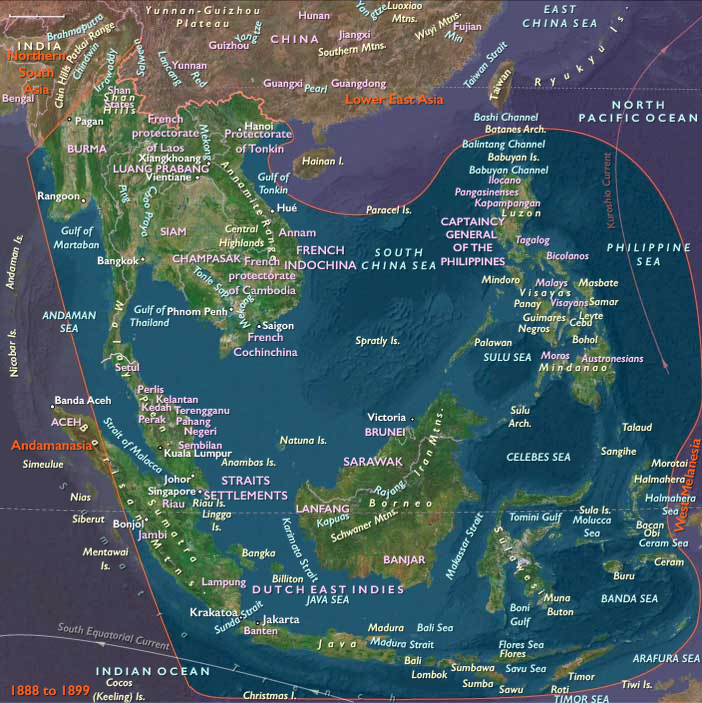
The Filipino nationalist movement led by general Emilio Aguinaldo erupts in a revolt against Spanish rule in 1896.
Locations
People
Groups
Topics
Subjects
Regions
Subregions
Related Events
Filter results
Showing 10 events out of 9327 total
War and disease have reduced the Maori population to a low of forty-two thousand by 1896, representing a sixty-eight percent reduction in just over fifty years.
Their numbers will subsequently recover.
Now constituting only seven percent of New Zealand’s population, Maori own less than twenty percent of the land.
Spain formally annexes the Caroline Islands in 1896.
The Spanish colonel Coello had suggested to the Spanish government in 1852 that the effective occupation of the Caroline Islands provided trade advantages between the Philippines and Australia, New Guinea and the Americas, but Spain would ignore his suggestions until 1885.
In that year, the Spanish representative Butron and the kings of Koror and Artingal had signed an act that recognized the sovereignty of the king of Spain on the Carolines.
Having secured the territory, Spain had attempted to establish custom duties in the region in 1875, but Germany and the United Kingdom had protested because Spain's previous abandonment of the islands had allowed the arrival of German and British missions there.
A conflict had arisen, leading to the submission of these facts for arbitration by Pope Leo XIII, who recognized Spanish rights on the islands west of the 164th meridian east; he assigned to Germany the Marshall Islands and the right to maintain a naval station in one of the Caroline Islands, a right that Germany has never exercised.
Henry Lawson draws on his life in Sydney’s slums and the Western Australian bush in When the Billy Boils, published in 1896 by Angus and Robertson.
It includes "The Drover's Wife", "On the Edge of a Plain", and "The Union Buries Its Dead".
Kang Youwei, a Cantonese scholar, reinterprets Confucian principles to advocate social equality in China.
Kang calls for an end to property and the family in the interest of an idealized future cosmopolitan utopia and cites Confucius as an example of a reformer and not as a reactionary, as many of his contemporaries do.
The latter idea is discussed in great detail in his work Kongzi Gaizhi Kao (孔子改制攷), or Study of the Reforms of Confucius
He argues to bolster his claims that the rediscovered versions of the Confucian classics are forged, as he treats in detail in Xinxue weijing kao (A Study of the 'New Text' Forgeries).
Kang is a strong believer in constitutional monarchy and wants to remodel the country after Meiji Japan.
These ideas anger his colleagues in the scholarly class, who regard him as a heretic.
Russian visionary writer and theorist Konstantin Eduardovich Tsiolkovsky provides the theoretical basis for space travel.
Tsiolkovsky will state that he developed the theory of rocketry only as a supplement to philosophical research on the subject.
He will write more than four hundred works including approximately ninety published pieces on space travel and related subjects.
Among his works are designs for rockets with steering thrusters, multistage boosters, space stations, airlocks for exiting a spaceship into the vacuum of space, and closed-cycle biological systems to provide food and oxygen for space colonies.
Josef Breuer loses interest in psychoanalysis when Sigmund Freud makes sexuality central to his view of neurosis.
This defection, compounded by the death of Freud’s father in 1896, leads Freud to enter a period of self-analysis in which he explores his fantasies and dreams for clues to his childhood sexual passions.
The exposure of the secret Reinsurance treaty by former chancellor Bismarck, in retirement, causes a huge sensation when he reveals the existence of the treaty to a German newspaper, the Hamburger Nachrichten, in 1896.
He blames his successor (Count Caprivi) as responsible for the non-renewal in 1890.
Bismarck says the failure of the treaty made it possible for France and Russia to draw together.
The failure of this treaty will be seen as one of the factors contributing to the First World War, due to Germany's increasing sense of diplomatic isolation.
He believes that even if Jewish separateness in religion and social custom are to disappear, the Jews will continue to be treated as outsiders.
Thus, he argues, if Jews are forced by external pressure to form a nation, they can lead a normal existence only through concentration in one territory.
His pamphlet Der Judenstaat ("The Jewish State") proposes that the Jewish question is a political question to be settled by a world council of nations.
He calls for the establishment of a Jewish state in any available territory—citing Palestine and Argentina as possible destinations—to which the majority of European Jewry will immigrate.
The new state will be modeled after the post-emancipation European state.
Thus, it will be secular in nature, granting no special place to the Hebrew language, Judaism, or to the ancient Jewish homeland in Palestine.
Another important element contained in Herzl's concept of a Jewish state is the enlightenment faith that all men—including anti-Semites—are rational and will work for goals that they perceive to be in their best interest.
He is convinced, therefore, that the enlightened nations of Europe will support the Zionist cause to rid their domains of the problem-creating Jews.
Consequently, Herzl actively seeks international recognition and the cooperation of the Great Powers in creating a Jewish state.
Wassily Kandinsky is forced to choose among his possible futures, for he is offered a professorship in jurisprudence at the University of Dorpat (later called Tartu), in Estonia, which is undergoing Russification.
Approaching his thirtieth birthday in 1896, he turns down the offer (in what he will later call a "now or never" mood,) and takes the train for Germany with the intention of becoming a painter.
He already has an air of authority (that will contribute to his success as a teacher in later years).
Tall, large-framed, impeccably dressed, and equipped with pince-nez glasses, he has a habit of holding his head high and seeming to look down at the universe.
According to acquaintances, he resembles a mixture of diplomat, scientist, and Mongol prince.
But for the moment he is simply an average art student, and he enrolls as such in a private school at Munich run by Anton Azbé.
Here Kandinsky meets thirty-two-year-old Alexey von Jawlensky, who had given up an established career in the Russian Imperial Guard to study painting under the Russian historical painter Ilya Repin and in 1896, disenchanted with realism, had moved to Munich.

Armenian revolutionaries hoping to call attention to their cause stage another demonstration in 1896: they seize the Ottoman Bank in Istanbul.
In the mayhem that follows, mobs of Muslim Turks, their actions apparently coordinated by government troops, kill more than fifty thousand Armenians.
Abdülhamid's brutal repression of the Armenians in 1894–96 earns him the European title “red sultan.”