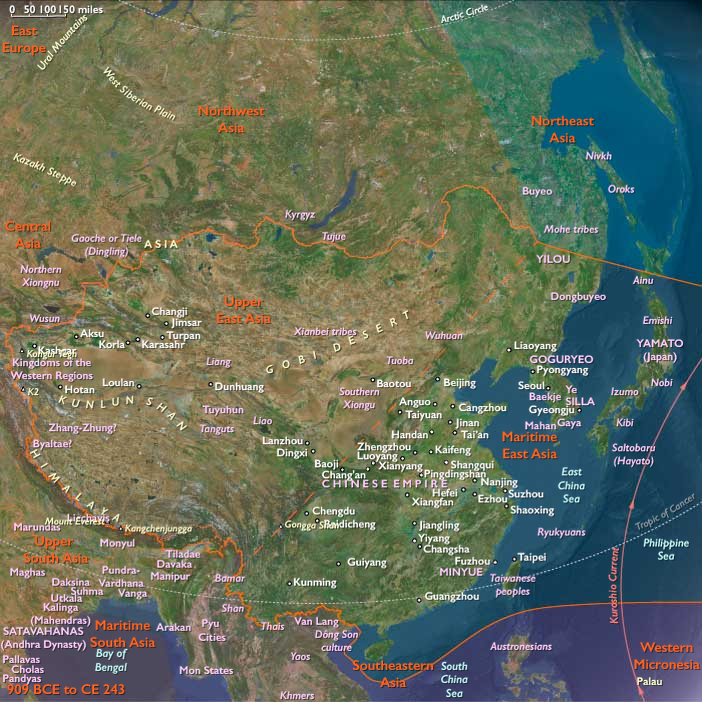
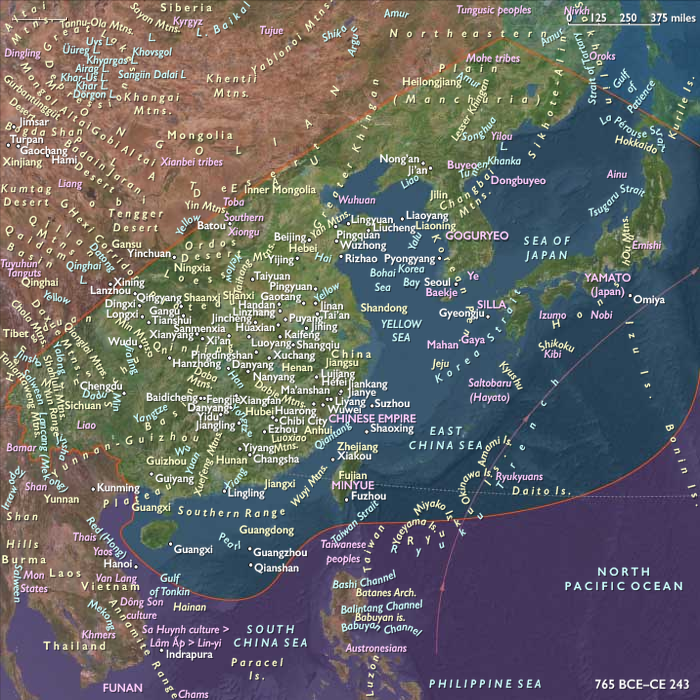
The fighting has left many areas of …
Years: 202BCE - 202BCE
The fighting has left many areas of China depopulated and impoverished, and feudal lords continue to rebel while the Xiongnu make frequent incursions into northern Chinese territory.
The precarious state of the empire therefore forces the Han court to treat Nanyue initially with the utmost circumspection.
Locations
People
Groups
Topics
Commodoties
Subjects
Regions
Subregions
Related Events
Filter results
Showing 10 events out of 63562 total
Liu Bang, after years of war with his rivals, establishes the Han dynasty and reunifies Central China in 202 BCE.
Establishing his capital at Chang'an, he inaugurates China’s Han Dynasty as Emperor Gaozu.
Prusias I has expanded the territories of Bithynia in a series of wars against Attalus I of Pergamon and Heraclea Pontica on the Black Sea.
Philip V of Macedon grants him the ports of Keios and Myrleia in 202, which he renames Prusias and Apameia respectively.
Agathocles, another member of the court clique in Alexandria, becomes the guardian of Ptolemy V when Sosibius retires in about 202.
Agathocles soon provokes Tlepolemus, the governor of Pelusium (Egypt's eastern frontier city), who marches on Alexandria, where his supporters rouse a mob, compelling Agathocles to resign in favor of another courtier.
The boy king, enthroned in the stadium while the mob clamors for the murderers of his parents, nods in confusion at the prompting of a courtier, and the mob searches out and butchers Agathocles and his family.
Tlepolemus, however, soon proves incompetent and is removed.
Antiochus now marches against Egypt.
The Roman Republic being embroiled in the Second Punic War with Carthage, ...
…Antiochus, secretly allied to Philip V, initiates the Fifth Syrian-Egyptian War by invading Palestine in 202 to reconquer what he had lost at Raphia.
During the confusion in Egypt, Antiochus makes serious inroads into Coele Syria.
Ptolemy's forces mount a counteroffensive, capturing Jerusalem.
The Rhodian admiral Theophiliscus, on the way back to Rhodes, dies of the wounds he had received at Chios, having appointed Cleonaeus as his successor.
As the Rhodian fleet is sailing in the strait between Lade and Miletus on the shore of Asia Minor, Philip's fleet attacks them.
Defeating the Rhodians, Philip forces their fleet to retreat back to Rhodes.
The Milesians are impressed, and send Philip and the Heracleides garlands of victory when they enter Milesian territory.
Rhodes' initial response to the declaration of war is diplomatic; they ask the Roman Republic for help against Philip.
The Romans, however, are wary of another war, the Second Punic War having just ended.
The Roman Senate attempts to persuade the populace to enter the war, even after Pergamon, Cyzicus and Byzantium have joined the war on the Rhodians’ side, but is unable to sway the city's war-weary population.
Philip next concludes a treaty with Antiochus III of the Seleucid Empire, hoping to divide up the land held by Ptolemaic Egypt under the young child-king Ptolemy V. Philip agrees to help Antiochus to seize southern Syria, Lycia, Cilicia, and Cyprus, while Antiochus promises to help Philip take control of Cyrene, the Cyclades and Ionia.
With this treaty concluded, Philip's army attacks Ptolemy's territories in Thrace.
Next, the Macedonian fleet heads south and takes the island of Samos from Ptolemy V, capturing the Egyptian fleet stationed there.
The fleet then turns north and …
…lays siege to the island of Chios.
Philip is planning to use the northern Aegean islands as stepping stones as he works his way down to Rhodes.
The siege is not going well for Philip, as the combined fleets of Pergamon, Rhodes and their new allies, Cyzicus and Byzantium, have successfully blockaded his fleet.
Philip, seeing no other option, decides to risk battle against the allies.
The Macedonian fleet of around two hundred ships outnumbers the allied fleet around two to one.
The battle begins with Attalus, who is commanding the allied left wing, advancing against the Macedonian right wing, while the allied right flank under the command of the Rhodian admiral, Theophiliscus attacks the Macedonian's left wing.
The allies gain the upper hand on their left flank and capture Philip's flagship; Philip's admiral, Democrates, is slain in the fighting.
Meanwhile, on the allied right flank, the Macedonians are pushing the Rhodians back.
Theophiliscus, fighting on his flagship, receives three fatal wounds but manages to rally his men and defeat the Macedonian boarders.
On the allied left flank, Attalus sees one of his ships being sunk by the enemy and the one next to it in danger.
He decides to sail to the rescue with two quadriremes and his flagship.
Philip, however, whose ship has not been involved in the fighting to this point, sees that Attalus has strayed some distance from his fleet and sails to attack him with four quinqueremes and three hemioliae.
Attalus, seeing Philip approaching, flees in terror and is forced to run his ships aground.
Upon landing he spreads coins, purple robes and other splendid articles on the deck of his ship and flees to the city of Erythrae.
When the Macedonians arrive at the shore, they stop to collect the plunder.
Philip, thinking that Attalus has perished in the chase, starts towing away the Pergamese flagship.
The situation on the allies' right flank, meanwhile, has reversed and the Macedonians are forced to disengage and retreat, leaving the Rhodians to tow their damaged ships into the harbor at Chios.
The allied left and center have also gained the advantage earlier and forced the Macedonians to retreat before sailing back to Chios unmolested.
The battle is a costly one for Philip, who has lost ninety-two ships destroyed and seven captured.
On the allied side, the Pergamese have had three ships destroyed and two captured, while the Rhodians have lost three ships sunk and none captured.
During the battle the Macedonians had lost six thousand rowers and three thousand marines killed and had two thousand men captured.
The casualties for the allies are significantly lower, with the Pergamese losing seventy men the Rhodians sixty killed, the allies as a whole losing six hundred captured.
Peter Green, in Alexander to Actium: The Historical Evolution of the Hellenistic Age, describes this action as "a crippling and costly defeat".
This defeat effectively cripples the Macedonian fleet and saves the Aegean islands from another large invasion.
After this battle, the Rhodian admirals decide to leave Chios and sail back home.

Philip further provokes Rhodes at this point by capturing and razing Cius and Myrleia, Greek cities on the coast of the Sea of Marmara.
Philip then hands these cities over to his brother-in-law, the King of Bithynia, Prusias I, who rebuilds and renames the cities Prusa after himself and Apameia after his wife, respectively.
In return for these cities, Prusias promised that he will continue on expanding his kingdom at the expense of Pergamon (his latest war with Pergamon had ended in 205).
The seizure of these cities also enrages the Aetolians, as both are members of the Aetolian League.
The alliance between Aetolia and Macedon is held together only by the Aetolians' fear of Philip, and this incident worsens the already tenuous relationship.
Philip next attacks and conquered the cities of Lysimachia and Chalcedon, which are also members of the Aetolian League, forcing them to break off their alliance with Aetolia.
On the way home, Philip's fleet stops at the island of Thasos off the coast of Thrace.
Philip's general Metrodorus goes to the island's eponymous capital to meet emissaries from the city.
The envoys say they will surrender the city to the Macedonians on the conditions that they not receive a garrison, that they not have to pay tribute or contribute soldiers to the Macedonian army and that they continue to use their own laws.
Metrodorus replies that the king accepts the terms, and the Thasians open their gates to the Macedonians.
Once within the walls, however, Philip orders his soldiers to enslave all the citizens, who are then sold away, and to loot the city.
Many Roman aristocrats, especially the outspoken Cato, expect Scipio to raze Carthage to the ground after his victory.
However, Scipio dictates extremely moderate terms in contrast to an immoderate Roman Senate.
While the security of Rome is guaranteed by demands such as the surrender of the fleet, and a lasting tribute is to be paid, the strictures are sufficiently light for Carthage to regain its full prosperity.
With Scipio's consent, Hannibal is allowed to become the civic leader of Carthage, which the Cato family will not forget.
In contrast to his moderation towards the Carthaginians, Scipio is cruel towards Roman and Latin deserters: the Latins are beheaded and the Romans crucified.
Welcomed back to Rome in triumph with the agnomen of Africanus, Scipio refuses the many further honors that the people would have thrust upon him, such as Consul for Life and Dictator.