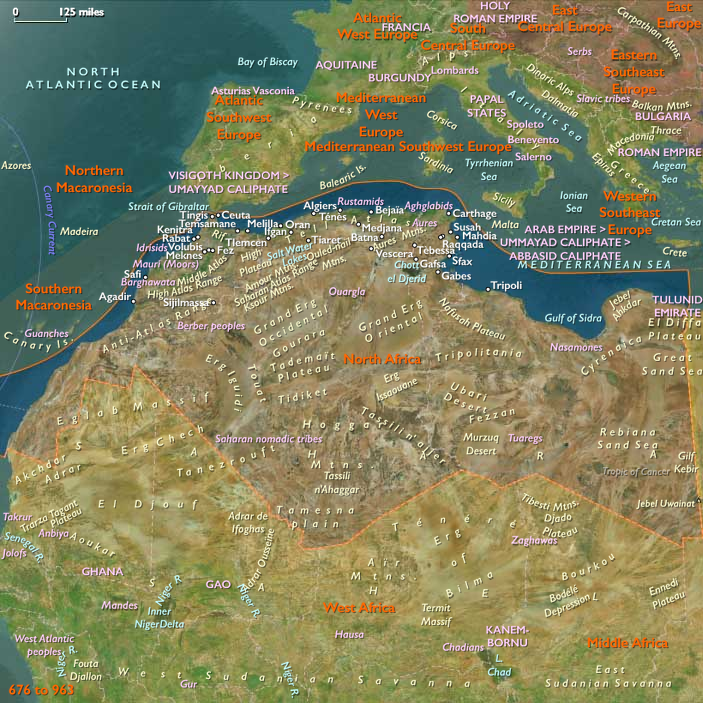
The Fatimids rule only in North Africa …
Years: 925 - 925
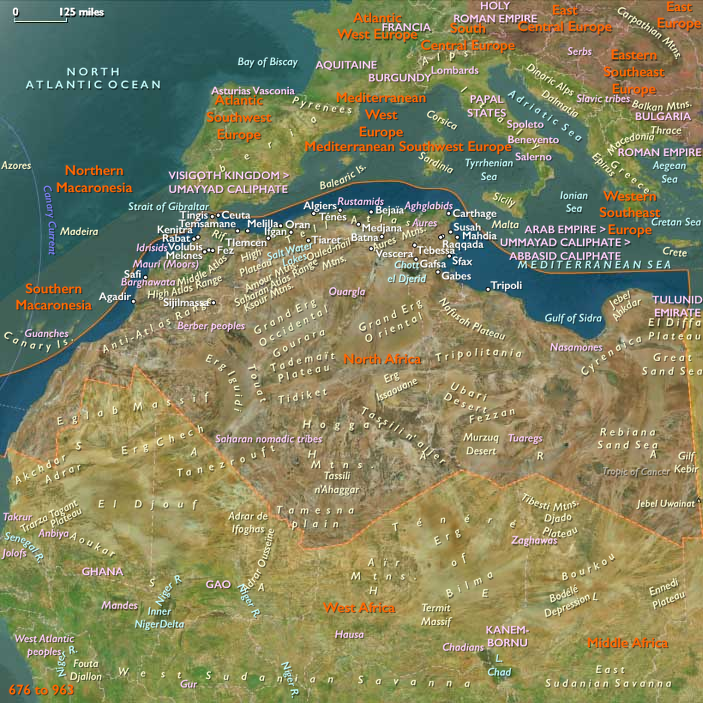
The Fatimids rule only in North Africa and Sicily, where they have to deal with many problems.
Most of their subjects are Sunnis of the Maliki school; others—a substantial minority—are the Khawarij, or Kharijites.
Neither group being well disposed toward the Isma'ili doctrines of the new rulers, they offer stubborn resistance to them.
Even among the Isma'ilis themselves, a conflict soon arises between the state and the revolution -- that is, between the caliph al-Mahdi and the missionaries who have brought him to power.
There also are political problems with Berber tribes and neighboring Muslim rulers, as well as a war against the Empire in Sicily and Italy that the Fatimid rulers have inherited from their North African predecessors.
While coping with these difficulties, the Fatimids never lose sight of their ultimate aim, expansion to the East, where the center of 'Abbasid strength lies.
Unsuccessful expeditions have been sent in 913-915, 919-921, and 925 against Egypt, the first step in the planned conquest.
Locations
People
Groups
- Arab people
- Berber people (also called Amazigh people or Imazighen, "free men", singular Amazigh)
- Islam
- Egypt in the Middle Ages
- Muslims, Sunni
- Muslims, Kharijite
- Muslims, Shi'a
- Ismailism
- Sicily, Emirate of
- Roman Empire, Eastern: Macedonian dynasty
- Abbasid Caliphate (Baghdad)
- Ifriqiya, Fatimid Caliphate of
- Longobardia, Theme of
Topics
Commodoties
Subjects
Regions
Subregions
Related Events
Filter results
Showing 10 events out of 53239 total
Wang Jian, ruler of Former Shu, had died in 918 and had been replaced by an incompetent son, Wang Yan.
in 925, the Shatuo Turk-controlled northern China dynasty marches in under the leadership of Li Cunxu, and incorporates the kingdom into the Later Tang domains.
The same territory will revive its independence as a kingdom shortly hereafter, as Later Shu under a different ruling family; this will also be a brief regime.
Wenceslas is the son of Vratislaus I, Duke of Bohemia from the Přemyslid dynasty.
His father had been raised in a Christian milieu through his own father, Borivoj I of Bohemia, who had purportedly been converted by Saints Cyril and Methodius.
His mother Drahomíra is the daughter of a pagan tribal chief of Havolans and had been baptized at the time of her marriage.
In 921, when Wenceslas was thirteen, his father had died and he was brought up by his grandmother, Saint Ludmila, who had raised him as a Christian.
A dispute between the fervently Christian regent and her daughter-in-law had driven Ludmila to seek sanctuary at Tetín Castle near Beroun.
Drahomíra, who was trying to garner support from the nobility, was furious about losing influence on her son and had arranged to have Ludmila strangled at Tetín on September 15, 921.
Wenceslas is usually described as exceptionally pious and humble, and a very educated and intelligent young man for his time.
According to some legends, having regained control of her son, Drahomíra had set out to convert him to the old pagan religion.
According to other legends, she was a Christian herself; however, very little is known about her rule.
After the fall of Great Moravia, the rulers of the Bohemian duchy had had to deal both with continuous raids by the Magyars and the forces of the Saxon duke and East Frankish king Henry the Fowler, who had started several eastern campaigns into the adjacent lands of the Polabian Slavs, homeland of Wenceslas's mother.
To withstand Saxon overlordship, Wenceslas's father Vratislaus had forged an alliance with the Bavarian duke Arnulf the Bad, then a fierce opponent of King Henry; however, it had become worthless when Arnulf and Henry reconciled at Regensburg in 921.
Wenceslas assumes government for himself in 924 or 925.
The empire of the Gurjara-Pratiharas has reached its greatest extent, controlling most of northern India, at the death of Mahipala I, in 924/25.
Pope John X recognizes Tomislav as the first king of Croatia in 925 .
Croatian bishop Grgur (Gregory) of Nin successfully presses for the independence of the Latin-rite diocese of Nin from …
…the older Greek-rite archdiocese of Split, as well as for the right of the Croat church to employ the Slavonic liturgy and the Glagolitic, or Cyrillic, alphabet.
The Short and Controversial Reign of Fruela II of León (924–925 CE)
As King of Asturias, Fruela II is tasked with consolidating Castile and keeping its counts in check. His mother, Jimena of Pamplona, links him to the Basque royal family, and his own marriages further strengthen his political connections.
Marriages and Alliances
Fruela marries twice:
- Nunila (or Nunilona) – Her origins are unknown, though later sources claim she was from the Jiménez dynastyof Navarre, though without clear evidence.
- Urraca bint Qasi – According to Ibn Khaldun and Ibn Hazm, she is the daughter of the Banu Qasi governor of Tudela, and their marriage takes place by 917 CE.
Fruela maintains good relations with his older brother, King Ordoño II of León, working together in the Reconquista. He undersigns Ordoño’s royal documents as Froila rex, alongside his wife, Urraca regina.
Usurpation and Controversies
When Ordoño II dies in 924, the magnates of the realm bypass his heirs and elect Fruela as king, making him ruler of León, Galicia, and Asturias. However, his legitimacy is contested, and some historians view his ascension as a usurpation.
Fruela quickly alienates the nobility and his subjects:
- He assassinates Gebuldo and Aresindo, sons of Olmundo, who claim descent from the Visigothic King Witiza, further aggravating noble opposition.
- Ramón Menéndez Pidal suggests that Fruela exiles Bishop Frunimio of León, a relative of Olmundo.
Due to his brutal rule, one chronicler claims Fruela was "condemned to a reign of only fourteen months."
Death and Succession Crisis
Fruela dies in early summer 925, possibly from leprosy, leaving the kingdom in turmoil. Following his death, multiple factions vie for power:
- His younger brother, Ramiro, who marries the widowed queen Urraca bint Qasi and claims the throne but is ultimately unsuccessful.
- The sons of Ordoño II, who will ultimately prevail.
- His own sons, including Alfonso Fróilaz, who is briefly recognized as king in at least part of the kingdom.
Children and Uncertain Lineage
According to Bishop Pelayo, Fruela had three sons by Nunila:
- Alfonso,
- Ordoño, and
- Ramiro.
However, Ibn Khaldun attributes Ordoño and Ramiro to Urraca while leaving open the possibility of other children from either marriage.
Ultimately, Fruela’s family is unable to hold onto power, as the sons of Ordoño II secure control over the Kingdom of León.

The Short and Controversial Reign of Fruela II of León (924–925 CE)
As King of Asturias, Fruela II is tasked with consolidating Castile and keeping its counts in check. His mother, Jimena of Pamplona, links him to the Basque royal family, and his own marriages further strengthen his political connections.
Marriages and Alliances
Fruela marries twice:
- Nunila (or Nunilona) – Her origins are unknown, though later sources claim she was from the Jiménez dynasty of Navarre, though without clear evidence.
- Urraca bint Qasi – According to Ibn Khaldun and Ibn Hazm, she is the daughter of the Banu Qasi governor of Tudela, and their marriage takes place by 917 CE.
Fruela maintains good relations with his older brother, King Ordoño II of León, working together in the Reconquista. He undersigns Ordoño’s royal documents as Froila rex, alongside his wife, Urraca regina.
Usurpation and Controversies
When Ordoño II dies in 924, the magnates of the realm bypass his heirs and elect Fruela as king, making him ruler of León, Galicia, and Asturias. However, his legitimacy is contested, and some historians view his ascension as a usurpation.
Fruela quickly alienates the nobility and his subjects:
- He assassinates Gebuldo and Aresindo, sons of Olmundo, who claim descent from the Visigothic King Witiza, further aggravating noble opposition.
- Ramón Menéndez Pidal suggests that Fruela exiles Bishop Frunimio of León, a relative of Olmundo.
Due to his brutal rule, one chronicler claims Fruela was "condemned to a reign of only fourteen months."
Death and Succession Crisis
Fruela dies in early summer 925, possibly from leprosy, leaving the kingdom in turmoil. Following his death, multiple factions vie for power:
- His younger brother, Ramiro, who marries the widowed queen Urraca bint Qasi and claims the throne but is ultimately unsuccessful.
- The sons of Ordoño II, who will ultimately prevail.
- His own sons, including Alfonso Fróilaz, who is briefly recognized as king in at least part of the kingdom.
Children and Uncertain Lineage
According to Bishop Pelayo, Fruela had three sons by Nunila:
- Alfonso,
- Ordoño, and
- Ramiro.
However, Ibn Khaldun attributes Ordoño and Ramiro to Urraca while leaving open the possibility of other children from either marriage.
Ultimately, Fruela’s family is unable to hold onto power, as the sons of Ordoño II secure control over the Kingdom of León.
Henry I Seizes Lotharingia from West Francia (925): The Final Shift to East Francia
In 925, King Henry I of Germany (Henry the Fowler) invades Lotharingia, taking advantage of the political instability under Duke Gilbert and the weakness of King Rudolph of West Francia. This conquest permanently transfers Lotharingia from West Francia to East Francia, marking a major shift in the balance of power in medieval Europe.
Gilbert of Lorraine’s Shifting Loyalties
- Gilbert, Duke of Lorraine, had long been unreliable, frequently switching allegiances between West Francia and East Francia as political conditions changed.
- His indecisiveness had weakened Lotharingia’s position, making it vulnerable to external intervention.
- Sensing an opportunity, Henry I launches an invasion, facing little resistance from Rudolph of West Francia, who is too weak to oppose him.
Henry I’s Conquest of Lotharingia
- With Rudolph unable to respond militarily, Henry quickly wrests control of Lotharingia from West Francia.
- Rather than being removed from power, Gilbert submits to Henry, swearing fealty to the German king.
- This effectively solidifies Lotharingia as part of East Francia, where it will remain for centuries.
The Significance of the 925 Conquest
-
Lotharingia Becomes Part of East Francia Permanently
- After decades of shifting allegiances, Henry’s conquest ensures that Lotharingia is politically and militarily tied to Germany rather than France.
-
Further Weakening of West Francia
- With the loss of Lotharingia, Rudolph of West Francia is even more diminished, unable to maintain Carolingian-era borders.
- This loss accelerates the decline of royal authority in West Francia, as regional lords like the Robertians and the Dukes of Burgundy grow more powerful.
-
A Step Toward the Holy Roman Empire
- By integrating Lotharingia, Henry strengthens the foundation of East Francia, setting the stage for its transformation into the Holy Roman Empire under Otto I in 962.
Conclusion: A Turning Point in the Carolingian World
The seizure of Lotharingia in 925 marks the permanent separation of the region from France, ensuring that it remains part of the German sphere of influence. While Gilbert remains Duke, his subordination to Henry I reflects the growing dominance of East Francia over West Francia, paving the way for the eventual formation of Germany as a distinct political entity.
Æthelstan behaves as a Mercian king in early 925, describing himself as Rex Anglorum in a charter relating to land in Derbyshire, witnessed only by Mercian bishops.
He does not appear to have established his authority in Wessex until the middle of the year.
In the view of David Dumville and Janet Nelson he may have agreed not marry or have heirs in order to gain acceptance.
However, Sarah Foot suggested that he probably had a religious devotion to chastity as a way of life.
The coronation of Æthelstan takes place on September 4, 925 at Kingston upon Thames, perhaps due to its symbolic location on the border between Wessex and Mercia.
He is crowned by the Archbishop of Canterbury, Athelm, who probably designed or organized a new ordo (religious order of service) in which the king wore a crown for the first time instead of a helmet.
The new ordo is influenced by West Frankish liturgy and in turn will become one of the sources of the medieval French ordo.
Opposition seems to have continued even after the coronation.
According to William of Malmesbury, an otherwise unknown nobleman called Alfred plotted to blind Æthelstan on account of his supposed illegitimacy, although it is unknown whether he aimed to make himself king or was acting on behalf of Edwin, Ælfweard's younger brother.
Blinding would have been a disability that made Æthelstan ineligible for kingship without incurring the odium attached to murder.
Simeon has styled himself “Tsar of the Bulgars and Autocrat of the Greeks” from 925, and the pope recognizes him as such the following year, but his country is near exhaustion.
The Bulgarian kingdom has reached its greatest size under Simeon, who has presided over a golden age of artistic and commercial expansion.
He has encouraged the building of palaces and churches, the spread of monastic communities, and the translation of Greek books into Slavonic.
Preslav has been made into a magnificent capital that observers describe as rivaling Constantinople.
The artisans of its commercial quarter specialize in ceramics, stone, glass, wood, and metals, and Bulgarian tile work in the “Preslav style” surpasses its contemporary rivals and is eagerly imported by Constantinople and Kievan Rus.
Most likely after (or possibly at the time of) Patriarch Nicholas' death in 925, Simeon had raised the status of the Bulgarian Orthodox Church to a patriarchate.
This may be linked to Simeon's diplomatic relations with the Papacy between 924 and 926, during which he has demanded and received Pope John X's recognition of his title as "Emperor of the Romans", truly equal to the emperor in Constantinople, and possibly the confirmation of a patriarchal dignity for the head of the Bulgarian Orthodox Church.
Simeon's troops under Alogobotur invade Croatia in 926, at this time an ally of Constantinople.
The reason might have been that Tomislav had received and protected the Serbs who were expelled by Simeon from Rascia.
In all probability, however, the main reason is that Simeon, if crowned by the Papal Legate, fears an attack from the Emperor Romanos Lekapenos, supported by Tomislav.
Romanos had won the friendship of Tomislav some years previously, handing over Dalmatia to Tomislav and recognizing him as King of Croatia (Pope John X had recognized Tomislav as King of Croatia in 925).
Tomislav had sent his troops to Italy during the summer of 926 to expel Saracens from the city of Sipontus, which belongs to the imperial province of Langobardia.
This event could have been sufficient proof to Simeon that the Croats had taken the side of Constantinople and that they would support the Greek emperor actively in the future.
Therefore, when Simeon sends a great army against the Croats, the Bulgarians are met by Tomislav's army in the mountainous region of Eastern Bosnia.
The Croatian forces under the leadership of their king completely devastate the Bulgarian army.
Key to Tomislav's triumph is likely the choice of terrain on which the battle takes place: Croatian soldiers are probably more skilled in fighting in the mountainous terrain of the Bosnian highlands.
The Croatian victory is so decisive and the battle so big that contemporary sources greatly overestimate Croatia's army at one hundred and sixty thousand men, with a slightly bigger force on the Bulgarian side.
This is the only battle Tsar Simeon ever loses.
Since both rulers maintain good relations with John X, the pope is able to negotiate an end to the war soon afterward without any further border changes.
Tomislav, fearing Bulgarian retribution, accepts to abandon his union with Constantinople and make peace on the basis of the status quo, negotiated by the papal legate Madalbert.
Years: 925 - 925
Locations
People
Groups
- Arab people
- Berber people (also called Amazigh people or Imazighen, "free men", singular Amazigh)
- Islam
- Egypt in the Middle Ages
- Muslims, Sunni
- Muslims, Kharijite
- Muslims, Shi'a
- Ismailism
- Sicily, Emirate of
- Roman Empire, Eastern: Macedonian dynasty
- Abbasid Caliphate (Baghdad)
- Ifriqiya, Fatimid Caliphate of
- Longobardia, Theme of