
Charlotte Corday undergoes three separate cross-examinations by …
Years: 1793 - 1793
July
Charlotte Corday undergoes three separate cross-examinations by senior revolutionary judicial officials, including the President of the Revolutionary Tribunal and the chief prosecutor.
She stresses that she is a republican and had been so even before the Revolution, citing the values of ancient Rome as an ideal model.
The focus of the questioning is to establish whether she had been part of a wider Girondist conspiracy.
Corday remains constant in insisting that "I alone conceived the plan and executed it."
She refers to Marat as a "hoarder" and a "monster" who is respected only in Paris.
She credits her fatal knifing of Marat with one blow not to practicing in advance but to luck.
Following her sentencing Corday asks the court if her portrait can be painted, purportedly to record her true self.
She makes her request pleading, "Since I still have a few moments to live, might I hope, citizens, that you will allow me to have myself painted."
Given permission, she selects as the artist a National Guard officer, Jean-Jacques Hauer, who had already begun sketching her from the gallery of the courtroom.
Hauer's likeness is completed shortly before Corday is summoned to the tumbril, after she had viewed it and suggested a few changes.
On July 17, 1793, four days after Marat was killed, Corday is executed by the guillotine, wearing the red overblouse denoting a condemned traitor who has assassinated a representative of the people.
Standing alone in the tumbril amid a large and curious crowd she remains calm, although drenched by a sudden summer rainfall.
Her corpse is disposed of in the Madeleine Cemetery.
Jacobin leaders had her body autopsied immediately after her death to see if she was a virgin.
They believed there was a man sharing her bed and the assassination plans.
To their dismay, she was found to be virgo intacta (a virgin).
The assassination does not stop the Jacobins or the Terror: Marat becomes a martyr, a bust of him replaces a religious statue on the rue aux Ours and a number of place-names are changed to incorporate his.
Corday's act transforms the idea of what a woman is capable of, and to those who do not shun her for her act, she is a heroine.
André Chénier, for example, writes a piece in honor of Corday.
This highlights the "masculinity" possessed by Corday during the revolution.
Corday's act serves as a turning point of views held of women during the revolutionary period.
Women in France have been given a new-found power resulting from the necessity of their being increasingly involved in the revolution.
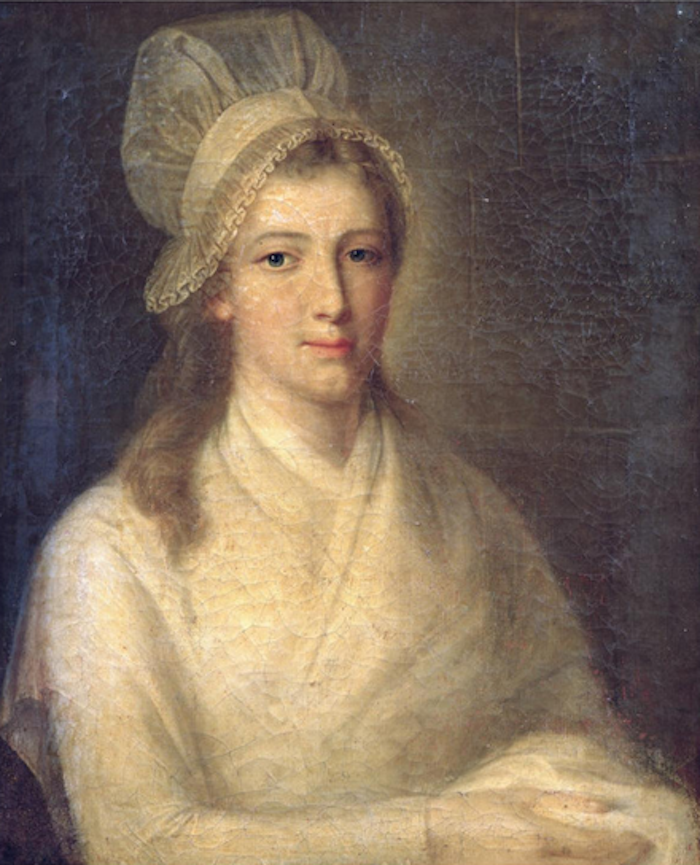
Charlotte Corday, painted at her request by Jean-Jacques Hauer, a few hours before her execution.
Locations
People
Groups
Topics
- Portraits, Rococco
- French Revolution
- First Coalition, War of the
- Western Art: 1792 to 1804
- French Revolutionary Wars, or “Great French War”
- Reign of Terror
- Vendée, War in the
- French Revolutionary Wars: Campaigns of 1793
Subjects
Regions
Subregions
Related Events
Showing 10 events out of 23676 total
Years: 1793 - 1793
July
Charlotte Corday, painted at her request by Jean-Jacques Hauer, a few hours before her execution.
Locations
People
Groups
Topics
- Portraits, Rococco
- French Revolution
- First Coalition, War of the
- Western Art: 1792 to 1804
- French Revolutionary Wars, or “Great French War”
- Reign of Terror
- Vendée, War in the
- French Revolutionary Wars: Campaigns of 1793
Subjects
Regions
Subregions