
The War of the Oranges (1801) – …
Years: 1792 - 1803
The War of the Oranges (1801) – Portugal Caught Between France and Spain
After years of fighting alongside Portugal against Revolutionary France, Spain abruptly changed sides, making a separate peace with France at Basel in 1795 without consulting Portugal. This betrayal marked a major shift in Iberian geopolitics, leaving Portugal increasingly isolated.
By 1800, Spain went even further, signing the secret Treaty of San Ildefonso with France, becoming a full ally of Napoleon. This alliance threatened Portugal’s survival, as France and Spain now viewed it as a British satellite that needed to be neutralized.
The Ultimatum – Franco-Spanish Demands on Portugal (1801)
In February 1801, France and Spain delivered an ultimatum to Prince Regent João (acting on behalf of his mother, Maria I, who was now fully incapacitated by mental illness), demanding that Portugal:
- Abandon its alliance with Britain.
- Close all its ports to British ships and open them exclusively to French and Spanish vessels.
- Hand over one-quarter of Portuguese territory as a guarantee for Spanish territories occupied by Britain.
This ultimatum was effectively a death sentence for Portugal’s sovereignty. João refused to comply, knowing that Portugal’s entire economic survival depended on British trade.
The War of the Oranges – Spain Invades (May 1801)
In May 1801, Spain, with French support, invaded Portugal from the east, launching what became known as the War of the Oranges—so called because Spanish Prime Minister Manuel de Godoy allegedly sent a basket of oranges to Queen Maria Luisa as a token of his victory.
- The Spanish army crossed into the Alentejo, capturing towns including Olivença.
- The Portuguese army, outnumbered and poorly equipped, offered resistance but was quickly overwhelmed.
- After just two weeks of fighting, Portugal was forced to negotiate peace.
The Treaty of Badajoz (June 1801) – Portugal’s Concessions
The war ended with the Treaty of Badajoz on June 6, 1801, in which Portugal was forced to make humiliating concessions:
- Portugal had to close its ports to British ships.
- Commercial privileges were granted to France.
- A large war indemnity was paid to Spain and France.
- Portugal ceded the town of Olivença and its surrounding territory to Spain, marking the only permanent territorial loss in modern Portuguese history.
A Short-Term Peace, A Long-Term Crisis
While the Treaty of Badajoz ended hostilities, it was only a temporary reprieve:
- Portugal had not fully complied with Napoleon’s demands, as it still maintained covert ties with Britain.
- The ceding of Olivença was deeply unpopular in Portugal, and the loss of the territory would remain a source of tension with Spain for centuries.
- The Napoleonic threat did not go away—just a few years later, in 1807, Napoleon would invade Portugal directly, forcing the Portuguese royal family to flee to Brazil.
The War of the Oranges demonstrated Portugal’s vulnerability but also its determination to resist total submission to Napoleonic France. However, greater challenges lay ahead, as the Napoleonic Wars would soon engulf Portugal in full-scale conflict.
Locations
People
- John VI of Portugal
- José I of Portugal
- Maria I of Portugal
- Sebastião José de Carvalho e Melo, 1st Marquis of Pombal
Groups
- Portuguese people
- Portuguese Empire
- Portugal, Bragança Kingdom of
- Spain, Bourbon Kingdom of
- Britain, Kingdom of Great
- Brazil, Viceroyalty of
- French First Republic
Topics
Subjects
Regions
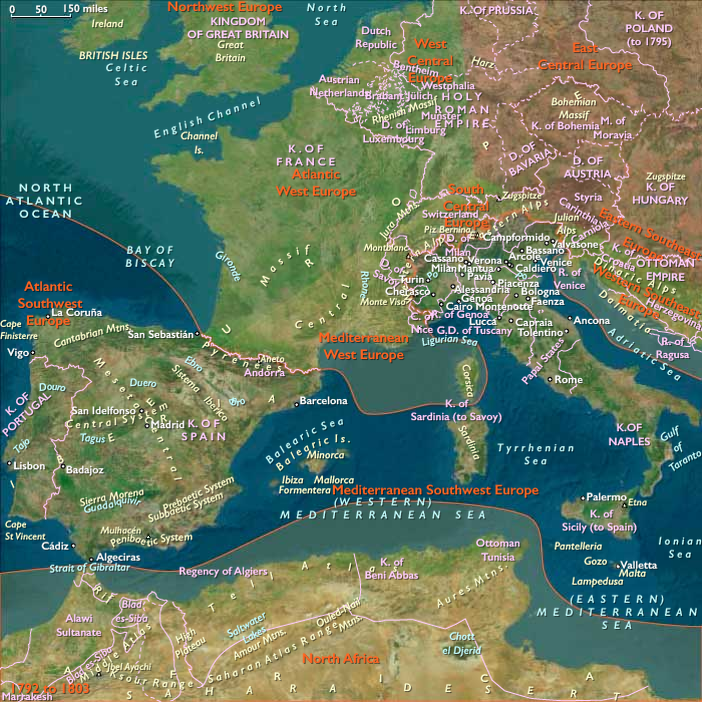
Subregions
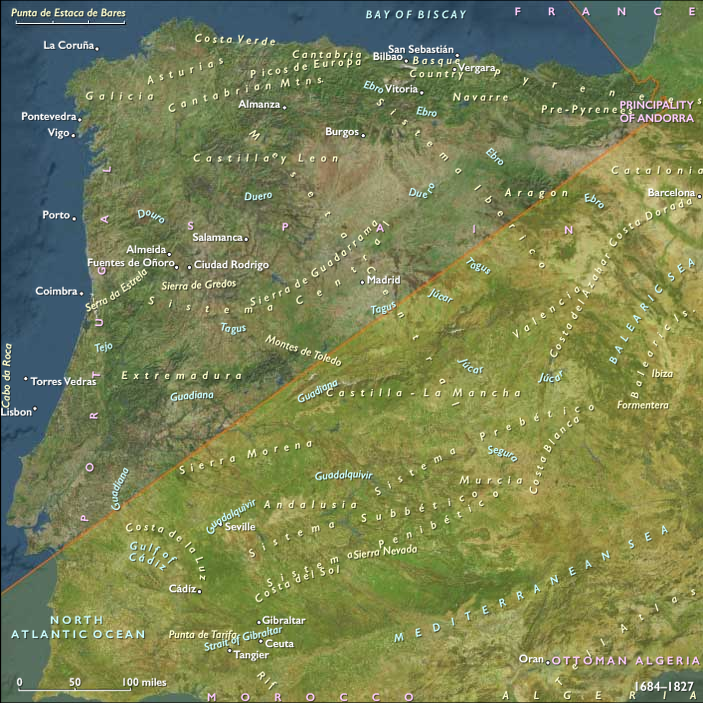
Years: 1792 - 1803
Locations
People
- John VI of Portugal
- José I of Portugal
- Maria I of Portugal
- Sebastião José de Carvalho e Melo, 1st Marquis of Pombal
Groups
- Portuguese people
- Portuguese Empire
- Portugal, Bragança Kingdom of
- Spain, Bourbon Kingdom of
- Britain, Kingdom of Great
- Brazil, Viceroyalty of
- French First Republic
Topics
Subjects
Regions
Subregions