The evacuation of China’s southeast coast, following …
Years: 1671 - 1671
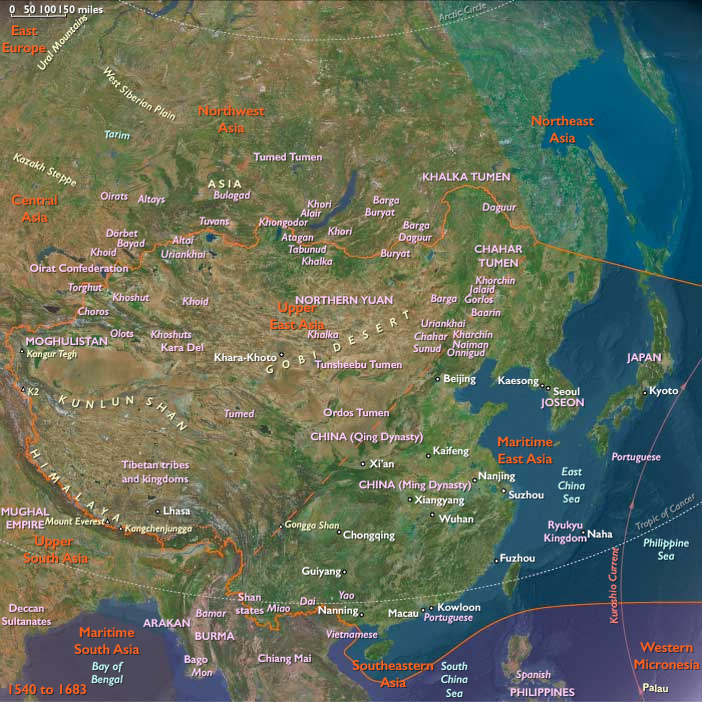
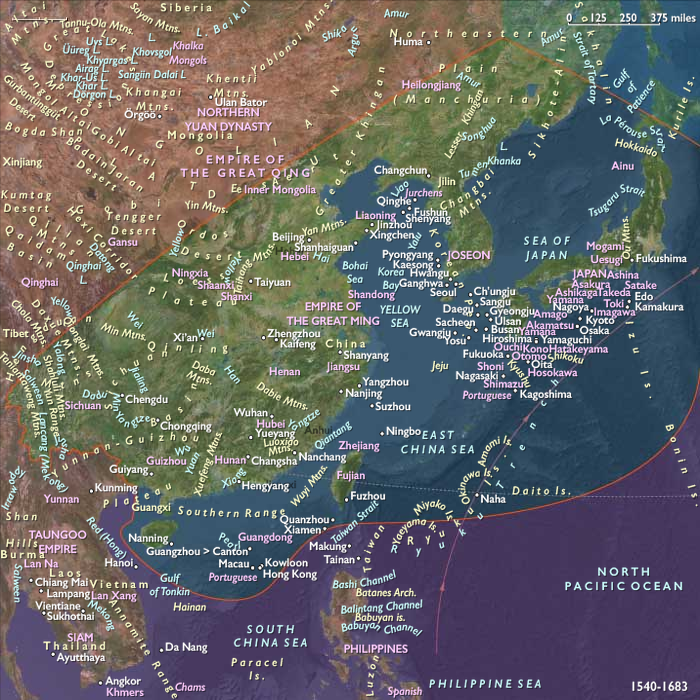
The evacuation of China’s southeast coast, following prolonged earlier years of miseries, has had a profound effect on the lives of the population and on the pattern of future settlement.
The survivors' hardships did not end when they returned to take up their interrupted lives in their old homes, for it is recorded that destructive typhoons in 1669 and 1671 destroyed the new houses in many places.
Locations
Groups
Subjects
Regions
Subregions
Related Events
Filter results
Showing 10 events out of 30792 total
Communities speaking the Hakka dialect are thought to have arrived in the Hong Kong area after the rescinding of the coastal evacuation order, their immigration into the area assisted by the government.
The formerly established Punti clans also return, expand their ancestral halls, build study halls and set up market towns in Sheung Shui, ...
...Yuen Long, and ...
...Tai Po.
Newton first uses the word spectrum (Latin for "appearance" or "apparition") in print in 1671 in describing his experiments in optics.
Newton has observed that when a narrow beam of sunlight strikes the face of a glass prism at an angle, some is reflected and some of the beam passes into and through the glass, emerging as different colored bands.
Newton hypothesizes that light is made up of "corpuscles" (particles) of different colors, and that the different colors of light move at different speeds in transparent matter, with red light moving more quickly in glass than violet.
The result is that red light bends (refracted) less sharply than violet as it passes through the prism, creating a spectrum of colors.
Newton divides the spectrum into seven named colors: red, orange, yellow, green, blue, indigo, and violet. (Some schoolchildren memorize this order using the mnemonic ROY G. BIV.)
He has chosen seven colors out of a belief, derived from the ancient Greek sophists, that there is a connection between the colors, the musical notes, the known objects in the solar system, and the days of the week.
He drafts development standards for towns as well as an illustrative plan that he includes in his instructions to the colonists.
His urban plan provides detailed standards for block size, lot size, street width, waterfront setbacks, and other standards similar to modern planning and zoning ordinances.
Locke also writes guiding principles for regional development that sre remarkably similar to principles of modern planning, including aspects of sustainable development and smart growth.
Such aspects include, a) consistency of development practices with the general plan (Fundamental Constitutions); b) concurrent provision of infrastructure with land development; and compactness of development to promote efficient use of land and access to markets.
The Grand Model allocates more land (sixty percent) and representation to “the people” than to the nobility, suggesting that yeoman farmers are envisioned ultimately to become the backbone of the colony.
Nevertheless, a slave-owning elite is also part of the formula from the beginning.
Where Ashley Cooper sees slavery as playing a vital role was in the establishment of the principal estates.
In December, 1671, he advises against bringing too many of “the poorer sort” to the colony until “men of estates” can first “stock the country with Negroes, cattle, and other necessarys.”
Claude-Jean Allouez is a principal speaker at the ceremony that formally declares the Northwest Territory subject to the King of France in 1671, and in this year establishes the St. Francis Xavier Mission at the last set of rapids on the Fox River before entering the Bay of Green Bay.
The site is known as Rapides Des Pères (rapids of the fathers) which will become modern day De Pere, Wisconsin.
The Nipissing, an aboriginal people of Ojibwa and Algonquin descent who have lived in the area of Lake Nipissing in the Canadian province of Ontario for about nine thousand four hundred years, are known in history by many names, but are generally considered part of the Anishinaabe peoples, a grouping which includes the Odawas, Ojibwe and Algonquins.
This broad heritage is likely the result of the Nipissings living at the crossroads between two watersheds, and are key to trade to the East, West, North and South of Lake Nipissing.
This watershed divide will later be portaged extensively by the French in accessing the Great Lakes by canoe from settlements around Montreal.
To the west, their trade routes extend as far as Lake Nipigon and their Ojibwa neighbors, and to the north as far James Bay where they trade with the Cree.
Their trade network to the east extends as far as present day Quebec City.
The Hurons had lived nearby to the South, and there is archaeological evidence that the Nipissings have integrated some Huron styles and techniques in their pottery.
They obtain food primarily through hunting, fishing, and gathering although their extensive trading likely allows them to supplement their diets with corn, beans and squash as well.
Certainly the land in the lake valleys would have supported some horticulture.
The trade routes that had been under the Nipissings' control had become increasingly desirable during the early colonial period, as the French proved a large market for the inland pelts.
As a result, the Iroquois had executed military campaigns against the Huron and, by 1647, the Nipissing had regrouped in the Lake Nipigon area.
The Nipissing nonetheless continued to use their historical trade routes, but at greater risk to themselves.
Claude-Jean Allouez visited the Nipissings at Lake Nipigon 1667, but in 1671 he reports that the Nipissing have returned to Lake Nipissing.
After returning to Lake Nipissing, some of the Nipissings relocate to the missions at Trois-Rivières, Quebec and Oka, Quebec.

Claude-Jean Allouez had spent the winter of 1669-70 at Green Bay, preaching to the Potawatomi, Menominee, Sauk, Meskwaki (Foxes,) and Winnebago, whom he had found commingled there. (The map of 1681 accompanying Marquette's Journal notes a Winnebago village near the north end of Lake Winnebago.)
The Winnebago have been known to Europeans since 1634, when the French explorer Jean Nicollet found them in Wisconsin, on Green Bay, at which time they probably extended to Lake Winnebago.
At this period they were found wedged in by Central Algonquian tribes, particularly by the Sauk, the Meskwaki, and the Menominee.
To the west they are in intimate contact with a kindred tribe, the Iowa, who in turn are neighbors of the Otoe and Missouri.
These four tribes—the Winnebago, Iowa, Otoe, and Missouri—speak dialects naturally intelligible to one another, and show many cultural similarities.
On the other hand, the Winnebago show many cultural similarities with their Central Algonquian neighbors, particularly in all that pertains to material culture and art, and this double influence, that from their Siouan neighbors and that from their Algonquian neighbors, must be borne in mind in any attempt to understand properly the Winnebago culture.
A Jesuit Mission is established in the area in 1671.
It is stated in the Jesuit Relation for 1671 (42, 1858) that the Winnebago had always dwelt in the Green Bay region and, at a very early date, they had been almost entirely destroyed by the Illinois, but all captives had at last been allowed to return and form a tribe again.
The Meskwaki have gained control of the Fox River system in present Wisconsin.
This river is vital for the fur trade between French Canada and the interior of North America, because it allows travel from Green Bay in Lake Michigan to the Mississippi River.
At first contact, which occurs at approximately this time, the French estimate the number of Meskwaki as about 6,500.
Marquette establishes the St. Ignace Mission in 1671, naming it for St. Ignatius of Loyola, founder of the Jesuit religious order.