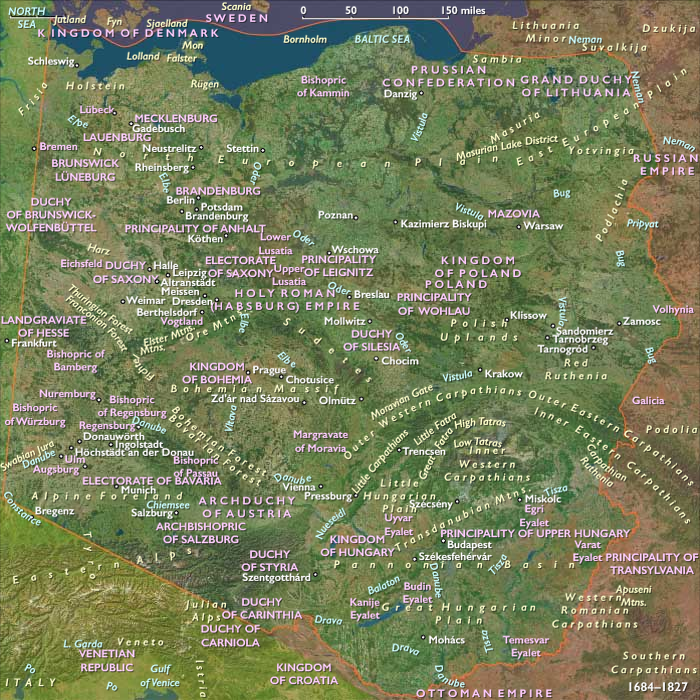
The ethnic composition of Hungary has changed …
Years: 1720 - 1720
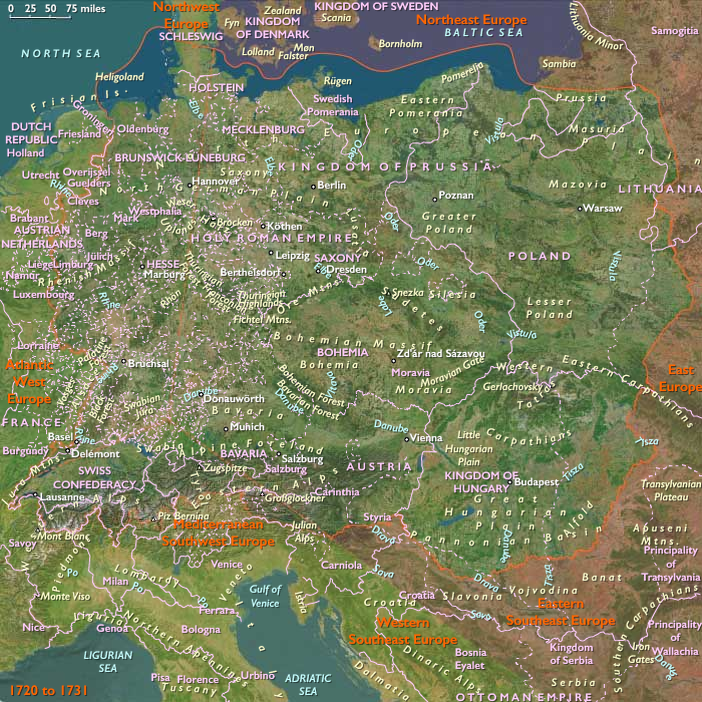
The ethnic composition of Hungary has changed dramatically over the past two centuries.
The most purely Magyar areas had been heavily depopulated during the Turkish wars.
These losses had been accompanied by mass immigrations of Serbs, Croats, and Romanians from the Balkans and later by the introduction by the Austrian government of large numbers of German and other colonists.
The Magyars number only some thirty-five percent of the total population by 1720.
Related Events
Filter results
Showing 10 events out of 28131 total
Northeast Asia (1720–1731 CE)
Expansion of Russian Influence and Kamchatka’s Integration
From 1720 to 1731, Northeast Asia—a region encompassing the easternmost areas of Siberia (east of 130°E), the extreme northeastern portion of China's Heilongjiang province, the northern half of Russia's Primorsky Krai, and most of the island of Hokkaido (excluding its southwestern portion)—continued to witness steady Russian expansion and consolidation of maritime and colonial efforts, significantly affecting the region's indigenous populations and economic dynamics.
The maritime route established earlier between Okhotsk and Kamchatka, although challenging due to Okhotsk's harsh climate, poor harbor conditions, and limited agricultural potential, became increasingly significant for Russia’s colonial strategy. Despite these ongoing hardships, Okhotsk strengthened its position as Russia's primary Pacific seaport, handling critical logistical demands and supplying the isolated outposts scattered along the Siberian coastline.
The successful voyages of vessels like the Vostok under commanders such as Kozma Sokolov had demonstrated the practicality of maritime navigation in these remote waters, and Russia now moved decisively toward increased utilization of naval routes. This strategic maritime connection supported the rapid expansion of the Russian fur trade, which depended heavily on the abundant sable, fox, and sea otter pelts available in Kamchatka and the surrounding areas.
During this era, Russian presence in Kamchatka became more structured and extensive. Early settlements transitioned from temporary outposts into permanent trading centers and forts, supported by consistent naval supply lines established through Okhotsk. These settlements introduced considerable disruption to indigenous lifeways, particularly for the Itelmen of Kamchatka, who began experiencing intensified pressures from Russian traders, including demands for tribute (yasak). Indigenous communities faced significant ecological impacts due to intensified fur trapping, while simultaneously becoming increasingly integrated into Russian economic networks as intermediaries, hunters, and laborers.
This period set important precedents for future colonization efforts, marking a shift from sporadic exploration and trading missions toward a more sustained and systematic Russian colonial presence. The foundation laid during these critical years enabled Russia to consolidate its hold over Northeast Asia and significantly alter the region’s demographic, cultural, and ecological landscape.
Vitus Bering’s First Kamchatka Expedition proves that Asia and America are separated by the strait now named for him.
His explorations mark the beginning of what will become known as the Maritime Fur Trade, and is a significant moment in the colonization of the Russian Far East.
The Dutch East India Company collects a tax in coffee in the Priangen region of west Java and earns vast profits through sales in Europe and America.
Soon becoming the globe's greatest coffee broker, the Dutch company gains thereby a substitute for its substantial share of the China opium trade lost to Britain after 1720.
Sava Raguzinsky, a Serb in the employ of Peter the Great, founds Kyakhta as a trading point between Russia and the Qing Empire in 1728.
The eastern terminal of the Great Siberian Route from Moscow, Kyakhta will prosper from cross-border trade with Altanbulag, which is at this time a Chinese trading center called Maimachin (Mǎimàichéng, "Trading City.")
Trade is essentially based on barter, with merchants crossing the border to make their business.
The foundation of the city is paralleled by a treaty, one of the first between China and a Western nation, named the Treaty of Kyakhta, which establishes trade agreements and defines the border between Siberia and the Qing Empire territories of Mongolia and Manchuria.
As a result of this agreement, Kyakhta is an exclusive trading point on the frontier.
East Europe (1720–1731 CE): Post-War Consolidation and Continued Reform
Political and Military Developments
Post-War Stabilization and Governance
Between 1720 and 1731 CE, Russia entered a period of consolidation following its triumphs in the Great Northern War. Peter the Great focused on stabilizing and further centralizing governmental structures to solidify newly gained territories and strengthen administrative coherence.
Continued Diplomatic Engagements
Diplomatic relations expanded further, with Russia reinforcing its status among major European powers. Strategic alliances were nurtured, ensuring peace and regional stability, and enhancing Russia's international influence.
Military Modernization and Organization
Military modernization continued unabated, with substantial enhancements to Russia's naval and land forces. Further reforms in military organization, logistics, and fortification significantly strengthened Russia’s defensive capabilities and territorial security.
Economic and Technological Developments
Ongoing Economic Modernization
Economic growth persisted, driven by continuing industrialization and expansion in manufacturing sectors such as textiles, metallurgy, and shipbuilding. Robust trade networks facilitated sustained economic prosperity.
Infrastructure and Technological Advancements
Infrastructure development remained a priority, with significant improvements in roads, canals, and urban amenities. Technological progress, especially in military engineering and agriculture, enhanced productivity and regional stability.
Cultural and Artistic Developments
Deepening Cultural Integration
Cultural life flourished further, driven by sustained patronage from the Russian elite. Architectural developments, artistic endeavors, and cultural exchanges with Europe continued to enrich Russia's cultural landscape.
Expansion of Intellectual and Academic Activities
Intellectual pursuits thrived, with increasing interaction with European academic traditions. New scholarly institutions and continued literary production advanced Russia’s intellectual reputation and educational standards.
Settlement Patterns and Urban Development
Continued Urban Growth
Cities, notably Saint Petersburg and Moscow, experienced continued expansion and modernization. Infrastructure upgrades and urban planning improvements significantly enhanced livability, economic vitality, and administrative effectiveness.
Fortification and Strategic Defense
Urban and territorial fortifications saw ongoing enhancements, crucial for maintaining security and protecting vital economic and administrative centers from potential threats.
Social and Religious Developments
Social Integration and Stability
Social reforms maintained momentum, aiming at deeper integration and Westernization of societal structures. Efforts persisted to incorporate diverse ethnic and regional communities into Russia's administrative and cultural framework.
State and Orthodox Church Relations
Relations between the state and the Orthodox Church continued evolving, with further reforms ensuring greater alignment between religious institutions and governmental objectives. This restructuring continued to shape the Church’s societal role and influence.
Long-Term Consequences and Historical Significance
The period from 1720 to 1731 CE marked sustained post-war consolidation and ongoing reforms that cemented Russia's place as a leading European power. The stability, economic strength, and cultural richness achieved during this era set critical precedents for Russia's future development and international role.
Peter achieves Muscovy's expansion into Europe and its transformation into the Russian Empire through several major initiatives.
He establishes Russia's naval forces, reorganizes the army according to European models, streamlines the government, and mobilizes Russia's financial and human resources.
Under Peter, the army drafts soldiers for lifetime terms from the taxpaying population, and it draws officers from the nobility and requires them to give lifelong service in either the military or civilian administration.
In 1722 Peter introduces the Table of Ranks, which determines a person's position and status according to service to the tsar rather than to birth or seniority.
Even commoners who achieve a certain level on the table are ennobled automatically.
Peter's wife seizes the throne as Catherine I after his death, but when she dies in 1727, Peter's grandson, Peter II, is crowned tsar.
In 1730 Peter II succumbs to smallpox, and Anna, a daughter of Ivan V, who had been co-ruler with Peter, ascends the throne.
The clique of nobles that put Anna on the throne attempts to impose various conditions on her.
In her struggle against those restrictions, Anna has the support of other nobles who fear oligarchic rule more than autocracy.
Thus the principle of autocracy continues to receive strong support despite chaotic struggles for the throne.
Peter changes the rules of succession to the throne after he kills his own son, Aleksey, who had opposed his father's reforms and served as a rallying figure for anti-reform groups.
A new law provides that the tsar will choose his own successor, but Peter fails to do so before his death in 1725.
In the decades that follow, the absence of clear rules of succession leave the monarchy open to intrigues, plots, coups, and counter-coups.
Henceforth, the crucial factor for obtaining the throne is the support of the elite palace guard in St. Petersburg.
Northeast Europe (1720–1731 CE): Postwar Stability, Diplomatic Realignments, and Economic Recovery
Between 1720 and 1731 CE, Northeast Europe experienced stabilization, diplomatic realignment, and economic recovery following the devastating conclusion of the Great Northern War. This era marked the definitive end of Sweden’s imperial status, the ascendance of Russia as a dominant European power, strategic consolidation by Denmark–Norway, cautious Prussian diplomacy, and sustained regional economic and cultural recovery.
Conclusion of the Great Northern War: The Treaty of Nystad (Uusikaupunki)
The Great Northern War officially concluded on August 30, 1721, with the signing of the Peace of Nystad (Swedish: Uusikaupunki). Sweden ceded substantial territories on the southern and eastern shores of the Baltic Sea—including critical regions such as Estonia, Livonia, Ingria, and significant parts of Karelia—to Russia. In addition, Sweden was compelled to pay a substantial indemnity to Russia. In return, Russian forces evacuated occupied areas of Finland, retaining only strategically important territory along Finland’s southeastern border, notably including the vital fortress city of Viipuri (Vyborg).
These territorial and economic concessions drastically reduced Sweden’s influence and ended its role as a Baltic empire. The scale of Sweden's human losses from the war was immense: approximately 200,000 men perished, with roughly 150,000 from present-day Sweden and 50,000 from Finland.
Russia’s Emergence as the Dominant Baltic Power
In contrast to Sweden’s decline, Russia decisively emerged from the war as the leading regional power, replacing Sweden as the primary force in Baltic geopolitics. Tsar Peter I ("Peter the Great") further consolidated Russia’s newfound position, transforming the nation into a significant European empire. Peter continued administrative, military, and economic reforms, and rapidly developed the newly founded city of Saint Petersburg into a major cultural and economic center, symbolizing Russia's dominant presence in the Baltic.
Swedish Transition into the Age of Liberty
Under Frederick I (r. 1720–1751), Sweden transitioned into the Age of Liberty, characterized by parliamentary governance and a reduction in royal authority. Political factions such as the Hats and Caps gained prominence, reshaping Sweden’s internal governance. The Swedish government prioritized economic recovery, social stabilization, and diplomatic caution in the face of diminished international standing.
Danish–Norwegian Strategic Stability and Economic Growth
Denmark–Norway, under Frederick IV (r. 1699–1730), capitalized on Sweden’s reduced influence, maintaining careful neutrality while consolidating control over maritime trade and enhancing territorial defenses. Internal administrative and economic reforms led to stability, infrastructure improvements, and steady regional prosperity, with a particular emphasis on strengthening Copenhagen and other key urban centers.
Prussian Diplomatic Prudence and Internal Consolidation
Prussia, led by King Frederick William I (r. 1713–1740), adhered to cautious diplomacy, avoiding direct involvement in regional conflicts. Frederick William’s disciplined military and administrative reforms ensured internal stability, economic prosperity, and established Prussia’s foundation as a formidable Central European state.
Economic Revitalization and Urban Resilience
Despite wartime disruptions, major urban centers—Stockholm, Copenhagen, Königsberg, Riga, and particularly Saint Petersburg—experienced gradual economic revitalization. Renewed maritime trade, effective merchant networks, and stable governance facilitated regional prosperity and economic integration, significantly mitigating the broader impacts of the war.
Finland’s Territorial Adjustments and Stabilization
Following Russian withdrawal, Finland remained a part of a diminished Sweden but faced significant territorial adjustments along its southeastern border, notably losing the fortress city of Viipuri and surrounding areas to Russia. Nevertheless, Finland underwent internal administrative stabilization, economic recovery, and improved agricultural productivity, adjusting effectively to its altered geopolitical status within the Swedish kingdom.
Cultural and Intellectual Resurgence
Across Northeast Europe, cultural and educational institutions flourished. Universities and academies benefited from renewed royal and private patronage, significantly advancing scholarly activities and intellectual discourse. Prominent scholars, artists, and scientists continued to enrich the region’s cultural identity despite lingering postwar challenges.
Diplomatic Maneuvering and Realignment
Diplomatic interactions grew increasingly complex as regional powers adapted to the drastically altered postwar environment. Sweden pursued diplomatic rapprochement with former adversaries, Russia consolidated its dominance, Denmark–Norway maintained cautious neutrality, and Prussia navigated regional politics with pragmatic diplomacy, laying the groundwork for sustained regional stability.
Legacy of the Era
The era from 1720 to 1731 CE fundamentally reshaped Northeast Europe through territorial adjustments, diplomatic realignments, and economic recovery. Sweden's substantial territorial losses under the Treaty of Nystad, combined with severe demographic impacts, firmly ended its imperial status. Russia’s ascendance as a major European empire significantly redefined regional geopolitics, shaping territorial boundaries, diplomatic relations, and cultural developments for subsequent generations.
Sweden is also forced to pay a large indemnity to Russia, and, in return, the Russians evacuate Finland, retaining only some territory along Finland's southeastern border.
This area includes the fortress city of Viipuri.
As a result of the war, Sweden's power is much reduced, and Russia replaces Sweden as the main power in the Baltic.
Years: 1720 - 1720
Locations
Groups
- Germans
- Hungarian people
- Croats (South Slavs)
- Serbs (South Slavs)
- Romanians
- Austria, Archduchy of
- Ottoman Empire
- Serbia, Ottoman
- Croatia, (Habsburg) Kingdom of
- Croatian Krajina (Military Frontier)
- Hungary, Kingdom of
Regions
Subregions