
The English East India Company has also …
Years: 1622 - 1622
The English East India Company has also begun to take what is to be a long-running interest in Iran: in 1622 four of its ships help Shah Abbas retake Hormuz from the Portuguese.
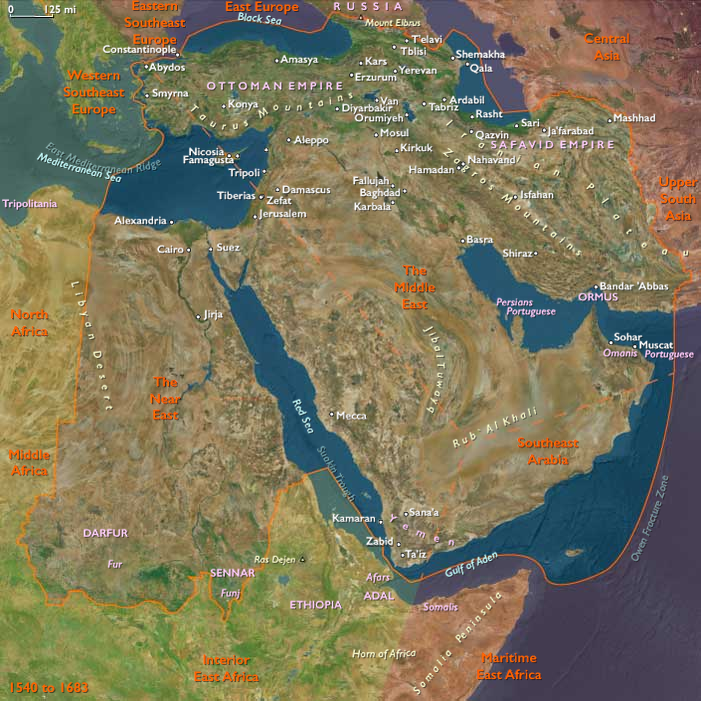
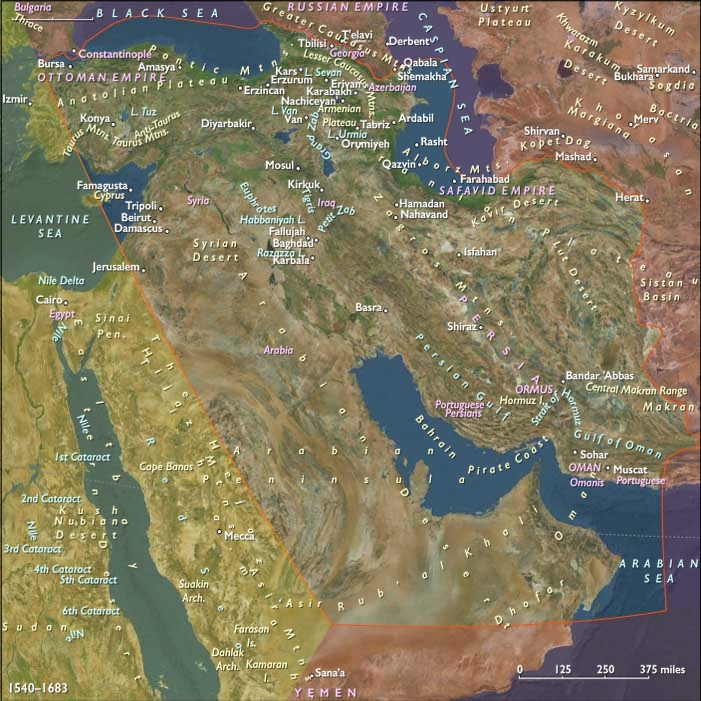
The Portuguese had held the Castle of Ormuz for more than a century, since 1507 when Afonso de Albuquerque had established it in the Capture of Ormuz (1507), giving them full control of the trade between India and Europe through the Persian Gulf and entirely changed the balance of power and trade.
The English side consists of a force supplied by the English East India Company consisting of five warships and four pinnaces.
The Persians had recently gone to war with the Portuguese, and a Persian army is besieging the Portuguese fort in Kishm, but English help is needed to capture Ormuz.
Abbas wishes to obtain English support against the Portuguese, and the commander Imam Kuli Khan, son of Allahverdi Khan, has negotiated with the English to obtain their support, promising the development of silk trade in their favor.
An agreement is signed, providing for the sharing of spoils and customs dues at Hormuz, the repatriations of prisoners according to their faith, and the payment by the Persians of half of the supply costs for the fleet.
The English fleet had gone to Kishm, some 15 miles away, to bombard the Portuguese position.
The Portuguese quickly surrenders, and the English casualties are few, but include the famous explorer William Baffin.
The Anglo-Persian fleet then sails to Ormuz and the Persians disembark to capture the town.
The English bombard the castle and sink the Portuguese fleet, and on April 22, 1622, Ormuz is finally captured.
The Portuguese have to retreat to another base at Maskat.
Locations
People
Groups
- Persia, Safavid Kingdom of
- Ormus, kingdom of (Portuguese-occupied)
- Portugal, Habsburg (Philippine) Kingdom of
- East India Company, British (The Company of Merchants of London Trading into the East Indies)
- England, (Stuart) Kingdom of
Topics
Commodoties
Subjects
Regions
Subregions
Related Events
Showing 10 events out of 32975 total
Years: 1622 - 1622
Locations
People
Groups
- Persia, Safavid Kingdom of
- Ormus, kingdom of (Portuguese-occupied)
- Portugal, Habsburg (Philippine) Kingdom of
- East India Company, British (The Company of Merchants of London Trading into the East Indies)
- England, (Stuart) Kingdom of
Topics
Commodoties
Subjects
Regions
Subregions