
Atlantic West Europe: Civil Strife and Cultural …
Years: 1408 - 1419
Atlantic West Europe: Civil Strife and Cultural Flourishing (1408–1419)
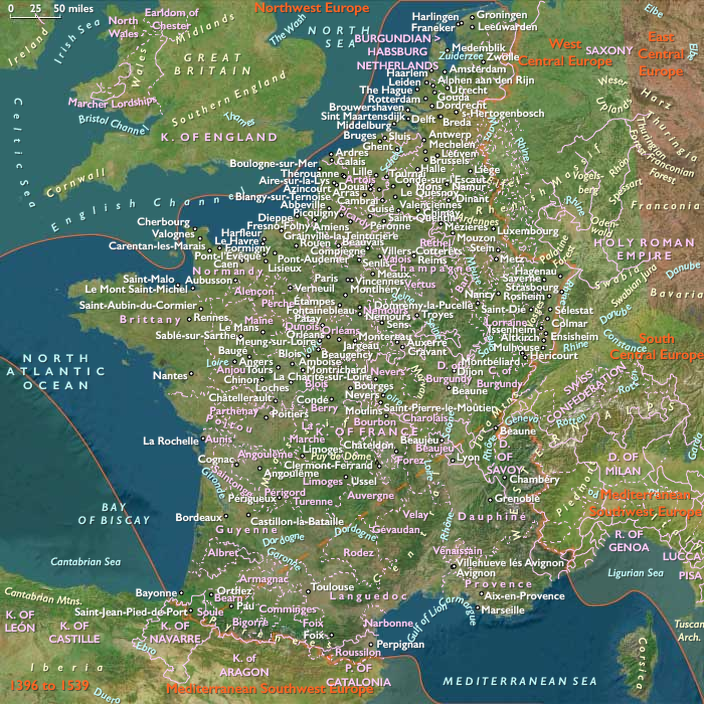
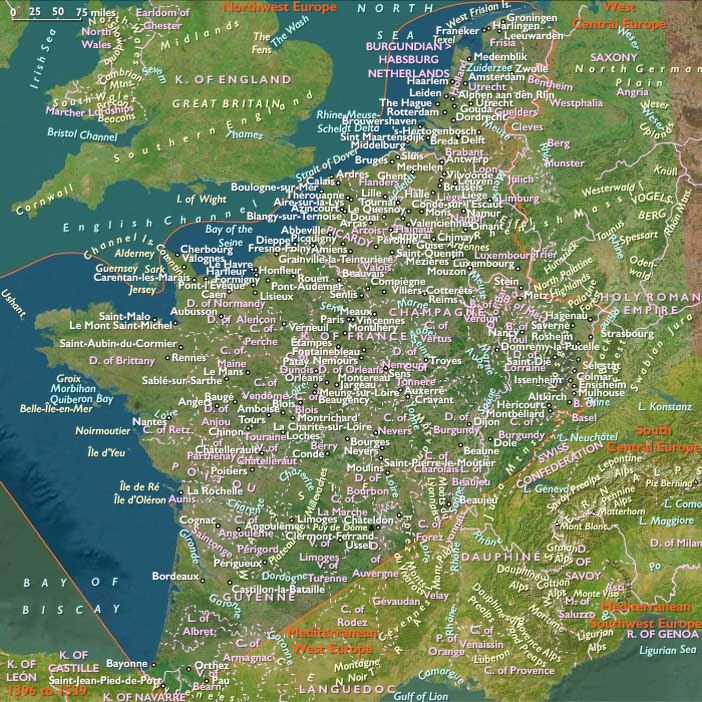
The era of 1408 to 1419 continues the early phase of the Upper Late Medieval Age (1396–1539) in Atlantic West Europe, a region spanning northern France, the Low Countries, and the Loire Valley. These years are defined by heightened internal conflict, notable political upheaval, significant economic adjustments, and considerable artistic and cultural developments.
Political and Military Developments
This era is profoundly shaped by the intensification of the Armagnac–Burgundian Civil War (1407–1435) within France, following the assassination of Louis of Orléans in 1407 by agents of John the Fearless, Duke of Burgundy. The brutal factional rivalry divides French nobility sharply, fueling instability that severely weakens royal authority. In 1415, the Battle of Agincourt dramatically illustrates France’s vulnerability, with the English under Henry V decisively defeating French forces, capturing or killing many of the kingdom’s most important nobles. The following years see English control expand significantly, notably into Normandy and surrounding territories, plunging Atlantic West Europe deeper into political turmoil.
Economic Developments
Despite political unrest, the economy of Atlantic West Europe remains resilient. Flemish cities, particularly Bruges, Ghent, and emerging Antwerp, maintain their prominence as centers of international trade. Yet, intermittent warfare and political disruptions increasingly affect commerce, complicating wool and cloth trade routes between England and the Continent. To counteract these difficulties, merchants and artisans intensify local production and diversify trading connections, bolstering resilience despite political instability.
Cultural and Artistic Trends
Cultural life experiences remarkable growth in this period. Under Burgundian patronage, artistic innovation thrives, particularly in illuminated manuscripts, tapestry-making, and early panel painting. The court of Burgundy, despite its political intrigues, fosters an opulent culture, commissioning works from artists who set a precedent for subsequent artistic movements. Literary production also flourishes, driven by the complex political climate, producing works reflecting contemporary anxieties and critiques, notably those dealing with themes of loyalty, betrayal, and governance.
Technological and Societal Changes
Technological advancements continue gradually, particularly in maritime navigation, as demand grows for safer, more reliable trade routes around war-torn regions. Urban elites further consolidate power in cities like Bruges and Ghent, challenging traditional feudal relationships and shifting societal structures toward more centralized civic governance. These transformations begin redefining regional identity, especially as civic pride and autonomy grow stronger within influential urban centers.
Long-term Consequences and Significance
The years 1408–1419 significantly deepen the region’s internal fractures, embedding tensions that will profoundly influence subsequent decades. The disastrous loss at Agincourt marks a turning point, significantly weakening French royal authority and bolstering English ambitions. Simultaneously, Burgundian influence continues to shape the region culturally, artistically, and politically, laying the groundwork for future power dynamics.
This era solidifies Atlantic West Europe as both a battlefield of powerful dynastic ambitions and a crucible of artistic innovation, shaping the political landscape and cultural heritage for generations to come.
People
Groups
- Flanders, County of
- Normandy, Duchy of
- Burgundy, Duchy of
- France, (Valois) Kingdom of
- Netherlands, Burgundian
- England, (Plantagenet, Lancastrian) Kingdom of
Topics
- Hundred Years' War
- Renaissance literature
- Armagnac-Burgundian Civil War
- Western Art: 1408 to 1420
- Agincourt, Battle of
- Hundred Years' War: Resumption of the war under Henry V
Commodoties
Subjects
Regions
Subregions
Related Events
Showing 10 events out of 42493 total
Years: 1408 - 1419
People
Groups
- Flanders, County of
- Normandy, Duchy of
- Burgundy, Duchy of
- France, (Valois) Kingdom of
- Netherlands, Burgundian
- England, (Plantagenet, Lancastrian) Kingdom of
Topics
- Hundred Years' War
- Renaissance literature
- Armagnac-Burgundian Civil War
- Western Art: 1408 to 1420
- Agincourt, Battle of
- Hundred Years' War: Resumption of the war under Henry V
Commodoties
Subjects
Regions
Subregions