The empress Zoë dies in 1050, leaving …
Years: 1050 - 1050
The empress Zoë dies in 1050, leaving Constantine IX Monomachos as the Empire’s sole effective ruler.
Locations
People
Groups
- Christianity, Chalcedonian
- Greeks, Medieval (Byzantines)
- Roman Empire, Eastern: Macedonian dynasty
- Normans
- Italy, Catepanate of
Topics
Commodoties
Subjects
Regions
Subregions
Related Events
Filter results
Showing 10 events out of 51199 total
Cham king Jaya Paramesvarman and his son Yuvaraja Mahsenapati suppress a revolt in Panduranga, the kingdom’s border province with the Khmer empire.
Yuvaraja’s forces then advance into Khmer territory, and seize Sambhupara, where the Cham troops destroy all the temples and donate looted treasure and prisoners to the Mi-son temples.
Kievan Rus', a union of all the eastern Slavs and several non-Slavic tribes, is Europe’s largest federation by the mid-eleventh century.
Oslo, situated on the small Akershus Peninsula at the head of Oslo Fjord, about sixty miles (ninety-seven kilometers) from the open sea, was already a village around the year 1000 with the St. Clement's Church and the cemetery .
According to Snorri's Heimskringla, the city was built in 1050 by King Harald Hardrada.
Subsequent archaeological excavations and research have established that Oslo had an urban structure as early as the end of the Viking Age.
Nuremberg, located in Bavaria on the Pegnitz River about ninety miles (one hundred and forty-five kilometers) northwest of Munich, first appears in written sources in 1050 as the location of an Imperial castle between the East Franks and the Bavarian March of the Nordgau.
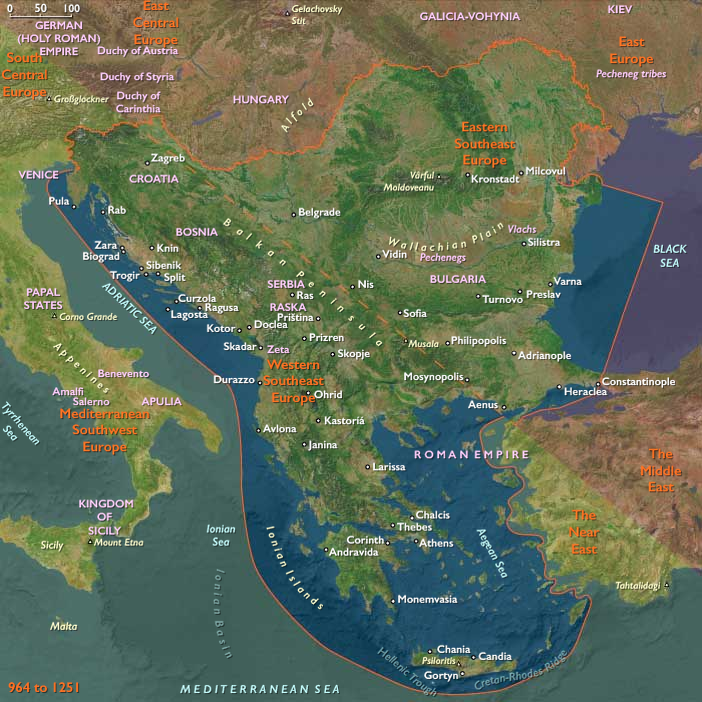
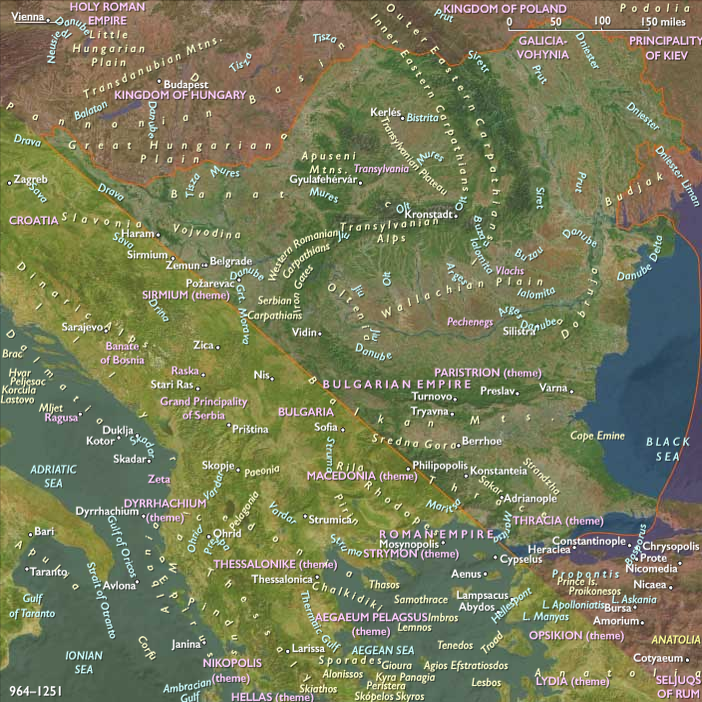
Constantine IX has allowed the Pechenegs to settle south of the Danube, where their numbers and their ambitions have increased.
By the mid-eleventh century, however, the Pechenegs are a constant menace to the peace in Thrace and Macedonia, and they encourage the spirit of revolt among the Bogomil heretics in Bulgaria.
Nikephoros Bryennios, who hails from Adrianople, had risen to become the ethnarch responsible for commanding foreign mercenaries in the Macedonian Theme.
He first appears in 1050, when he inflicts a heavy defeat on the Pechenegs, who have been raiding the Empire's Balkan provinces for years.
This victory puts an end to these raids for some time.
The Fatimid governors of Damascus and Hims had coordinated an attack against the Mirdasids of Aleppo in 1048.
The Mirdasid amir, Thimal, had managed to force the Fatimid army to retreat to Damascus, following which he had attempted to negotiate a peace with Cairo officials.
This had not prevented a second Fatimid expedition from being undertaken against him.
The imperial government in Constantinople had attempted to mediate a peace between the two sides; after being unsuccessful in this effort, the Emperor had sent imperial forces into the region to make sure the situation did not get completely out of hand.
Fortunately for Thimal, the Fatimid army is extremely heterogeneous, consisting of Berbers, Turks, Sub-Saharan Africans and Bedouins, making it difficult to control.
In August 1050, Thimal's army defeats the Fatimids at Djabal Djawshin near Aleppo and captures their commander, who dies shortly after.
A peace is eventually established between the Mirdasids and Fatimids, with the Fatimid caliph recognizing Thimal as his vassal in all the lands that he controls.
The intense competition between the kingdoms of the western Deccan and those of the Tamil kingdoms come to the fore in the eleventh century over the acutely contested fertile river valleys in the doab region of the Krishna and Godavari River called Vengi (modern coastal Andhra Pradesh).
The Western Chalukyas and the Chola Dynasty fight many bitter wars over control of this strategic resource.
The imperial Cholas had gained power during the time of the famous king Rajaraja Chola I and the crown prince Rajendra Chola I.
The Eastern Chalukyas of Vengi are cousins of the Western Chalukyas but have become increasingly influenced by the Cholas through their marital ties with the Tamil kingdom.
As this is against the interests of the Western Chalukyas, they had wasted no time in involving themselves politically and militarily in Vengi.
When King Satyasraya succeeded Tailapa II to the throne in 997, he had been able to protect his kingdom from Chola aggression as well as his northern territories in Konkan and Gujarat although his control over Vengi was shaky.
His successor, Jayasimha II, had fought many battles with the Cholas in the south while both powerful kingdoms struggled to choose the Vengi king.
Simultaneously, Jayasimha II had subdued the Paramara of central India.
It is known from records that Jayasimha's son, Somesvara I, moved the Chalukya capital to Kalyani, today's Basavakalyan, in about 1042 as hostilities with the Cholas continued and while both sides win and lose battles, neither has lost significant territory during the ongoing politics of installing a puppet on the Vengi throne.
Rajadhiraja Chola I, on becoming the Chola king in 1042, had immediately sought to restore Chola power in Vengi.
He had personally led a force to the Vengi kingdom and defeated the occupying Western Chalukya forces there at the battle of Dannada on the Krishna River and made Somesvara's son Vikramaditya (the later Vikramaditya VI ) and Vijayaditya retreat.
Rajadhiraja had then entered the Western Chalukya territories and sacked the fort at Kollipakkai (in present day Andhra Pradesh).
Rajadhiraja thad hus enabled the Eastern Chalukya Rajaraja Narendra to get some respite.
Rajadhiraja had continued his campaign on the western front and in several battles defeated the Chalukya army, demolished the Chalukya palace in the city of Kampili, in present day Bellary district.
The victorious Chola army had planted a victory pillar at Yedagiri.
After more fighting, the Chalukya capital Kalyani itself had been occupied in 1045.
Rajadhiraja had celebrated a coronation in the Chalukya capital and assumed the title of Virarajendra.
The Chola occupation is, however, short lived.
Somesvara manages to defeat and drive the Chola forces out of the Chalukya territories by 1050.
He also manages to revive his influence in Vengi and forces Rajaraja Narendra to acknowledge this suzerainty.

The Council of Narbonne, convened in 1050, officially forbids Christians throughout Western Europe to live in Jewish homes.
Its implementation, as with many Church council declarations, depends on external factors and location.
The power of Pisa as a mighty maritime nation begins to grow and reaches its apex in the eleventh century, when it acquires traditional fame as one of the four main historical Maritime Republics of Italy (Repubbliche Marinare).
At this time, the city is a very important commercial center and controls a significant Mediterranean merchant fleet and navy.
It had expanded its powers in 1005 through the sack of Reggio Calabria in the south of Italy.
Pisa is in continuous conflict with the Saracens, who had their bases in Corsica, for control of the Mediterranean.
In 1017, Sardinian Giudicati had been militarily supported by Pisa, in alliance with Genoa, to defeat the Saracen King Mugahid, who had settled a logistic base in the north of Sardinia the year before.
This victory had given Pisa supremacy in the Tyrrhenian Sea.
When the Pisans subsequently ousted the Genoese from Sardinia, a new conflict and rivalry had been born between these mighty marine republics.
Between 1030 and 1035, Pisa had gone on to defeat several rival towns in Sicily and conquer Carthage in North Africa.
In 1051–1052, the admiral Jacopo Ciurini conquers Corsica, provoking more resentment from the Genoese.
Palermo has a population of three hundred and fifty thousand by 1050, making it one of the largest cities in Europe, second only to Islamic Spain's capital Cordova, which has a population of four hundred and fifty thousand.
Years: 1050 - 1050
Locations
People
Groups
- Christianity, Chalcedonian
- Greeks, Medieval (Byzantines)
- Roman Empire, Eastern: Macedonian dynasty
- Normans
- Italy, Catepanate of