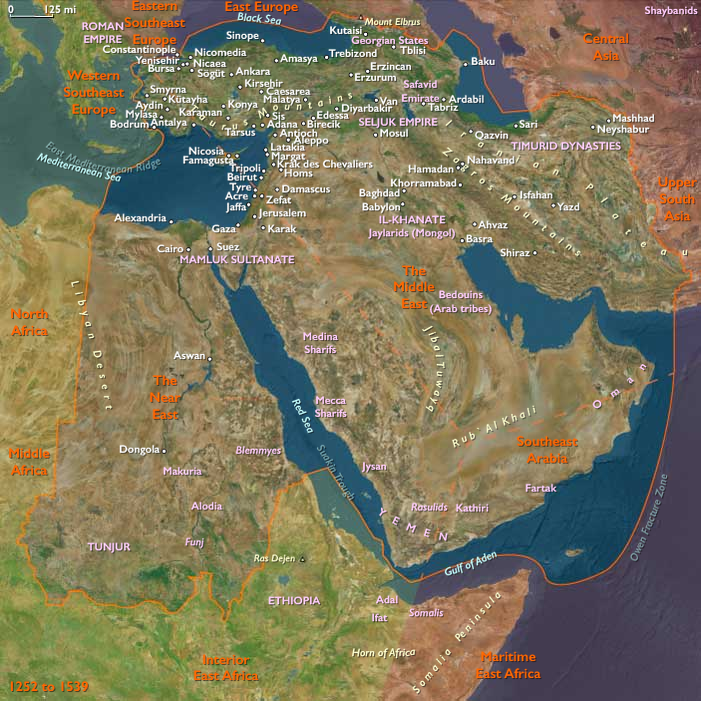
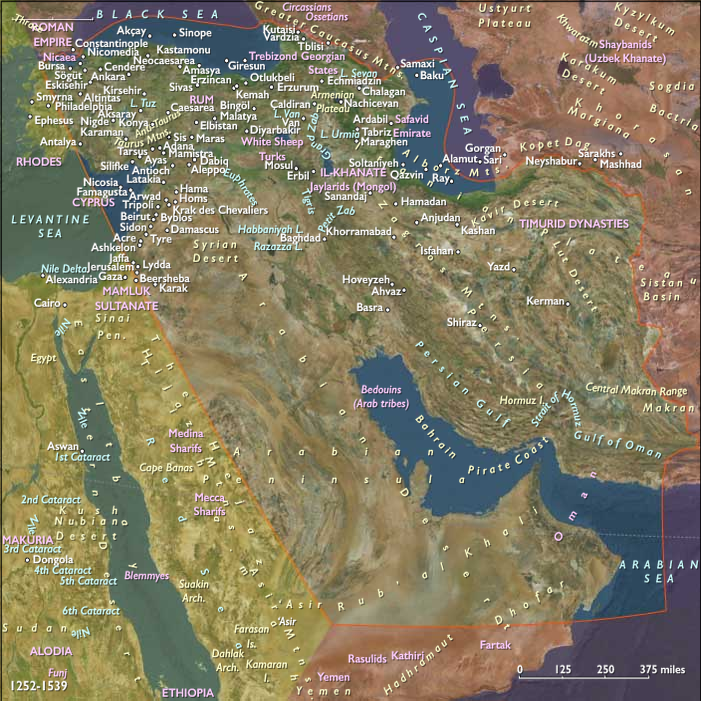
The Nicaea Empire has not dissipated its …
Years: 1259 - 1259
The Nicaea Empire has not dissipated its strength by stretching the frontiers into Europe, for the possession of Thessalonica balances that of Nicaea.
Locations
People
Groups
Topics
Commodoties
Subjects
Regions
Subregions
Related Events
Filter results
Showing 10 events out of 46073 total
Möngke, taking command personally late in the decade, has captured many of the Song’s fortified cities along the northern front.
These actions ultimately rendered the conquest a matter of time.
Having waged a series of brilliantly successful campaigns against the Song between 1257 and 1259, Möngke dies on August 11, 1259 near the site of the siege of Fishing Town in modern-day Chongqing.
The Khan’s sudden death halts the war and allows the Song time to revive.
There are several different accounts as to how he perished.
One was that he had been killed by an arrow shot from a Chinese archer during the siege.
Other accounts claim that he was killed by dysentery or even a cholera epidemic.
In any case, his death will ultimately force Hulagu to abort his campaign in Syria and Egypt, and cause another succession crisis, as Kublai and his brother Ariq Böke both claim the Mongol throne.
The ensuing civil war will destroy the unity and invincibility of the Mongol Empire.
The Mongols under Jalairtai Qorchi, in the final successful campaign against Korea, have launched four devastating invasions between 1253 and 1258 at tremendous cost to civilian lives throughout the Korean peninsula.
The Mongols annex the northern provinces of Korea after the invasions and incorporate them into their empire.
The long-ruling Ch’oe military family had in 1258 been forced from power in Koryo; their civilian successor in 1259 acknowledges Mongol suzerainty.
The treaty permits the sovereign power and traditional cultures of Goryeo, and implies that the Mongols have given up controlling Goryeo by direct rule.
The Chinese official Li Zengbo writes in his Kozhai Zagao, Xugaohou that the city of Qingzhou is manufacturing one to two thousand strong iron-cased gunpowder bomb shells a month during the Song dynasty's war with the Mongols, dispatching to Xiangyang and Yingzhou about ten to twenty thousand such bombs at a time.
Möngke’s sudden death from dysentery during the campaign against the Song fortress of Hezhou leads to another succession crisis, as Kublai and his younger brother Ariq Böge, sons of Genghis Khan’s son Tolui, both claim the Mongol throne.
Arigböge, supported by the traditionalists who distrust Kublai’s modernizing bent, summons a kuriltai at Karakorum, about two weeks after a similar event convoked by Kublai at Zhongdu.
Both are elected supreme ruler, or khakhan.
Kublai sends an army toward Karakorum, but Ariq Böge retreats westward with his forces.
The two Mongol armies clash, then withdraw without a decisive settlement.
Möngke has conducted a census of the Mongol Empire from 1252–1259.
While that of China had been completed in 1252, Novgorod in the far northwest is not counted until winter 1258–59.
The Novgorod Republic had managed to escape the horrors of the Mongol invasion, not through any feat of arms, but because the Mongol commanders probably had not wanted to get bogged down in the marshlands surrounding the city and had turned back one hundred kilometers from Novogorod.
Despite never having been formally conquered, the Republic has begun to pay tribute to the khans of the Blue Horde.
Mongol tax-collectors and census-takers arrive in the city in 1259, leading to political disturbances in the city and forcing Alexander Nevsky to punish a number of town officials (he cuts off their noses) for defying him as Grand Prince of Vladimir (soon to be the khan's tax-collector in Russia) and his Mongol overlords.
The new census counts not only households but also the number of men aged fifteen to sixty and the number of fields, livestock, vineyards, and orchards.
Within the civilian register, craftsmen are listed separately while in the military registers, auxiliary and regular households are distinguished.
Clergy of the approved religions are separated and not counted.
When the new register is completed, one copy is sent to Karakorum and one copy kept for the local administration.
Möngke tries to create a fixed poll tax collected by imperial agents, which could forward to the needy units.
Initially, the maximum rate had been fixed at ten to eleven gold dinars in the West Asia and six to seven taels of silver in China, but protests from the landlord classes had reduced this relatively low rate to six to seven dinars and taels.
Some of Möngke's officials had raised the top rate on the wealthy of five hundred dinars.
Although the reform of the taxation does not lighten the tax burden, it makes the payments more predictable.
Even so, the census and the regressive taxation it facilitated sparks popular riots and resistance in the western districts.
Alexander Nevsky, who has proved to be a cautious and far-sighted politician, dismisses the Roman Curia’s attempts to cause war between Russia and the Blue Horde, because he understands the uselessness of such war with Tatars at this time since they remain a powerful force.
Nevsky tries to strengthen his authority at the expense of the boyars and at the same time suppress any anti-Muscovite uprisings in the country, such as the Novgorod uprising of 1259.
The Kingdom of Denmark had reached a high point during the reign of Valdemar II, who had forged a Danish "Baltic Sea Empire", which by 1221 extended control from Estonia in the east to Norway in the north.
In this period, several of the "regional" law codes had been given; notably the Code of Jutland from 1241, which asserts several modern concepts like right of property; "that the king cannot rule without and beyond the law"; "and that all men are equal to the law".
Following the death of Valdemar II in 1241, the kingdom is in general decline due to internal strife and the rise of the Hanseatic League.
The competition between Valdemar’s sons—Erik IV “Plough-tax,” Abel, Duke of Schleswig, and Christopher I—will have the long term result that the southern parts of Jutland will become separated from the kingdom of Denmark and become semi-independent vassal duchies/counties.
Eric was supposedly murdered by his brother Abel in 1250; Christopher, elected King upon the death of his older brother Abel in the summer of 1252, has spent most of his reign trying to fight his many opponents.
By accepting Abel's sons as rulers of South Jutland, he has prevented their demands on the throne but in return the border district is now more or less independent.
He has also had to be reconciled with the kings of Norway and Sweden, who had been provoked by Abel's interventions.
Finally, he has had to yield to some of the political demands of the Danish magnates.
The Danehof seems to have become an institution during his rule.
Christopher’s men had arrested and humiliated the proud and self-righteous Archbishop Jakob Erlandsen after Erlandsen had refused to recognize Christopher's son, Eric, as his (Christopher's) rightful successor.
While trying to have his brother Eric canonized, Christopher finds himself excommunicated from the Catholic Church, but the excommunication has little or no effect.
Dying very "unexpectedly" and shortly after taking the Holy Communion on May 29, 1259, Christopher is buried in consecrated ground by the Bishop of Ribe.
His son succeeds him as Eric V under the auspices of his mother, the competent Queen Dowager Margaret Sambiria.
Eric's succession overrides the rights of the descendants of earlier monarchs, counter to the dictates of agnatic seniority.
However, since the reputations of the sons of Abel of Denmark are tainted by acts of fratricide and murder, it is relatively easy to ignore their claims to the throne.
Eric’s accession leads to what will be serious rivalry for generations, yet Christopher's line will be able to successfully retain their claim to the Danish throne.

The Mongols raid Bitom, one of the oldest cities of Upper Silesia.
Chartered by Bohemia only five years earlier, the city had grown owing to its location on a strategic crossroads.
(The city, slowly Germanized from the fourteenth century, will become known as Beuthen but will see its German population expelled in the aftermath of the Second World War.
Today known as Bytom, it is one of the main cities of Poland’s Upper Silesian Metropolitan Union.)
Invading Tatar forces led by Nogai Khan, a promising nephew of Berke who has become an ambitious and powerful warlord, plunder several villages of northern Poland during the rule of Boleslaw V, and such cities as Kraków, ...
…Zawichost, …
…Sandomierz, and other cities with the famous Mongol general Burundai, who had led the force that had overcome the resistance of Danylo of Halych earlier in the year.