
The Empire takes over the briefly independent …
Years: 1094 - 1094
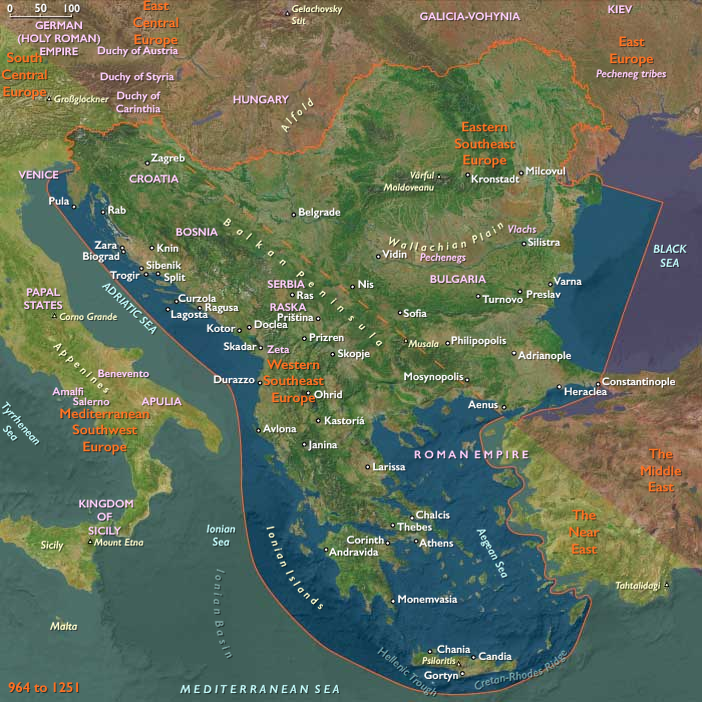
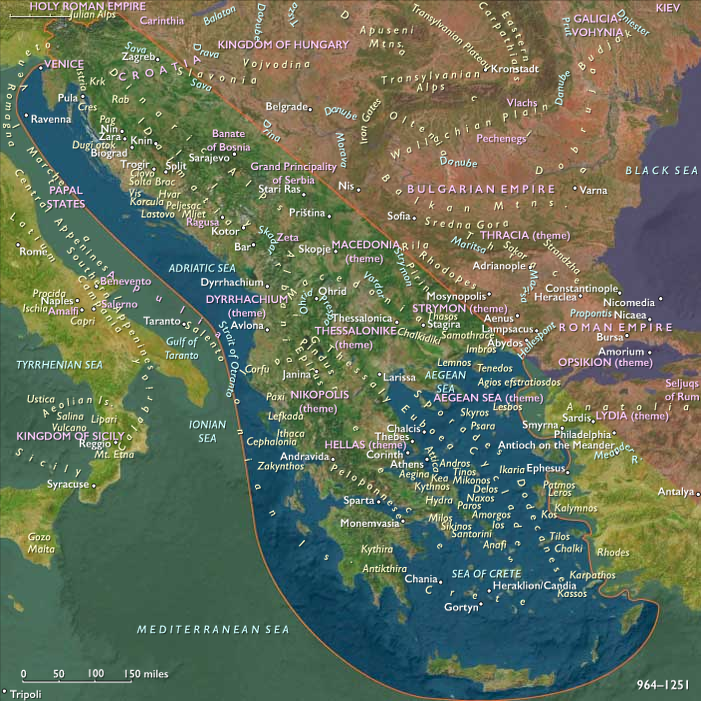
The Empire takes over the briefly independent Serbian state of Duklja on the Adriatic coast in 1094.
Locations
People
Groups
- Slavs, South
- Greeks, Medieval (Byzantines)
- Croatia, Kingdom of
- Duklja, or Doclea
- Christians, Roman Catholic
- Christians, Eastern Orthodox
- Roman Empire, Eastern: Komnenos dynasty, restored
Topics
Subjects
Regions
Subregions
Related Events
Filter results
Showing 10 events out of 50253 total
The Cumans attack the Pechenegs again in 1094, many Pechenegs are again slain; others are absorbed.
The remnants flee to Hungary.
For some four centuries, significant communities of Pechenegs will remain in the Kingdom of Hungary.
With time, the Balkan Pechenegs will lose their national identity and be fully assimilated, mostly with Hungarians and Bulgarians.
The Seljuqs have wrested Syria, Palestine and the Hejaz from the Fatimids, who, having lost both Crete and Cyprus to Constantinople in the 960s, now hold only Egypt.
While the Fatimids had been tolerant of Christian pilgrimage, the Seljuqs are not.
The Eastern Romans, driven from all but the coastal regions of Asia Minor, and with Nicaea in Turkish hands by 1092, face a resurgent Islam perilously close to the capital.
With stability at last achieved in the Empire’s western holding, Alexios now has a chance to begin solving his severe economic difficulties and the disintegration of the empire's traditional defenses.
In order to reestablish the army, Alexios has begin to build a new force on the basis of feudal grants (próniai) and prepares to advance against the Seljuqs, who have conquered Asia Minor and are now established at Nicaea.
Despite his improvements, Alexios has insufficient manpower to recover the lost territories in Asia Minor.
Having been impressed by the abilities of the Norman cavalry at Dyrrhachium, he sends ambassadors west to ask for reinforcements from Europe.
Hassan Sabbah is the supposed founder of the so-called Assassins of Persia, an anti-Sunnite Ismaili Muslim sect.
The Assassins, in one of their first political killings, are supposedly behind the killing of Malik Shah’s Persian minister, the seventy-four-year-old Nizam al-Mulk, on October 14, 1092, thus (eventually) lending their name to the later English word for a politically motivated murderer.
The Seljuq sultan, Malik Shah, dies a few weeks later in November at age thirty-seven.
At the death, in 1094, of Fatimid caliph al-Mustansir, the caliphate in Egypt is divided between his two sons.
Sabbah, leading a group of fanatical Ismaili partisans of al-Mustansir’s deposed eldest son, Nizar, seizes a string of mountain fortresses in northern Persia—notably Alamut in Daylam in the Elburz Mountains—and Syria, waging from these strongholds a war of terror against orthodox Muslims in their effort to create a new Fatimid caliphate.
(This group, joining with Sabbah’s terrorists, is known in the West as Assassins, a designation that derives from the Arabic ”hashashin,” meaning "users of hashish," based on stories—unconfirmed in any Ismaili sources—related by Marco Polo and others that the group employs hallucinatory drugs to stimulate them to their murderous acts.)
Al-Afdal Shahanshah was born in Acre, the son of Badr al-Jamali, the Armenian mamluk who had become Muslim.
Badr has served as vizier for the Fatimids in Cairo from 1074 until his death in 1094, when al-Afdal succeeds him.
Caliph Ma'ad al-Mustansir Billah dies soon afterwards, and al-Afdal appoints as caliph al-Musta'li, a child, instead of Musta'li's much older brother Nizar.
Al-Afdal claims that Imam Mustansir had changed his choice of successor upon his death bed, appointing his younger son (who is married to the daughter of Badr al-Jamali, the sister of al-Afdal Shahanshah).
King Ladislaus of Hungary in 1094 establishes the Zagreb bishopric, which is destined to become the ecclesiastical center of Croatia.
The Moorish emirate of Badajoz falls to the Almoravids in 1094, leaving the Moorish emirate of Valencia the only polity in southern Iberia not under the control of the Almoravids, whose restoration of a centralized Moorish power effectively blocks the further progress of the Christian “reconquista.”
An attempt to break the siege of Valenica in December 1093 had failed.
The Valencians resist Vivar’s forces until starvation finally forces their capitulation on June 17, 1094, by which time El Cid has carved out his own principality on the coast of the Mediterranean.
Officially El Cid rules in the name of Alfonso; in reality, El Cid is fully independent.
The city is both Christian and Muslim, and both Moors and Christians serve in the army and as administrators.
As the new ruler of the city of Valencia and the surrounding region of the same name, El Cid permits freedom of worship and property ownership subject to payment of tribute.
He becomes known as the Cid (lord, “el Cid Campeador”).
In October of 1094, the Almoravids invade, but the Cid’s soldiers repulse the attackers at the Battle of Cuarte outside the city walls, forcing them to flee.
Conrad is at the height of his power in 1094, when his father is staying with Margrave Henry and Patriarch Udalric in the March of Verona, unable to enter Italy.
His antipope, Clement III, elected at the Synod of Brixen in 1080, who is traveling with him, even offers to resign so that Henry can negotiate with Pope Urban II if that is all that stands in the way.
A contemporary tract, Altercatio inter Urbanum et Clementum, argues the two popes claims should be adjudicated by a council.
The first St. Mark's had been a building next to the Doge's Palace, ordered by the doge in 828, when Venetian merchants stole the supposed relics of Mark the Evangelist from Alexandria, and completed by 832; from the same century dates the first St. Mark's Campanile (bell tower).
The church was burned in a rebellion in 976, when the populace locked Pietro IV Candiano inside to kill him, and restored or rebuilt in 978.
Nothing certain is known of the form of these early churches.
From perhaps 1073, the present basilica was constructed.
The consecration is variously recorded as being in 1084-5, 1093 (the date most often taken), 1102 and 1117, probably reflecting a series of consecrations of different parts.
The building also incorporates a low tower (now housing St. Mark’s Treasure), believed by some to have been part of the original Doge's Palace.
In 1094, the body supposed that of Saint Mark is rediscovered in a pillar by Vitale Faliero, the current doge.
Vitale Faliero is a member of a noble Venetian family, probably from Fano.
A member of the minor consiglio (the council of doge's advisers), he had been elected Doge in the revolt that overthrew Domenico Selvo in December 1084, probably initiated by Faliero himself, among others.
He is the first Doge whose image is known, being allegedly portrayed next to the high altar of St. Mark's Basilica.
During the latter part of his reign the city has been hit by an earthquake, a seastorm, and a heavy famine.
Henry Expands His Power in Normandy with Support from William Rufus (1092–1094)
By 1094, Henry had successfully rebuilt his power base in western Normandy, operating as if he were the Duke, distributing lands and castles to his followers. With William Rufus now backing him financially, Henry strengthened his position against their mutual rival, Duke Robert Curthose. As William Rufus launched a new campaign into Normandy, Henry’s role became increasingly important, though ambiguous, as he maneuvered between Norman and English politics.
Henry's Growing Authority in Western Normandy (1092–1094)
- Over the past two years, Henry had reestablished a network of supporters, particularly in western Normandy.
- By 1094, he was granting lands and castles to his followers like a ruling duke, despite Robert Curthose still being the nominal Duke of Normandy.
- William Rufus saw Henry as a useful counterbalance to Robert and began supporting him financially, helping fuel Henry’s military expansion.
- Henry used part of this financial backing to build a strong castle at Domfront, further securing his territorial hold.
William Rufus’ 1094 Invasion of Normandy and Henry’s Role
- In 1094, William Rufus crossed into Normandy, taking the war directly to Robert Curthose.
- As the campaign stalled, William called upon Henry for assistance.
- However, instead of joining the main front, Henry traveled to London—possibly at the king’s request.
- Shortly after, William abandoned the campaign and returned to England, leaving Robert’s position temporarily intact.
Henry’s Continued Rise in Normandy (1094–1096)
- Over the next few years, Henry strengthened his influence in western Normandy, maintaining his own faction within the duchy.
- He continued to visit England, attending William Rufus’ court occasionally, ensuring he remained in the king’s favor.
- His dual position—as a rising force in Normandy and a recognized noble in England—placed him in a powerful intermediary role between his feuding brothers.
Consequences and Long-Term Impact
- Henry’s increasing autonomy in Normandy set the stage for his eventual claim to power, as he continued building his influence despite not officially being duke.
- His ties to William Rufus gave him resources, but also showed his pragmatism, as he navigated between Norman and English politics.
- Robert’s inability to suppress Henry’s rise further demonstrated his weakness as Duke, foreshadowing the eventual loss of Normandy to Henry in 1106.
By 1094, Henry had transitioned from exile to power broker, and while his path to the ducal throne was not yet clear, he had firmly entrenched himself as a force to be reckoned with in both Normandy and England.
Years: 1094 - 1094
Locations
People
Groups
- Slavs, South
- Greeks, Medieval (Byzantines)
- Croatia, Kingdom of
- Duklja, or Doclea
- Christians, Roman Catholic
- Christians, Eastern Orthodox
- Roman Empire, Eastern: Komnenos dynasty, restored
