
The Empire, after a series of successful …
Years: 917 - 917
August
The Empire, after a series of successful campaigns, has stabilized its eastern borders by 917, and the generals John Bogas and Leo Phokas are able to gather additional troops from Asia Minor, to reinforce the imperial tagmata and the European thematic troops, gathering a force of some thirty thousand to sixty-two thousand men.
This is a very large army by contemporary standards, and its goal is the elimination of the Bulgarian threat from the north.
The troops are paid in advance and a fleet commanded by Romanos Lekapenos sets off to the north at the mouth of the Danube.
The Greeks had tried to pay some Pecheneg tribes to attack, but Romanus will not agree to transport them across the Danube, and instead they attack Bulgarian territory on their own.
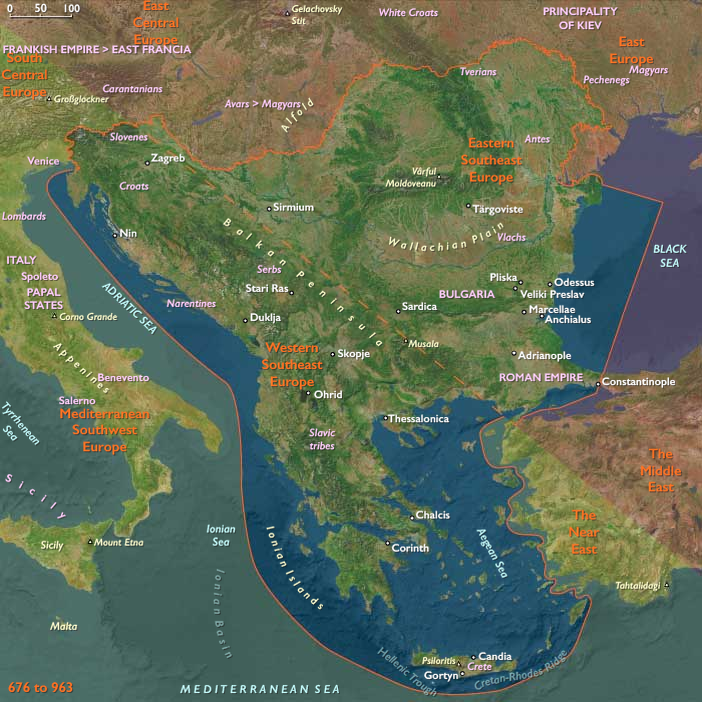
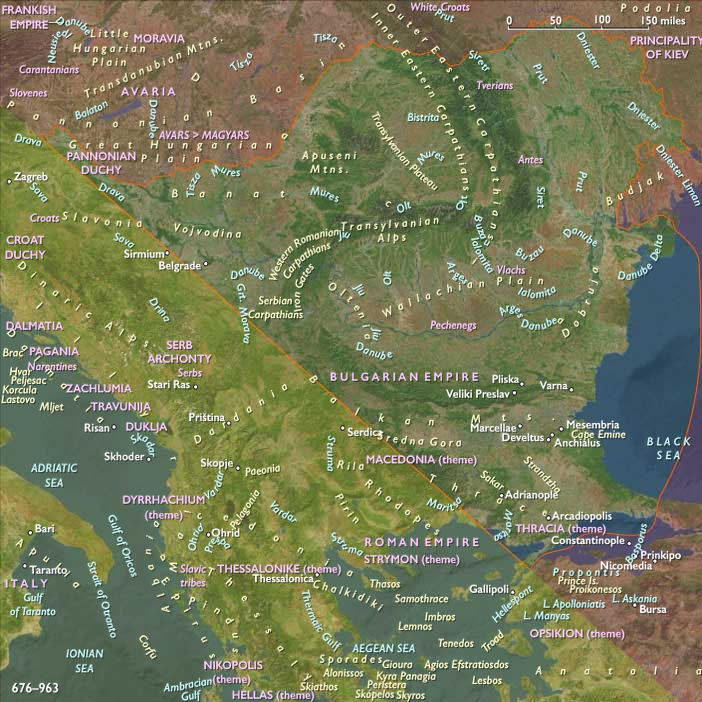
The imperial army marches northwards and sets its camp in the vicinity of the strong fortress of Anchialus.
Leo Phokas intends to invade Moesia and meet the Pechenegs and Lekapenos's troops in Dobrudzha.
Simeon swiftly concentrates his army on the heights around the fortress.
On the morning of August 20, 917, the battle between the Bulgarians and the Greeks begins by the river Achelous near the modern village Acheloi, eight kilometers to the north of Anchialus (modern Pomorie) on Bulgaria's Black Sea coast.
The imperial generals plan to outflank the right Bulgarian wing in order to detach Simeon's troops from the Balkan Passes.
The Bulgarian ruler concentrates his most powerful forces in the two wings and leaves the center relatively weak in order to surround the enemy when the center would yield to the imperial attack.
Simeon himself is in charge of large cavalry reserves hidden behind the hills which are intended to strike the decisive blow.
The imperial attack is fierce and it is not long before the Bulgarians begin slowly to retreat.
The enemy cavalry charges the infantry in the center, killing many Bulgarians.
The Bulgarian position becomes desperate as they cannot manage to hold the heights to the south of the river and begin a hasty retreat to the north.
Elated, the imperial troops give chase and their battle formations soon begin to break, especially as a rumor spreads that their commander, Leo Phokas, has been killed.
At this point, Simeon, who has detected the disarray in the imperial formation, orders his army to stand, and, at the head of his heavy cavalry corps, attacks the imperial left wing from behind the hills.
With an irresistible onslaught, the cavalry bears down on the confused enemy, who immediately bend under their attack, panic and take to their heels.
Some imperial officers try to repulse the cavalry charge but they are also attacked by the infantry.
Tsar Simeon personally takes part in the fight, his white horse killed at the height of the battle.
The imperial army is completely routed.
Leo Phokas is saved by fleeing to Mesembria (modern Nesebar) in Bulgaria, but in the thick of the battle Constantine Lips, John Grapson and many other commanders (archontes) are cut down along with an enormous number of soldiers and officers.
By the end of the day, the Bulgarians overwhelm the defenders of Mesembria and capture the town.
Leo Phocas barely escapes by boarding a ship.
The Byzantine historian Leo the Deacon says that seventy-five years after this military catastrophe the field at Anchialus was still covered with tens of thousands of Roman skeletons.
The battle is among the bloodiest of medieval history.
Locations
People
- Constantine VII
- Leo Phokas the Elder
- Nicholas Mystikos
- Romanos I Lekapenos
- Simeon I of Bulgaria
- Zoe Karbonopsina
Groups
- Greeks, Medieval (Byzantines)
- Bulgarians (South Slavs)
- Serbian Principality
- Pechenegs, or Patzinaks
- Roman Empire, Eastern: Macedonian dynasty
- Bulgarian Empire (First)
- Hungary, Principality of
Topics
- Byzantine-Bulgarian Wars
- Bulgarian-Serbian Wars
- Croatian–Bulgarian wars
- Bulgarian–Hungarian wars
- Bulgarian-Byzantine War of 913-27
- Achelous, Battle of
Commodoties
Subjects
Regions
Subregions
Years: 917 - 917
August
Locations
People
- Constantine VII
- Leo Phokas the Elder
- Nicholas Mystikos
- Romanos I Lekapenos
- Simeon I of Bulgaria
- Zoe Karbonopsina
Groups
- Greeks, Medieval (Byzantines)
- Bulgarians (South Slavs)
- Serbian Principality
- Pechenegs, or Patzinaks
- Roman Empire, Eastern: Macedonian dynasty
- Bulgarian Empire (First)
- Hungary, Principality of
Topics
- Byzantine-Bulgarian Wars
- Bulgarian-Serbian Wars
- Croatian–Bulgarian wars
- Bulgarian–Hungarian wars
- Bulgarian-Byzantine War of 913-27
- Achelous, Battle of
Commodoties
Subjects
Regions
Subregions