The Emirate of Granada, the remnant of …
Years: 1269 - 1269
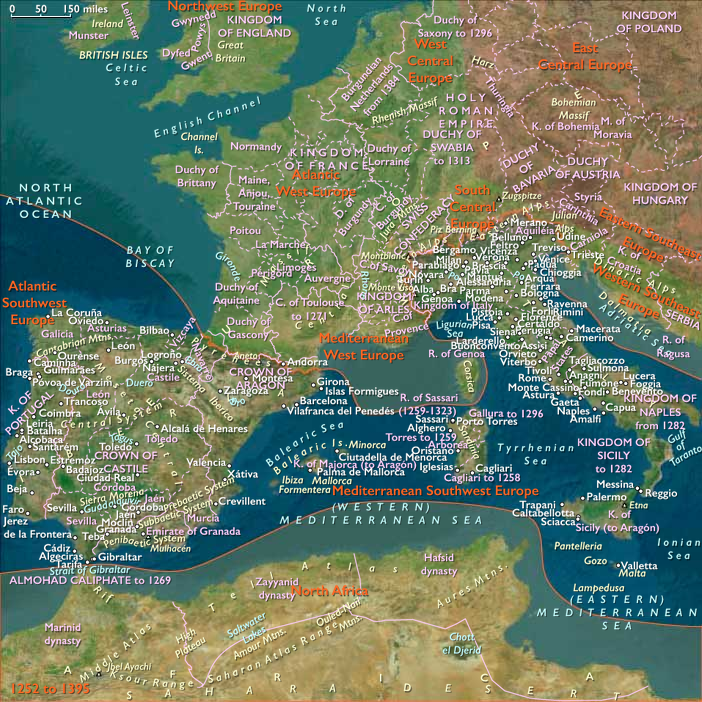
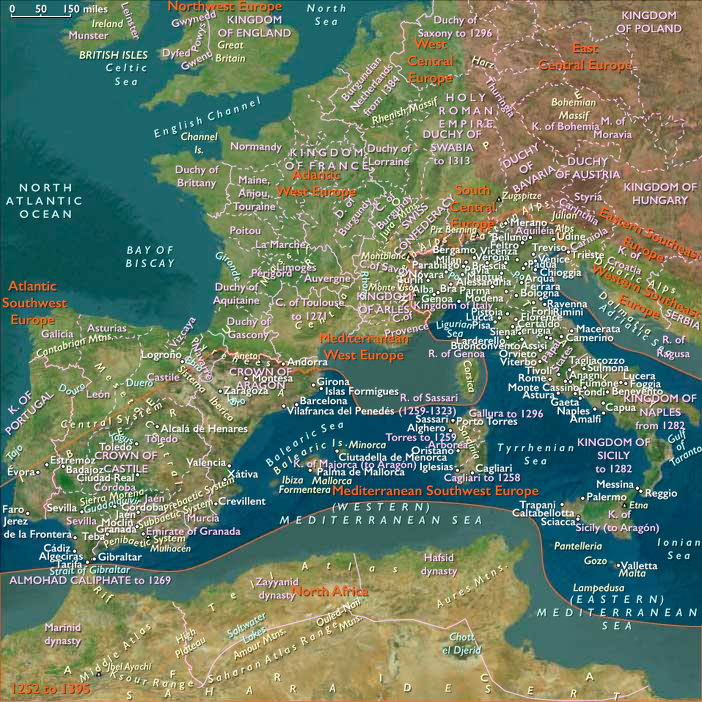
The Emirate of Granada, the remnant of Islamic Spain, remains independent of the new Marinid state in the western Maghreb.
Locations
People
Groups
- Moors
- Almohad Caliphate
- Granada, Emirate of, or Nasrid Kingdom of
- Marinid Dynasty (Sultanate of Morocco)
Topics
Commodoties
Subjects
Regions
Subregions
Related Events
Filter results
Showing 10 events out of 45771 total
Otto von Lutterberg, Grand Master of the Livonian Order, lays siege to Pskov in 1269, but Daumantas, supported by the Novgorodians, repels the attack, personally wounding Lutterberg in battle.
The knights seek peace at any cost and their attacks on Pskov and Novgorod cease for thirty years.
The deposition of Emperor Frederick II of Hohenstaufen by Pope Innocent IV in 1245 created a grave crisis for the Holy Roman Empire, as in the following decades several nobles have been elected as Rex Romanorum and Emperor-to-be, none of whom had been able to gain actual governing power upon the Emperor's death in 1250.
That same year, Ottokar, son of king Wenceslaus I of Bohemia, had moved into the princeless Duchies of Austria and Styria.
The last Babenberg duke Frederick II of Austria had been killed at the 1246 Battle of the Leitha River, in a border conflict he had picked with King Béla IV of Hungary.
Ottokar, having gained the support of the local nobility, had been proclaimed Austrian and Styrian duke by the estates one year later.
He becomes Bohemian king Ottokar II upon the death of his father in 1253; the concentration of power on the western Hungarian border had been viewed with suspicion by King Béla IV, who campaigned against Austria and Styria but was finally defeated at the 1260 Battle of Kressenbrunn.
King Ottokar II of Bohemia inherits Carinthia and part of Carniola in 1269, making him the most powerful prince within the Holy Roman Empire as well one of the most powerful men in Europe.
The Emperor's promise provokes the violent opposition of most of Michael's own people, who oppose union on doctrinal grounds; specifically they object to such parts of the Latin liturgy as the Filioque (procession of the Holy Spirit from the Son and the Father) and the use of the azyme (unleavened bread).
Perhaps more important, most of them refuse to accept papal ecclesiastical supremacy, which they feel, however obscurely, would lead to restoration of Latin political domination and possibly even cultural assimilation to the Latins.
Abaqa is one in a long line of Mongol rulers who attempt to secure Western cooperation against the Muslim Mamluks.
He had corresponded with Pope Clement IV through 1267-1268, and had reportedly sent a Mongol ambassador in 1268, trying to form a Franco-Mongol alliance between his forces, those of the West, and those of his father-in-law, Emperor Michael VIII.
He has received responses from Rome and from James I of Aragon, though it is unclear if this was what led to James’s unsuccessful expedition to Acre in 1269.
Abaqa is recorded as having written to the Aragonese king, saying that he was going to send his brother Aghai to join it when it arrived in Cilicia.
The Egyptian Mamluks gain control of Mecca in 1269.
The dwindling crusader kingdom of Jerusalem-Acre has been governed by absentee rulers from the time of Frederick II, in theory the Hohenstaufens represented in the East by agents, followed after 1243 by regents of the Jerusalem dynasty chosen by the High Court of barons.
Hugh III of Cyprus, having had succeeded his cousin Hugh II to the throne of Cyprus the previous year, had claimed the Kingdom of Jerusalem as well in 1267 or in 1268 upon the execution of Conradin, the last Hohenstaufen.
However, the throne of Jerusalem is also claimed by Mary of Antioch by proximity of blood to Conradin.
The Haute Cour of Jerusalem rejects her claim and on September 24, 1269, Hugh is crowned King of Jerusalem at Tyre.
The efforts of his rival, Charles I d'Anjou, newly crowned king of Sicily, who also claims his rights to be a king of Jerusalem, and the resistance of his subjects, prevents him from effectively establishing his authority in the Holy Land.
Pedro Fernández and Fernán Sánchez, sons of James I of Aragon who had been given command of part of the fleet, had continued on their way to Acre, where they arrive in December 1269.
They find that Baibars has broken his truce with the Kingdom of Jerusalem and is making a demonstration of his military power in front of Acre.
During the demonstration, Egyptian troops hidden in the bushes ambush a returning Frankish force which had been in Galilee.
James' sons, initially eager for a fight, change their minds after this spectacle and return home via Sicily, where Fernán Sánchez will be knighted by Charles of Anjou.
The marches of Carniola, Carinthia and Styria, in which live the Slovenians, have come under the tenuous authority of several territorial dynasts over the past three centuries.
Emperor Otto II had deposed Duke Henry II, "the Quarreller" of Bavaria in 976, and by creating a sixth duchy in his empire, the new Duchy of Carinthia, had split the latter's lands.
He had invested Henry the Younger as Duke of Carinthia and Otto I of Swabia as Duke of Bavaria.
Adalbero I of Eppenstein had become margrave in 995, and in 1012 Duke of Carinthia; he had been removed from office in 1035.
The duchy had been given in 1077 to Luitpold, another member of the Eppenstein family, which, however, had ended with the death of Henry III of Carinthia in 1122, at which point the duchy had been considerably reduced in area: a large part of what is today Upper Styria had passed to Ottokar II of Styria.
The remainder of Carinthia had passed from the last Eppenstein duke, Henry III of Carinthia, to his godchild Henry of the Spanheim family, who, as Henry IV, had ruled from 1122 to his early death the following year.
The Spannheims have their seat at Ljubljana, a Slovenia center with Town Rights in the Duchy of Carinthia, home also to Teutonic Knights and Franciscans friars.
Two bridges connect the walled areas with wood-made buildings, many artisans having organized themselves into guilds; fire are frequent.
The most outstanding of the Spanheim dukes was Bernhard, the first Carinthian duke who was actually described and honored in documents as "prince of the land,“ and under whose rule he dynasty had reached the height of its power.
He married Judith, a daughter of King Ottokar I of Bohemia, in 1213, thereby affiliating the ducal line with the Czech royal Přemyslid dynasty.
Bernhard's son and heir Ulrich III, by marriage with Agnes of Merania in 1248, had also inherited the title of a margrave in the adjacent March of Carniola.
However, as he has outlived his children, he has bequeathed his Carinthian and Carniolan lands to his Přemyslid cousin King Ottokar II of Bohemia according to a secret inheritance agreement of 1268.
The energetic Otokar II of Bohemia, taking advantage of an anarchic period in the Holy Roman Empire, had already seized Styria from the Hungarians, in his attempt, like the seventh century Frankish merchant-king Samo, to establish a Slavic empire.

Pope Gregory X accepts Michael's offer of union at its face value.
The "khan of Tartary" (actually the Ilkhan) Abaqa had corresponded with James in early 1267, inviting him to join forces with the Mongols and go on Crusade.
James had sent an ambassador to Abaqa in the person of Jayme Alaric de Perpignan, who had returned with a Mongol embassy in 1269.
Pope Clement IV had tried to dissuade James from Crusading, regarding his moral character as sub-par, and Alfonso X had done the same.
Nonetheless, James, who was at that time campaigning in Murcia, had made peace with Mohammed I ibn Nasr, the Sultan of Granada, and set about collecting funds for a Crusade.
After organizing the government for his absence and assembling a fleet at Barcelona in September 1269, he is ready to sail east.
The troubadour Olivier lo Templier composes a song praising the voyage and hoping for its success.
A storm, however, drives him off course and he landed at Aigues-Mortes.
According to the continuator of William of Tyre, he returns via Montpellier por l'amor de sa dame Berenguiere ("for the love his lady Berengaria") and abandons any further effort at a Crusade.
Years: 1269 - 1269
Locations
People
Groups
- Moors
- Almohad Caliphate
- Granada, Emirate of, or Nasrid Kingdom of
- Marinid Dynasty (Sultanate of Morocco)