
The Emirate of Granada has been the …
Years: 1481 - 1481
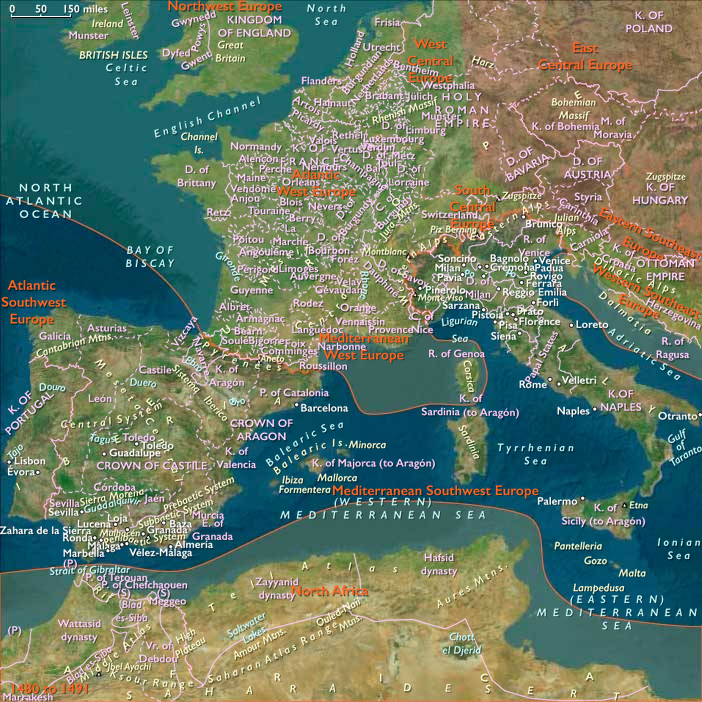
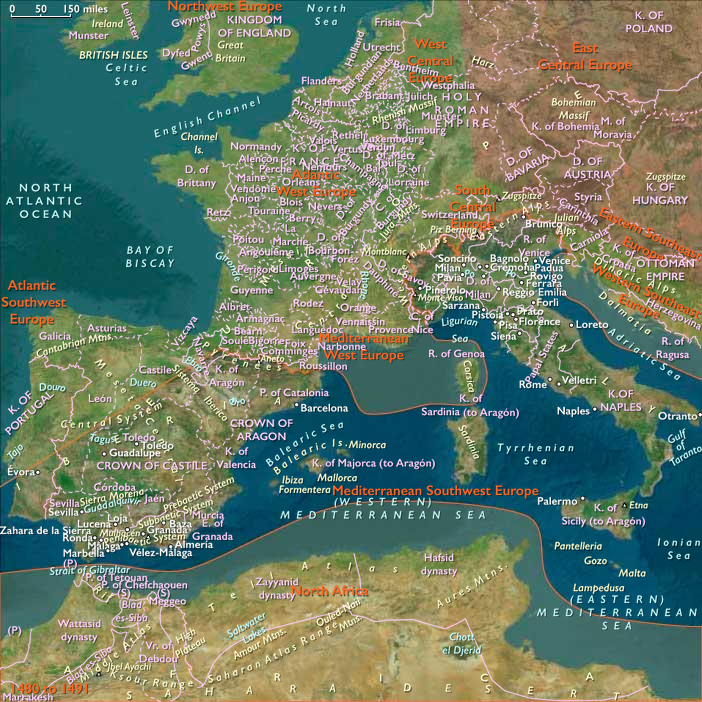
The Emirate of Granada has been the sole Muslim state in al-Andalus—the Arab name for Iberia—for more than a century, the Spanish Christians having already conquered he other remnant states (taifas) of the once mighty Caliphate of Córdoba.
Pessimism for Granada's future existed long before its ultimate fall.
Still, Granada is wealthy and powerful, and the Christian kingdoms had been divided and fight among themselves.
Granada's problems had begun to worsen after the death of Emir Yusuf III in 1417.
Succession struggles ensured that Granada has been in an almost constant low-level civil war.
Clan loyalties are stronger than allegiance to the Emir, making consolidation of power difficult.
Often, the only territory the Emir really controls is the city of Granada itself.
At times, the emir does not even control all the city, but rather one rival emir would control the Alhambra, and another the Albayzín, the most important district of Granada.
This internal fighting has greatly weakened the state.
The economy has declined, with Granada's once world-famous porcelain manufacture now disrupted and challenged by the Christian town of Manises near Valencia, in Aragon.
Despite the weakening economy, taxes are still imposed at their earlier high rates to support Granada's extensive defenses and large army.
Ordinary Granadans pay triple the taxes of (non-tax-exempt) Castilians.
The heavy taxes that Emir Abu-l-Hasan Ali has imposed contribut greatly to his unpopularity.
These taxes do at least support a respected army; Hasan has been successful in putting down Christian revolts in his lands, and some observers estimate he can muster as many as seven thousand horsemen.
The frontier between Granada and the Castilian lands of Andalusia is in a constant state of flux.
Raids across the border are common, as are intermixing alliances between local nobles on both sides of the frontier.
Relations are governed by occasional truces and demands for tribute should one side have been seen to overstep their bounds.
Neither country's central government intervenes or controls the warfare much.
The deatt of King Henry IV of Castile in December 1474 has sparked the War of the Castilian Succession between Henry's daughter Joanna la Beltraneja and Henry's half-sister Isabella.
The war had raged from 1475–1479, setting Isabella's supporters and the Crown of Aragon against Joanna's supporters, Portugal, and France.
During this time, the frontier with Granada had been practically ignored; the Castilians did not even bother to ask for or obtain reparation for a raid in 1477.
Truces had been agreed upon in 1475, 1476, and 1478.
In 1479, the Succession War had concluded with Isabella victorious.
As Isabella had married Ferdinand of Aragon in 1469, this means that the two powerful kingdoms of Castile and Aragon will now stand united, free from the inter-Christian warring that has helped Granada survive Abu l-Hasan Ali, son of Said, had become sultan of Granada in 1464, and in 1477 he had refused to pay tribute to the Crown of Castile.
The truce of 1478 is still theoretically in effect when Granada launches a surprise attack on the fortress of Zahara de la Sierra, near Rond,a in December 1481, as part of a reprisal for a Christian raid.
The town falls, and the population is enslaved.
This attack proves to be a great provocation, and factions in favor of war in Andalusia use it to rally support for a counterstrike, quickly moving to take credit for it, and back a wider war.
Locations
People
Groups
- Moors
- Christians, Roman Catholic
- Aragón, Kingdom of
- Aragon, Crown of
- Castile, Crown of
- Granada, Emirate of, or Nasrid Kingdom of
Topics
Commodoties
Subjects
Regions
Subregions
Related Events
Showing 10 events out of 40570 total
Years: 1481 - 1481
Locations
People
Groups
- Moors
- Christians, Roman Catholic
- Aragón, Kingdom of
- Aragon, Crown of
- Castile, Crown of
- Granada, Emirate of, or Nasrid Kingdom of
Topics
Commodoties
Subjects
Regions
Subregions