The emir of the great commercial center …
Years: 1142 - 1142
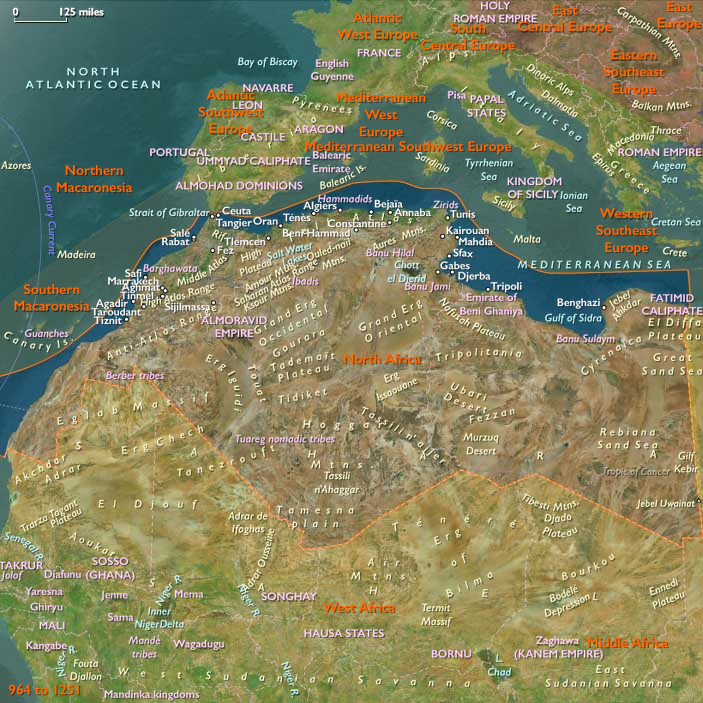
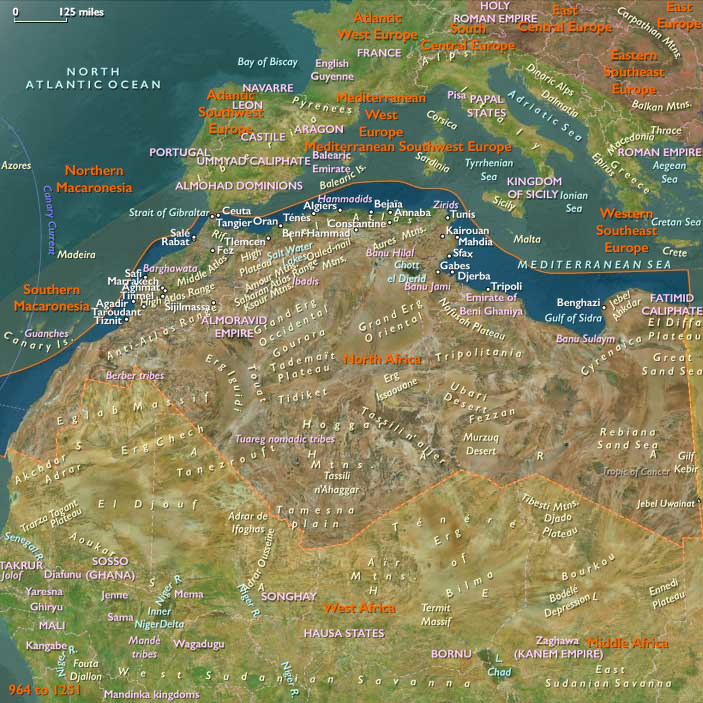
The emir of the great commercial center of Mahdia, unable to feed its population during a famine, has to recognize the de facto protectorate of Roger II of Sicily.
Locations
People
Groups
Commodoties
Subjects
Regions
Subregions
Related Events
Filter results
Showing 10 events out of 48931 total
Atsïz had become Shah of Khwarazm following his father's death in 1127.
During the early part of his reign he had focused on securing Khwarazm against nomad attacks.
He rebelled in 1138 against his suzerain, the Seljuk sultan Ahmed Sanjar, but was defeated in Hezarasp and forced to flee.
Sanjar installed his nephew Suleiman Shah as ruler of Khwarazm and returned to Merv.
Atsïz returned, however, and Suleiman Shah had been unable to hold onto the province.
Atsïz then attacked Bukhara, but by 1141 he had again submitted to Sanjar, who pardoned him and formally returned control of Khwarazm over to him.
The same year that Sanjar pardoned Atsïz, the Kara Khitai under Yelü Dashi had defeated the Seljuks at Qatwan, near Samarkand.
Atsïz takes advantage of the defeat to invade Khurasan, occupying Merv and Nishapur.
Yelü Dashi, however, sends a force under Erbuz to plunder Khwarazm, forcing Atsïz to pay an annual tribute of thirty thousand dinars.
Inge’s infirmity, according to the sagas Morkinskinna and Heimskringla, stemmed from having been carried into battle by one of his guardians during a battle in 1137: “...his back was knotted into a hump, and the one foot was shorter than the other; and he was besides so infirm that he could scarcely walk as long as he lived.” (Heimskringla/Saga of Sigurd, Inge, and Eystein, the Sons of Harald/Of Sigurd Slembidjakn.)
The Danish chronicler Saxo Grammaticus offers the alternative explanation that he became a hunchback after having been dropped on the floor by a maid during infancy.
During the minority of Inge, Sigurd and Magnus, the country is ruled in peace by their guardians, prominent among whom is Inge’s mother, queen Ingiriðr.
Magnus, of whom little more is known, dies at some point in the 1140s.
A fourth, older brother, Eystein, comes to Norway in 1142 from Scotland, where he had grown up.
Harald Gille had acknowledged Eystein as a son before his death, and Eystein is therefore given a share of the kingdom.
Henry recovers the confiscated Saxon estates by treaty in 1142, but Conrad wins a partial victory in this year by depriving the Welfs of the Bavarian duchy.
Raymond establishes the Knights Hospitaller in 1142 as a force in his county, donating to them …
…Krak des Chevaliers, an enormous fortress on the road from Homs to the Mediterranean Sea, as well as other smaller castles.
The Hospitallers are virtually independent in the county and will often be often responsible for the protection of Tripoli's borders, which will be often raided by Damascus and the forces of Zengi.
John campaigns in early 1142 against the Seljuqs of Iconium to secure his lines of communication through Antalya.
During this campaign, his eldest son and co-emperor Alexios dies of a fever.
Having secured his route, John embarks on a new expedition into Syria determined to reduce Antioch to direct imperial rule.
This expedition includes a planned pilgrimage to Jerusalem on which he intends to take his army.
King Fulk of Jerusalem, fearing that the emperor's presence with overwhelming military force will constrain him to make an act of homage and formally recognize imperial suzerainty over his kingdom, begs the emperor to bring only a modest escort.
Fulk cites the inability of his largely barren kingdom to support the passage of a substantial army.
This lukewarm response results in John II deciding to postpone his pilgrimage.
John descends rapidly on northern Syria, forcing Joscelin II of Edessa to render hostages, including his daughter, as a guarantee of his good behavior.
John next advances on Antioch demanding that the city and its citadel be surrendered to him.
Raymond of Poitiers plays for time, putting the proposal to the vote of the Antiochene general assembly.
With the season well advanced, John decides to take his army into winter quarters in Cilicia, proposing to renew his attack on Antioch the following year.
Mahmud's descendants, the Ghaznavids, continue to rule over a gradually diminishing empire.
The rival Turkic Shansabanis of Ghur, who inhabit the mountainous region between Ghazna and Herat, rise rapidly in power during the last half of the twelfth century.
This ascendancy is partly due to the changing balance of power that results from the westward movement of the non-Muslim Kara-Khitans into the area dominated by the Seljuq Turks, who had been the principal power in Iran and parts of Afghanistan during the previous fifty years.
The Seljuq defeat in 1141 leads to a struggle for power among the Kara-Khitai Khanate, the Khwarezm-Shahs, and the Ghurids for control of parts of Central Asia and Iran.
Robert of Ketton is believed to have been educated at the Cathedral School of Paris.
In 1134, he had traveled from France to the East for four years with his fellow student and friend Herman of Carinthia (also known as Herman Dalmatin).
They had visited Constantinople, the Crusader States in Palestine, and Damascus.
Both men are to become famous as translators from the Arabic.
By 1141, Robert had moved to Spain, where the division of the peninsula between Muslim and Christian rulers makes it a natural base for translators.
Some sources identify him with Robert of Chester (Latin: Robertus Castrensis), who is also active in Spain as a translator in the 1140s.
Herman of Carinthia is in Spain also in 1142, and becomes involved in an important project to translate Islamic texts.
Peter the Venerable recruits a team, including Herman, to translate five texts about Islam into Latin.
Different members of the team appear to have concentrated on different works, and Herman is credited as the main translator of two of them: De generatione Muhamet et nutritura eius and Doctrina Muhamet.
The most significant translation in the collection is that of the Qur'an.
This is entitled Lex Mahumet pseudoprophete and is the first known translation of the Qur'an into a European language.
Robert of Ketton is its principal translator, according to most sources (including the Lex Mahumet pseudoprophete itself).
However, Herman may have had some input, given the team nature of the project.
Despite being an imperfect translation, Lex Mahumet pseudoprophete will remain the standard one for centuries, circulating in manuscript before being printed in the 1543 edition published in Basel by Theodor Bibliander.
In this edition, both Herman's above-mentioned translations of treatises about Islam will appear together with a preface by Martin Luther.
Herman translates Euclid's Elements, possibly in collaboration with Robert of Ketton. (There are also other twelfth century translations).
Herman also translates into Latin the astronomical work of Abu Ma'shar, Kitab al-madkhal ila ilm ahkam al nujum (Introduction to Astronomy).
The work contains problems from Greek philosophy, Arabic astronomy and Eastern astrology, and had been first translated into Latin by John of Seville in 1133.
Herman's less literal translation will be published several times under the title Liber introductorius in astronomiam Albumasaris, Abalachii (Augusta Vindelicorum, Augsburg 1489; Venice 1495 and 1506).
A large part of Herman's translation will be copied into Roger of Hereford's Book of Astronomical Judgements.
Herman also produces a version of Muḥammad ibn Mūsā al-Ḵwārizmī's astronomical tables (zij)—they had also been translated in 1126 by Adelard of Bath (1075–1164).

The Ralph of Vermandois Marital Scandal and the War with Champagne (1142–1143 CE)
In 1142, under pressure from Queen Eleanor of Aquitaine, King Louis VII of France allowed his powerful cousin Ralph I of Vermandois to repudiate his first wife, Eleanor of Blois, in favor of Petronilla of Aquitaine, Eleanor of Aquitaine’s younger sister. This politically motivated annulment triggered a diplomatic and military crisis in France, culminating in a war with Theobald II of Champagne and an excommunication from the papacy.
The Political and Familial Tensions Behind the Annulment
- Ralph of Vermandois was a high-ranking noble and seneschal of France, making his marriage alliances crucial to Capetian politics.
- His first wife, Eleanor of Blois, was the daughter of Stephen, Count of Blois, and Adela of Normandy, making her the sister of King Stephen of England.
- Eleanor of Aquitaine and her sister Petronilla sought greater power at court, and Eleanor persuaded Louis VII to arrange for Ralph to marry Petronilla.
- This required annulling Ralph’s first marriage, which was facilitated by three bishops, but their ruling was quickly overruled by Pope Innocent II.
The War with Theobald II of Champagne
- Theobald II of Champagne, Eleanor of Blois’ brother, vehemently opposed the repudiation of his sister and sought papal support to challenge it.
- Innocent II excommunicated Ralph and Petronilla, declaring their marriage illegitimate, further escalating tensions.
- In retaliation, Louis VII launched a military campaign against Theobald, attacking Champagne and its allies.
- The war led to the infamous burning of Vitry, where over 1,000 people seeking refuge in a church were burned alive, a deeply regrettable act for Louis that would later push him toward a penitential Crusade.
Resolution: Papal Intervention and the Legitimization of Ralph’s Marriage (1143 CE)
- The war and excommunication persisted until the death of Pope Innocent II in 1143.
- His successor, Pope Celestine II, took a more conciliatory approach, lifting the excommunication and sanctifying Ralph and Petronilla’s marriage.
- The conflict weakened Louis VII’s relations with the Church and the Champagne nobility, setting the stage for future tensions within the Capetian realm.
Impact of the Scandal
- Eleanor of Aquitaine’s influence over Louis VII became even more pronounced, increasing her role in shaping Capetian policies.
- The war with Champagne demonstrated Louis VII’s willingness to challenge noble autonomy, but it also alienated many powerful vassals.
- The burning of Vitry weighed heavily on Louis VII’s conscience, contributing to his later decision to lead the ill-fated Second Crusade (1147–1149).
The Ralph of Vermandois marriage scandal was more than a personal affair—it was a political crisis that entangled the French monarchy in war, excommunication, and lasting noble unrest.