
The Eleventh (all of Egypt), Twelfth, Thirteenth …
Years: 1917BCE - 1906BCE
The Eleventh (all of Egypt), Twelfth, Thirteenth and Fourteenth dynasties of Egypt are often combined under the group title, Middle Kingdom, of which Egyptologists consider the Twelfth dynasty to be the apex and during which building, art and international commerce flourish.
Its founding pharaoh, Amenemhat I, who may have been vizier to the last pharaoh of the Eleventh Dynasty, Mentuhotep IV, had built a new capital for Egypt, known as Itjtawy.
The location of this capital is unknown, but is presumably the present-day al-Lisht, the site of Middle Kingdom royal and elite burials, including two pyramids built by Amenemhat I and Senusret I. Amenemhat, whose armies had campaigned south as far as the Second Cataract of the Nile and into the Near East, had reestablished diplomatic relations with Byblos and the rulers in the Aegean Sea.
His son Senusret, or Sesostris, (1971 BCE – 1926 BCE), had continued the policy of his father to recapture Nubia and other territories lost during the First Intermediate Period, following his father's triumphs with an expedition south to the Third Cataract and subduing the Libyans.
Under his forty-five year reign, Egypt's prosperity and borders had been secured, leaving his successors to live in peace and enjoy the trade and tribute brought to them.
Senusret's successor Amenemhat II, of whose reign not much is known, had made the position of the nomarchs hereditary again (thus weakening the centralized government) and established trade connections with Nubia, with whom a war seems to have been fought from 1913 to 1903 BCE.
A war seems to have been conducted in the Levant also.
The most important monument of his reign are the fragments of an annal stone found at Memphis, reused in the New Kingdom.
It reports events of the first years of his reign.
Donations to various temples are mentioned as well as a campaign to Southern Palestine and the destruction of two cities.
The court of the king is not well known; Senusret and Ameny were the viziers at the beginning of the reign.
Three treasurers are known: Rehuerdjersen, Merykau and Zaaset.
The overseer of the gateway, Khentykhetywer, is attested on a stelae, where he reports an expedition to Punt.
Locations
People
Groups
Topics
Commodoties
Subjects
- Commerce
- Environment
- Labor and Service
- Conflict
- Faith
- Government
- Custom and Law
- Technology
- Anthropology
- Archaeology
- Movements
Regions
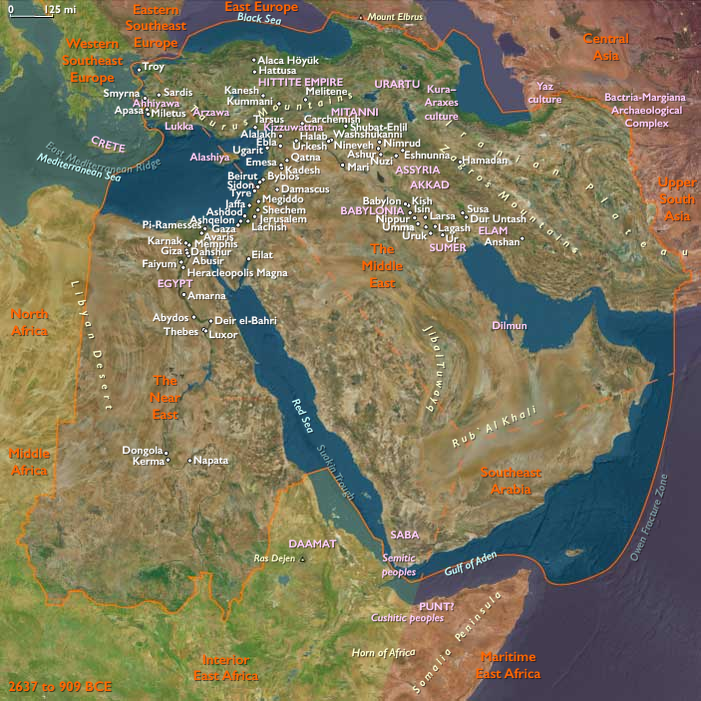
Subregions
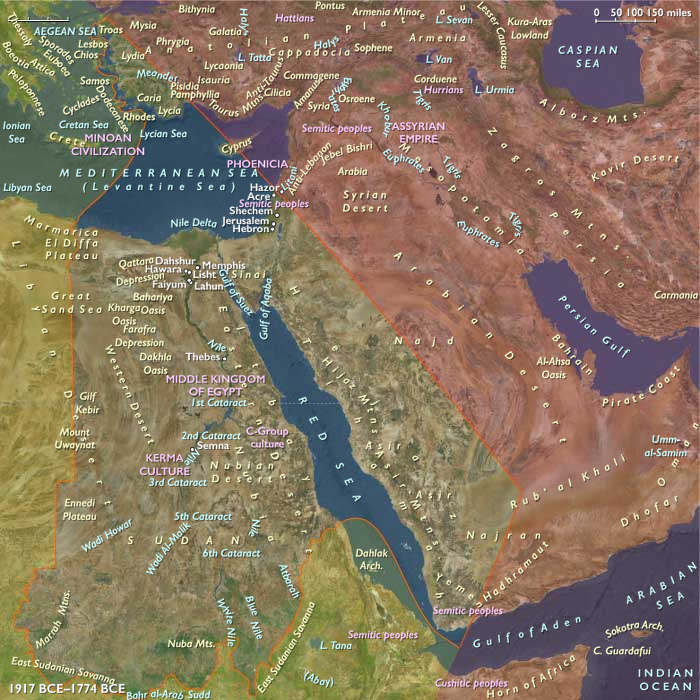
Years: 1917BCE - 1906BCE
Locations
People
Groups
Topics
Commodoties
Subjects
- Commerce
- Environment
- Labor and Service
- Conflict
- Faith
- Government
- Custom and Law
- Technology
- Anthropology
- Archaeology
- Movements
Regions
Subregions