The French occupation of Spain and the …
Years: 1684 - 1827
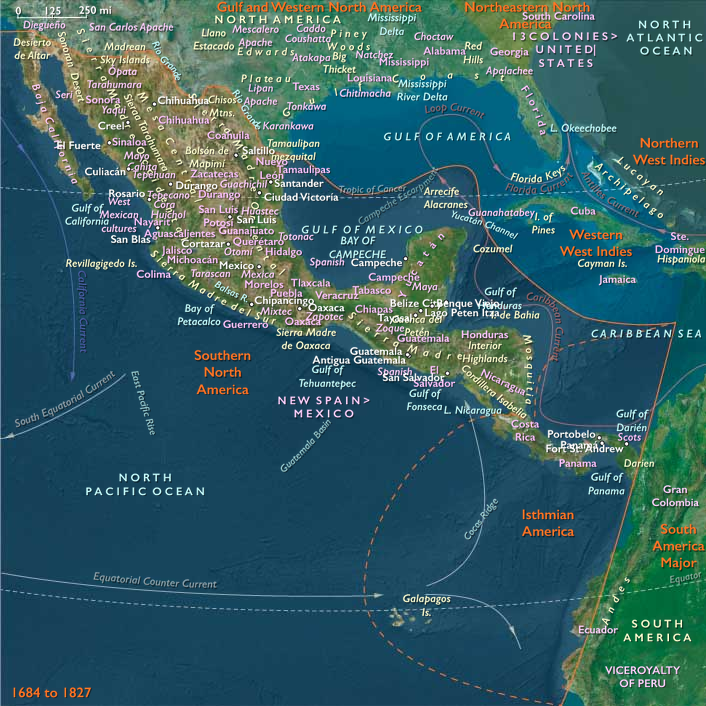
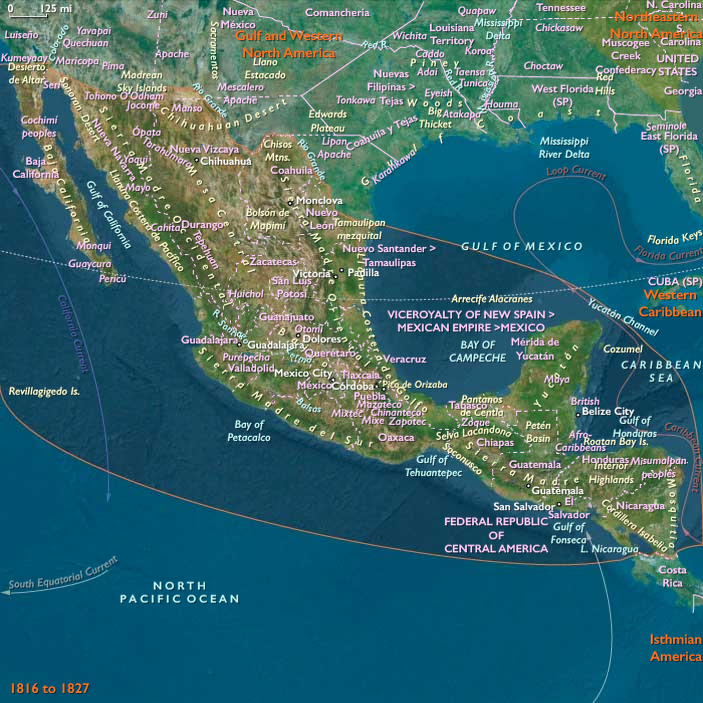
The French occupation of Spain and the overthrow of the Iturrigaray junta creates a vacuum of legitimacy, as it is no longer clear that the ad hoc peninsular administration represents any authority or interests other than its own.
A revolt will no longer necessarily be a challenge to the paternal crown and the faith that it ostensibly defends, but will instead shake off the rule of the increasingly despised gachupines, as the peninsulares are derisively called.
It is in this context that a radical criollo parish priest, Miguel Hidalgo y Costilla, is able to lead the first truly widespread insurrection for Mexican independence.
Locations
People
- Charles IV of Spain
- Ferdinand VII of Spain
- Joseph Bonaparte
- José de Iturrigaray
- Miguel Hidalgo y Costilla
- Napoleon
- Pedro de Garibay
Groups
- New Spain, Viceroyalty of
- Spain, Bourbon Kingdom of
- France, (first) Empire of
- Spain, Bonapartist Kingdom of
Topics
- Colonization of the Americas, Spanish
- Napoleonic Wars
- Peninsular War
- Mexican War of Independence
- Mexican Revolt of 1810-11
Subjects
Regions
Subregions
Related Events
Filter results
Showing 10 events out of 30218 total
We begin in the easternmost subregions and move westwardly around the globe, crossing the equator as many as six times to explore ever shorter time periods as we continue to circle the planet. The maps of the regions and subregions change to reflect the appropriate time period.
Narrow results by searching for a word or selecting from one or more of a dozen filters.
Opium comes into wide use in the West in the eighteenth century as a painkiller, and opium, laudanum, and paregoric are active ingredients in many patent medicines.
These drugs are freely available without legal or medical restrictions, but the many cases of addiction they cause arouse little social concern.
Maritime exploration becomes safer and more efficient with technical innovations that significantly advance navigation and cartography. By the eighteenth century, improvements to the theodolite, octant, precision clocks, compass, telescope, and general shipbuilding techniques enhance the accuracy and reach of seafaring expeditions.
From the mid-eighteenth century through the nineteenth century, scientific missions systematically map newly discovered regions, document unfamiliar flora and fauna, and conduct hydrological, astronomical, and meteorological observations. These expeditions also refine navigation techniques, further integrating science into exploration.
This period fosters remarkable advancements across numerous scientific disciplines, including natural history, botany, zoology, ichthyology, conchology, taxonomy, medicine, geography, geology, mineralogy, hydrology, oceanography, physics, and meteorology. Together, these fields embody the spirit of "improvement" and "progress" that defines the Enlightenment.
Artists play a crucial role in these endeavors, visually documenting landscapes and indigenous peoples, while natural history illustrators meticulously capture organisms before they degrade after collection. Some of the world's finest natural history illustrations emerge during this time, marking a shift from skilled amateurs to professionally trained illustrators, who become acutely aware of the necessity for scientific accuracy.
Northeast Asia (1684–1827 CE): Imperial Frontiers, Salmon Rivers, and Expanding Maritime Worlds
Geography & Environmental Context
Northeast Asia encompasses the Lena–Indigirka–Kolyma river basins and the New Siberian Islands; the Chukchi Peninsula, Wrangel Island, and Anadyr basin; the Sea of Okhotsk rim from Magadan to Okhotsk; the Uda–Amur–Ussuri lowlands (including extreme northeastern Heilongjiang); the Sikhote–Alin and Primorye uplands; Sakhalin and the lower Amur mouth; and Hokkaidō (all but the southwestern corner). These lands stretch from permafrosted tundra and taiga to salmon-filled rivers, storm-beaten Arctic coasts, and the oak–birch forests of Hokkaidō. Their contrasts created a vast frontier between Arctic barrens, Amur floodplains, and the resource-rich Okhotsk and Japan Seas.
Climate & Environmental Shifts
The Little Ice Age remained in force, with long winters and shortened growing seasons. Permafrost deepened across the Lena and Kolyma basins, constraining cultivation but preserving winter travel routes over frozen rivers. The Sea of Okhotsk froze extensively, limiting navigation to brief summer months, while its ice-edge fisheries remained highly productive. Hokkaidō endured cold, snowy winters but maintained rich salmon and herring runs. Volcanic eruptions in Kamchatka occasionally cast ash over the subregion, while harsh storms along the Okhotsk and Chukchi coasts tested seafaring communities.
Subsistence & Settlement
-
High Arctic and Chukchi Peninsula: Chukchi herders expanded large-scale reindeer pastoralism, while coastal communities pursued whale and walrus hunting. Siberian Yupik and Yukaghir relied on fishing and seal hunting, moving seasonally between tundra and shore.
-
Taiga and River Basins (Lena–Indigirka–Kolyma): Evenki and Even followed seasonal hunting and fishing rounds, combining fur trapping with mobile herding. Russian settlers established wintering posts and small farming colonies along rivers.
-
Amur–Ussuri–Sakhalin: Daur, Nanai, Nivkh, and Udege cultivated millet and beans, alongside intensive salmon and sturgeon fishing. Villages lined riverbanks, with smokehouses and storehouses prominent features.
-
Hokkaidō: Ainu relied on salmon runs, deer and bear hunting, and limited agriculture, while Japanese settlers under the Matsumae domain controlled trade posts on the southwestern fringe.
Settlements multiplied with Russian forts and villages along the Lena and Okhotsk coasts, while Qing garrisons appeared in the Amur to police frontiers after the Treaty of Nerchinsk (1689).
Technology & Material Culture
Traditional toolkits remained vital—bows, harpoons, fish weirs, sledges, and birch-bark canoes—but new materials entered rapidly. Russian firearms, iron traps, and metal tools spread along fur routes. The yakut horse and cattle breeds supported Russian colonists, while imported crops like rye and barley were planted near river posts. Ainu artisans continued to carve ritual sticks (ikupasuy) and wooden inau, while Matsumae trade introduced lacquerware, sake, and rice. Along the Amur, iron cauldrons, ceramics, and silks filtered in through both Russian and Qing channels.
Movement & Interaction Corridors
-
Frozen rivers (Lena, Aldan, Indigirka, Kolyma, Anadyr) functioned as winter highways, enabling Russian Cossack expansion and indigenous trade.
-
Amur corridor: A contested artery where Daur, Nanai, and Qing forces intersected. After 1689, the Treaty of Nerchinsk fixed a negotiated border, limiting Russian access.
-
Sea of Okhotsk coast: Became Russia’s maritime lifeline, with Okhotsk town (founded 1649, expanded in the 18th century) serving as the staging point for Pacific expeditions.
-
Hokkaidō littoral: Canoe routes linked Ainu villages; Matsumae intermediaries funneled trade to Honshu.
-
Global links: Vitus Bering’s expeditions (1728, 1741) pushed Russian presence into the Pacific; fur traders later reached Alaska, with Northeast Asia as their base.
Cultural & Symbolic Expressions
Shamanism remained vital among Evenki, Chukchi, and Yukaghir, with trance rituals, drums, and spirit journeys mediating between human and natural realms. Ainu bear-sending ceremonies (iomante) continued as the centerpiece of ritual life, blending ecological reverence with social cohesion. Russian Orthodoxy arrived with missions, erecting chapels at Yakutsk, Okhotsk, and in scattered forts. In the Amur basin, ancestor shrines, wooden masks, and ritual feasts bound communities to rivers and forests. Cross-cultural encounters layered new symbols: icons and crosses, lacquer bowls, firearms reinterpreted as prestige items, and silk robes entering indigenous ritual circuits.
Environmental Adaptation & Resilience
Adaptations reflected deep ecological knowledge:
-
Reindeer pastoralists adjusted migration routes as pasture zones shifted with snow cover.
-
Salmon management in Amur and Hokkaidō was reinforced with taboos and regulated weir use.
-
Stone and wooden fish traps in Okhotsk rivers provided secure seasonal harvests.
-
Cache systems—smoked fish, dried venison, rendered oils—sustained households through long winters.
-
Kinship-based exchange systems, tribute obligations (yasak), and cross-cultural alliances distributed surpluses and buffered shortages.
Transition
Between 1684 and 1827, Northeast Asia transformed from a largely indigenous frontier into an imperial crossroads. Russian forts, settlers, and traders advanced along rivers and the Okhotsk coast, seeking furs and Pacific access. The Qing consolidated Amur defenses after Nerchinsk, enforcing borders with patrols and alliances. The Matsumae domain tightened control over Ainu trade, sowing tensions that would later erupt into conflict. At the same time, Vitus Bering’s voyages linked Northeast Asia to the Americas, beginning a Pacific system of trade and empire. Indigenous lifeways remained resilient, but their landscapes were now arenas where empires tested boundaries and reshaped the seascape of northern Eurasia.

Northeastern Eurasia (1684–1827 CE)
Imperial Frontiers, Salmon Rivers, and the Making of a Northern Sea–Steppe System
Geography & Environmental Context
From the Baltic–Black Sea corridor across the forest–steppe of East Europe to the taiga, tundra, and Pacific rims of Siberia and Northeast Asia, this macro-region bridged three oceanic worlds: the Arctic, the North Atlantic–Baltic, and the North Pacific. Anchors ranged from the Dnieper–Don–Volga and Neva to the Ob–Yenisei–Lena–Kolyma river highways; from the Pontic steppe and Polesia wetlands to the Amur–Ussuri lowlands, Sakhalin, Okhotsk coast, Chukotka, Wrangel, and Hokkaidō. Permafrosted interiors, salmon-rich rivers, and storm-beaten coasts met fertile chernozem belts—a continent-spanning frontier of grain, furs, timber, fish, and salt.
Climate & Environmental Shifts
The Little Ice Age lingered with severe winters (notably 1708–1709) and short growing seasons. Baltic freeze-ups delayed shipping; Tambora (1816–1817) and earlier cool pulses triggered dearth from Finland to Ukraine. In Siberia, rivers were ice roads most of the year, and taiga fires alternated with deep frosts; along the Sea of Okhotsk and Chukchi coasts, gales and sea ice shortened sailing windows even as ice-edge fisheries boomed. Hokkaidō endured snowy winters yet sustained abundant salmon and herring runs.
Subsistence & Settlement
-
East Europe (Belarus–Ukraine–European Russia): Peasant communes rotated rye, oats, barley, wheat, flax, and hemp; chernozem frontiers (Novorossiya) turned to estate grain and sheep; Odessa (1794) rose as a Black Sea grain port. Cossack borderlands mixed fishing, apiaries, horse breeding, and mobile farming.
-
Northwest Asia (W/C Siberia): Indigenous Khanty, Mansi, Nenets, Evenki and others combined fishing, hunting (sable), and reindeer herding; Russian ostrogs (Tobolsk–Tomsk–Krasnoyarsk–Irkutsk) spread plough agriculture along river terraces; promyshlenniki pursued fur frontiers.
-
Northeast Asia (Amur–Okhotsk–Chukotka–Hokkaidō): Daur, Nanai, Nivkh, Udege, Evenki, Chukchi, Siberian Yupik, and Ainu economies centered on salmon, sturgeon, marine mammals, reindeer, and garden grains/beans; Russian wintering posts dotted the Lena–Kolyma–Anadyr; Matsumae traders controlled Hokkaidō’s SW littoral.
Technology & Material Culture
-
Agro-forestry & mills: Estate granaries, wind/watermills, and flax/hemp scutching in East Europe; drainage and rotations raised yields.
-
River–snow logistics: Birch-bark canoes, skis, sledges, and portages linked basins; in the south, barges moved bulk grain to Baltic and Black Sea outlets.
-
Maritime gear: Copper-sheathed hulls, chronometers, and sturdy Okhotsk craft; Ainu and Amur communities maintained weirs, net fisheries, and smokehouses.
-
Trade kits: Iron pots, beads, textiles, tobacco, vodka, firearms into indigenous markets; outflow of furs, hides, fish oils, potash, tar, timber, and grain.
-
Sacred and civic builds: Orthodox churches and wooden chapels along Siberian rivers; Ukrainian Baroque façades; ancestor shrines, masks, and bear-sending paraphernalia among Amur and Ainu communities.
Movement & Interaction Corridors
-
Baltic & Black Sea “windows”: St. Petersburg (1703) opened a northern outlet (timber, hemp, tar, flax); successive Russo-Ottoman wars unlocked a Black Sea export front (Kherson–Mykolaiv–Odessa).
-
Trans-Siberian rivers: Ob–Irtysh–Yenisei–Lena functioned as summer barge routes/winter roads; overland portages and the Omsk–Semipalatinsk steppe link tied Siberia to Central Asia.
-
Amur–Okhotsk–Pacific: The Treaty of Nerchinsk (1689) fixed a Qing–Russian line; Okhotsk became Russia’s Pacific lifeline; Bering’s voyages (1728, 1741) projected to Alaska.
-
Hokkaidō littoral: Canoe routes knit Ainu villages; Matsumae intermediaries funneled rice, sake, and lacquerware north in exchange for fish, furs, and crafts.
Cultural & Symbolic Expressions
-
Orthodox & imperial: Icons, pilgrimages, parish schools, and baroque/neoclassical cityscapes in Kyiv–St. Petersburg–Moscow; Cossack dumy and kobzar song preserved frontier memory.
-
Indigenous cosmologies: Shamanic drums, bear rituals, river and mountain shrines structured relations with animal masters and waters; Ainu iomante remained a central rite.
-
Border syncretisms: Crosses beside carved idols; firearms, silk robes, and lacquer bowls reinterpreted as prestige ritual items; Jesuit/Orthodox/mission outposts mingled with men’s houses and clan lodges.
Environmental Adaptation & Resilience
-
Risk portfolios: Salmon weirs, stone/wooden fish traps, oil rendering, and cached stores carried Arctic and taiga households through long winters; reindeer routes adjusted to snow cover.
-
Commune & kin relief: Mir/obshchina land repartition and labor exchange in East Europe; parish charity, confraternities, and brotherhoods mitigated dearth.
-
Frontier agronomy: Shelterbelts and spring sowings on steppe; rye/oats on floodplains; mixed household economies (spinning, weaving, seasonal wage-work) buffered shocks.
Political & Military Shocks
-
East European re-maps: Partitions of the Polish–Lithuanian Commonwealth (1772, 1793, 1795); Crimean annexation (1783); Russo-Ottoman wars (1768–1774; 1787–1792; 1806–1812) opened the Northern Black Sea corridor; 1812 invasion forged a continental war economy.
-
Siberian incorporation: Fort lines, yasak fur tribute, and missionary courts consolidated imperial rule; Kiakhta (1727) regulated China–Russia caravan exchange.
-
Amur frontier & Pacific turn: Qing patrols contained Russian access after Nerchinsk; Okhotsk staged Pacific expeditions; coastal violence and disease shadowed contact zones.
-
Hokkaidō: Matsumae monopoly tightened over Ainu trade, sowing tensions that presaged 19th-century conflict.
Transition
Between 1684 and 1827, Northeastern Eurasia shifted from mosaic frontiers to an integrated river-and-sea system of empires. East Europe became a grain-export engine tied to the Baltic and a newly forged Black Sea corridor; Siberia turned into a transcontinental fur and transit realm; Northeast Asia emerged as Russia’s Pacific hinge, bounded by Qing defenses and Matsumae controls yet newly linked to Alaska by Bering’s routes.
Amid wars, partitions, and missions, indigenous lifeways—reindeer herding, salmon fisheries, shamanic rites—endured and adapted. By 1827, the region stood enmeshed in global trade and imperial logistics, its salmon rivers and steppe grain, tar forests and Okhotsk ships, together powering a northern world poised for the accelerations and ruptures of the nineteenth century.
Siberia remains a mostly unexplored area, inhabited during the past few centuries only by a few exploratory missions and traders.
The Russians that migrate into Siberia in the seventeenth and eighteenth centuries are hunters, and those who have escaped from the Central Russia: fugitive peasants in search for life free of serfdom, fugitive convicts, and Old Believers.
The new settlements of Russians and the existing local peoples require defense from nomads, for which forts are established, such as Tomsk and Berdsk.
The nomads' threat weakens in the beginning of the eighteenth century; thus the region becomes increasingly populated; normal civic life is established in the cities.
From Muscovy's base in western Siberia, obtained in the sixteenth century, merchants, traders, and explorers had pushed eastward from the Ob' River to the Yenisey River, then to the Lena River.
By the middle of the seventeenth century, Muscovites have reached the Amur River and the outskirts of the Chinese Empire.
After a period of conflict with the Manchu Dynasty, Muscovy makes peace with China in 1689.
By the Treaty of Nerchinsk, Muscovy cedes its claims to the Amur Valley, but gains access to the region east of Lake Baikal and the trade route to Beijing.
Peace with China consolidates the initial breakthrough to the Pacific that had been made in the middle of the century.
Kortaga is a system of penal servitude of the prison farm type in Imperial Russia.
Katorgas had been established in the seventeenth century in underpopulated areas of Siberia and the Russian Far East that had few towns or food sources.
Prisoners are sent to remote camps in vast uninhabited areas of Siberia—where voluntary laborers are never available in satisfactory numbers—and forced to perform hard labor.
Unlike concentration camps, "katorga" is within the normal judicial system of Imperial Russia, but both share the same main features: confinement, simplified facilities (as opposed to prisons), and forced labor, usually on hard, unskilled or semiskilled work.
Years: 1684 - 1827
Locations
People
- Charles IV of Spain
- Ferdinand VII of Spain
- Joseph Bonaparte
- José de Iturrigaray
- Miguel Hidalgo y Costilla
- Napoleon
- Pedro de Garibay
Groups
- New Spain, Viceroyalty of
- Spain, Bourbon Kingdom of
- France, (first) Empire of
- Spain, Bonapartist Kingdom of
Topics
- Colonization of the Americas, Spanish
- Napoleonic Wars
- Peninsular War
- Mexican War of Independence
- Mexican Revolt of 1810-11