
Egyptians use the simplest form of water …
Years: 1629BCE - 1486BCE
Locations
Groups
Topics
Subjects
Regions
Subregions
Related Events
Filter results
Showing 10 events out of 67677 total
A cooling of world climate, lasting several years and recorded in tree-rings all over the world, begins in the year 1627 BCE.
It might have been caused by the eruption of Thera in the Aegean or the Avellino eruption of Mount Vesuvius.
Sea level peaks at one meter above the twentieth-century level during the Rottnest transgression, beginning in 1600 BCE and lasting for six centuries.
Austronesian peoples are believed to have settled in the Fijian islands some thirty-five hundred years ago, with Melanesians following around a thousand years later.
Most authorities agree that they originated in Southeast Asia and came via Indonesia.
Groups from southeastern Asia, primarily speakers of the languages (now) classified as Malayo-Polynesian, begin to spread out to nearby Pacific Islands from about 1500 BCE.
Human habitation in Saipan, the second largest of the Mariana Islands in the western Pacific Ocean, dates from this time.
Excavations at Ban Chiang, a site in present Thailand, plus survey and excavation at sites such as Non Nok Tha, Ban Pak Top, Ban Tong, and Don Klang, have demonstrated that Southeast Asia had developed a sophisticated metallurgical industry as early as the first half of the second millennium BCE.
Maritime East Asia (1629–1486 BCE): Rise and Consolidation of the Shang Dynasty
Between 1629 BCE and 1486 BCE, Maritime East Asia—comprising lower Primorsky Krai, the Korean Peninsula, the Japanese Archipelago below northern Hokkaido, Taiwan, and southern, central, and northeastern China—experiences a pivotal transition with the fall of the quasi-legendary Xia Dynasty and the rise of the historically attested Shang Dynasty. This era is marked by significant cultural advancements, including the introduction of sophisticated bronze metallurgy, the establishment of Chinese writing, and the formation of distinct social hierarchies, laying lasting foundations for Chinese civilization.
Fall of the Xia Dynasty
According to traditional Chinese historical accounts—including the Xia Shang Zhou Chronology Project—the Xia Dynasty’s last ruler, Jie, reigns for fifty-two years until approximately 1618 BCE. Jie’s oppressive and corrupt rule, characterized by tyranny and cruelty, precipitates the dynasty’s downfall. Later historical records, particularly the Bamboo Annals, describe catastrophic natural phenomena during Jie's final years, including unusual climatic events such as frost in July, heavy rains, crop failures, and an anomalous "yellow fog" accompanied by dim sunlight and multiple suns appearing simultaneously. Modern scientists speculate that these phenomena could have been related to volcanic events, notably the Thera eruption, linking environmental disturbances to historical upheaval.
Ultimately, Jie is overthrown by Tang of Shang at the pivotal Battle of Mingtiao, marking the end of Xia dominance and the beginning of a new era under the Shang Dynasty.
Rise and Expansion of the Shang Dynasty
Emerging prominently around 1600 BCE, the Shang Dynasty establishes dominance in North China’s Henan region, absorbing smaller kingdoms including the remnants of the Xia state. Archaeological evidence and historical texts—particularly Sima Qian’s Shiji (Records of the Grand Historian) and later Zhou Dynasty documents—indicate the Shang people share an ethnic affinity with the Huaxia peoples of the Yellow River basin.
The Shang society is fundamentally agrarian, supplemented by hunting and animal husbandry, and characterized by advanced urban centers supporting complex social stratification. Notably, the Shang Dynasty represents an early Chinese "slave society," structured hierarchically from the king and ruling elite—including royal family members, nobility, priesthood, and specialized artisans—down to the urban craftspeople, village agriculturists, and, at the bottom, enslaved populations.
Bronze Metallurgy and Cultural Achievements
During this period, sophisticated bronze metallurgy rapidly develops, transforming Shang society. Bronze-casting technology, previously undocumented at this level of sophistication in China, emerges fully formed, enabling the production of intricate ritual vessels, ceremonial weapons, and artistic objects. Shang bronze-working also enhances the crafting of jade artifacts, integrating multiple advanced artistic practices.
Development of Early Chinese Writing
The Shang Dynasty is critically significant for developing an early and fully operational system of Chinese writing. This script, evident in surviving inscriptions on bronze artifacts, oracle bones (turtle shells, cattle scapulae, and other bones), pottery, jade, and other media, indicates a complex writing system already mature by this period. Although the direct antecedents of Shang script remain obscure, it is widely assumed to have evolved from earlier hieroglyphic forms, attesting to a long period of development.
These oracle bone inscriptions represent China's earliest substantial corpus of recorded written characters, providing invaluable insights into Shang society, religion, governance, and daily life.
Religious Practices and Social Organization
Shang religion prominently features worship of the supreme deity Shangdi (Shang-ti), alongside rituals and prayers directed toward ancestral spirits. Ritual practice includes human sacrifice, reflecting beliefs about the afterlife, divine favor, and dynastic legitimacy. The Shang’s distinct religious and social systems solidify political cohesion, enforce hierarchical relationships, and reinforce the centralized authority of the king.
Legacy of the Era: Foundations of Historic Chinese Civilization
Thus, between 1629 and 1486 BCE, Maritime East Asia witnesses profound historical transformation as the Shang Dynasty supplants Xia, bringing advances in bronze metallurgy, sophisticated writing systems, hierarchical social structures, and centralized governance. These developments shape the essential foundations of historic Chinese civilization, significantly influencing subsequent cultural and political evolution in the region.
The last ruler of the Xia Dynasty ruled China for fifty-two years until 1618 BCE, according to the Xia Shang Zhou Chronology Project.
According to legend, Tang of Shang overthrew Jie of Xia in the Battle of Mingtiao.
According to the Shiji, the Shang had a long history, and there are different theories about their origin.
An analysis of bones from the remains of Shang people showed a Huaxia (Yellow River area) ethnic origin.
Their civilization was based on agriculture and augmented by hunting and animal husbandry, and in addition to war, the Shang also practiced human sacrifice.
Beginning around 1600, the Shang dynasty takes over a number of petty kingdoms including the Xia and controls a loose confederation of settlement groups in the Henan region of North China.
The Shang have a fully developed system of writing as attested on bronze inscriptions, oracle bones, and a small number of other writings on pottery, jade and other stones, horn, etc.
Their writing system's complexity and sophistication indicates an earlier period of development, but direct evidence of that development is still lacking.
(Chinese writing is thought to descend from a hieroglyphic script.)
Achieving political unification during the sixteenth century, the Shang dynasty maintains cultural continuity in matters of literary functions, as well as social, religious, economic, and governmental controls.
A slave society is apparently emplaced in China under the Shang dynasty, whose urban centers anchor the first true Chinese civilization.
The Shang state employs numerous specialists and distinguishes between commoners, the priesthood, the royal family, the nobility and, almost certainly, the slaves.
Power in Chinese society under the Shang emperors flows from them to the ruling elite, including feudatory landowners and commanders of the organized soldiery, down to the urban artisans and village agriculturists, with enslaved people at the bottom.
Sophisticated bronze metallurgy develops in China in the sixteenth century BCE.
Complex bronze-casting technology (previously undocumented in China) spreads rapidly under the Shang, whose artisans use metal tools in the carving of jade.
The supreme god of the Shangs is Shangdi (Shang-ti), to whom they pray, supplemented by prayers to ancestral spirits.
Eastern Southeast Europe (1629–1486 BCE): Thracian Origins and Early Metallurgy
Migratory Indo-Europeans intermixed with native Neolithic peoples to form the Thracians, settling in the Carpathian-Danube region. Though Thracian origins remain obscure due to a lack of written records, archaeological evidence suggests their development from indigenous and Indo-European groups around 1500 BCE. Thracian tribes would eventually inhabit lands from the Carpathian Mountains southward to the Adriatic and Aegean Seas. Meanwhile, smiths in the eastern Balkans began working locally mined gold and silver after about 1450 BCE, and trade routes extended to northern Europe and the Aegean.
Migratory Indo-Europeans, who intermingle with native Neolithic peoples to form the Thracians, settle the Carpathian-Danube region, in which the future Romanian ethnic community will evolve.
The origins of the Thracians remain obscure, in absence of written historical records.
Evidence of proto-Thracians in the prehistoric period depends on remains of material culture.
It is generally proposed that a proto-Thracian people developed from a mixture of indigenous peoples and Indo-Europeans from the time of Proto-Indo-European expansion in the Early Bronze Age when the latter conquered the indigenous peoples around 1500 BCE.
The Thracian tribes in later centuries will inhabit the lands extending from the Carpathian Mountains southward to the Adriatic and Aegean Seas. (Today's Romanians are in part descended from the Getae, a Thracian tribe that lived north of the Danube River.)
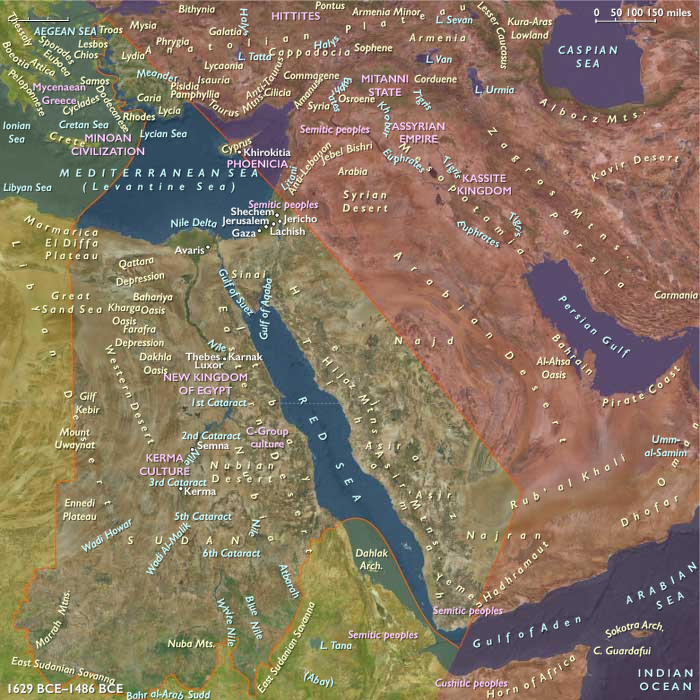
The Middle East: 1629–1486 BCE
Migration, Conquest, and Cultural Realignment
Semitic Settlements and the Arrival of the Hebrews
By the middle of the second millennium BCE, Semitic nomadic groups have increasingly settled in the Jordan Valley, gradually assimilating local populations and transforming the region into a predominantly Semitic linguistic area. The nomadic western Semitic group known as the Habiru, meaning wanderers or outsiders, includes the ancestral figure Abraham (Ibrahim), whose household enters the region from Mesopotamia. This movement marks the earliest identifiable presence of what will become the Hebrew people.
Hyksos Invasion and Egyptian Reconfiguration
The abrupt arrival of the Hyksos, a Semitic people from the north, dramatically reshapes the region as they invade Egypt via Canaan around 1600 BCE. Their rule over Egypt (c. 1600–1570 BCE) temporarily disrupts Egyptian influence, but the liberation war led by Ahmose I (1570–1545 BCE) restores native Egyptian control, reshaping geopolitical dynamics across the Levant.
Indo-European Expansion and Hittite-Kassite Alliance
Around 1600 BCE, Indo-European-speaking tribes initiate a period of widespread migration and settlement. One group, the Hittites, allies with the Kassites, a mountain people of uncertain origins, to conquer and destroy Babylon. The fall of Amorite power coincides with increased Egyptian dominance over Syria, further reshuffling regional power structures.
Hittite Ascendancy in Anatolia
The Hittite conquest of Anatolia accelerates during this period, with key victories such as the conquest of Aleppo (Yamhad) by the Hittite king Hattusili I. The Hittites introduce the chariot into warfare and establish a constitutional monarchy, evidenced by surviving legal tablets. Their legal system demonstrates a remarkable aversion to capital punishment, favoring reparations or forced labor instead.
Hurrian Expansion and the Rise of Mitanni
The Hurrians, whose original homeland lies in the Khabur River valley, significantly expand their territory westward into northern Syria and southern Anatolia by 1725 BCE, notably influencing cities such as Alalakh (Tell Atchana). Following the collapse of Babylon after its sacking by the Hittite king Mursili I, the Hurrian states coalesce into the powerful kingdom of Mitanni, filling a regional power vacuum.
Kassite Dynasty and Babylonian Continuity
The Kassite dynasty emerges in Babylon around 1531 BCE, inaugurating over four centuries of rule. Though culturally distinct and speaking a language isolate, the Kassites continue Babylon's religious and administrative traditions, maintaining Babylon (Kar-Duniash) as a significant regional center. Notably, Kassite kings do not adopt the divine attributes previously common among Babylonian rulers.
Economic and Cultural Networks
Strategic cities such as Ugarit and Byblos remain economically significant, maintaining connections despite disruptions caused by the Hyksos presence. Cyprus (Alashiya) emerges as a major copper supplier, fostering trade relationships with Ugarit and Egypt. Technological innovations, including improved plowshares in northern Mesopotamia around 1600 BCE and advancements in pottery and metallurgy, facilitate sustained economic development.
Religious and Cultural Developments
In religious contexts, significant deities such as El, Asherah, and Baal dominate in Levantine cities like Ugarit, reflecting Canaanite religious practices. The prominence of temples, such as the architecturally sophisticated temple at Tepe Gawra, underscores continued religious significance in civic life. Additionally, the era witnesses early developments in iron metallurgy attributed to peoples of the Caucasus and eastern Anatolia.
Elamite Resurgence and Ebla’s Decline
In southern Iran, the Elamite capital Susa thrives briefly under the later Epartid dynasty, though its influence diminishes following the Kassite consolidation in Babylon. Meanwhile, Ebla experiences its final destruction around 1575–1525 BCE, likely due to Hittite military campaigns, effectively ending its historical prominence.
Urban and Architectural Innovation
New architectural forms emerge, such as the megaron house, a structural innovation originating in northern Mesopotamia around 1800 BCE. This period also marks advancements in urban planning, with monumental temple complexes and fortified urban centers reflecting a sophisticated approach to city-building and defense.
This era encompasses significant migrations, military conquests, cultural integrations, and technological innovations, collectively reshaping the Middle Eastern geopolitical and cultural landscape profoundly.
Indo-European-speaking tribes invade India beginning in approximately 1600 BCE; other tribes settle in Iran and in Europe.
One of these groups, the Hittites, allies itself with the Kassites, a people of unknown origins.
Together, they conquer and destroy Babylon.
Years: 1629BCE - 1486BCE
Locations
Groups
Topics
Subjects
Regions
Subregions