The effect of the maritime fur trade …
Years: 1816 - 1827
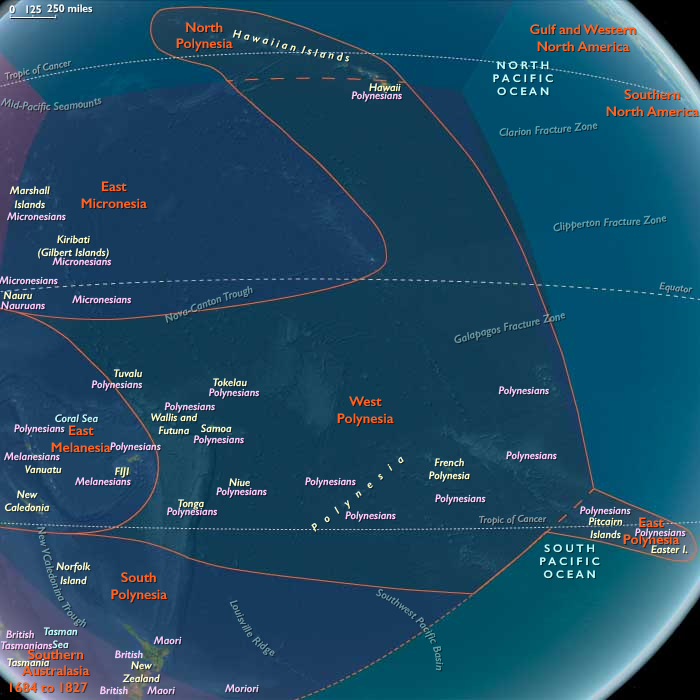
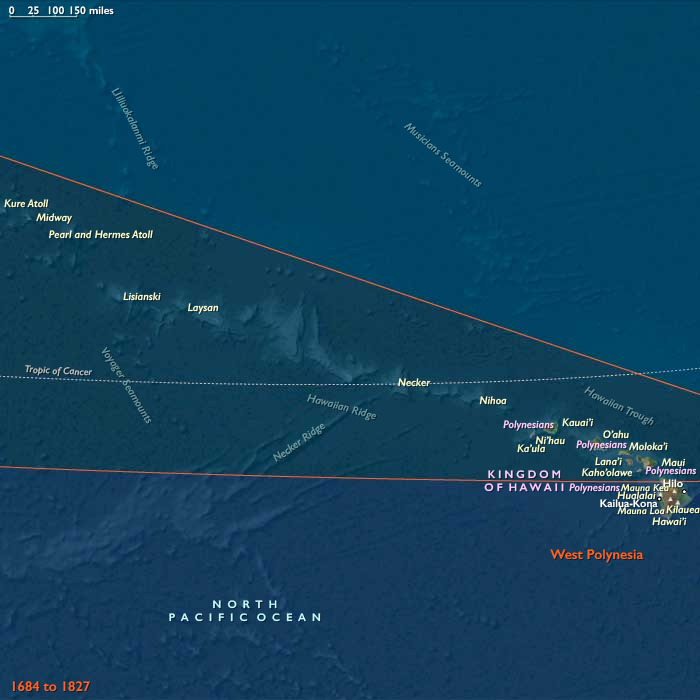
The effect of the maritime fur trade on native Hawaiians is similar to that of the North West Coast natives, but more powerfully transformative.
The Hawaiians are generally receptive to Western incursion and settlement.
The rise of King Kamehameha I and the unification of the islands under his rule had been made possible in part by the effects of the maritime fur trade and its larger Pacific scope.
The influx of wealth and technology helps make the new Kingdom of Hawaii relatively strong, in political and economic terms.
Many non-native foodstuffs are introduced to the Hawaiian Islands during the early trading era, including plants such as beans, cabbage, onions, squash, pumpkins, melons, and oranges, as well as cash crops like tobacco, cotton, and sugar.
Animals introduced include cattle, horses, sheep, and goats.
Due to its high fertility, Oahu becomes the most important of the islands.
The population of Honolulu is over ten thousand by the 1820s.
Locations
People
Groups
- Hawaiians, Native
- British North America
- North West Company
- United States of America (US, USA) (Washington DC)
- Britain (United Kingdom of Great Britain and Ireland)
- American Fur Company
- Hawaii, Kingdom of
- Pacific Fur Company
Topics
Commodoties
Subjects
Regions
Subregions
Related Events
Filter results
Showing 10 events out of 20863 total
The Middle East (1816–1827): Revival of the Al Saud and British Consolidation in the Gulf
Egyptian Intervention and the Fall of the First Saudi State
The modern history of the Arabian Peninsula is often divided into periods reflecting the fortunes of the Al Saud family. The first period began in 1744 with the alliance between Muhammad ibn Saud and the reformist religious leader Muhammad ibn Abd al-Wahhab, culminating in the establishment of the first Saudi-Wahhabi state. However, by 1818, Egyptian forces under Ibrahim Pasha, son of Egypt’s powerful ruler Muhammad Ali, dramatically altered the political landscape.
After capturing Ad Diriyah, the Saudi capital, Egyptian troops razed its walls, leveled buildings, and destroyed palm groves to ensure the city could no longer sustain life or resist reoccupation. Abdullah ibn Saud, the last ruler of the first Saudi state, was captured, sent to Istanbul, and publicly executed, signifying the apparent end of the Al Saud’s rule.
Revival of Al Saud Authority under Turki ibn Abdullah
Despite these catastrophic setbacks, the Al Saud lineage endured. Turki ibn Abdullah, a cousin and loyal commander who escaped the destruction of Ad Diriyah, became the pivotal figure in restoring Saudi authority. Having evaded capture by hiding among loyal tribesmen, he recaptured the ruins of Ad Diriyah in 1821, and then swiftly moved his base of operations to Riyadh, establishing it as the new center of power.
By 1824, Turki ibn Abdullah had reasserted Al Saud and Wahhabi rule over most of Najd, confirming the resilience and deep-rooted appeal of the Al Saud-Wahhabi alliance. This swift restoration of power underscored how firmly Wahhabi religious and political legitimacy had taken hold among the tribes of central Arabia.
Consolidation of Al Saud Influence in Central Arabia
From Riyadh, Turki ibn Abdullah extended his authority across a vast area of central Arabia. His rule combined direct control and strategic alliances, maintaining influence northward into Jabal Shammar through close ties with the influential Rashidi clan. Turki’s son, Faisal, later solidified this relationship through marriage, linking the two prominent families.
In eastern Arabia and along the Persian Gulf coast, Turki preferred to govern indirectly, appointing loyal local leaders who acknowledged Al Saud supremacy. Elsewhere, he secured agreements with tribes, extracting tribute and securing promises of neutrality or support, thus creating a complex but effective web of allegiance.
Religious Authority and Tribute Collection
Crucially, Turki’s reign was underpinned by Wahhabi religious authority. Al Saud leaders following the death of Muhammad ibn Abd al-Wahhab in 1792 had assumed the title of Imam, signifying combined religious and political leadership. This added dimension of legitimacy allowed them to mobilize tribes for military campaigns, often described as jihad. Tributes and taxes collected under their rule conformed to Islamic sharia principles, further embedding the regime’s religious legitimacy within its political structure.
British Intervention and the Emergence of the Trucial System in the Gulf
In the Persian Gulf region, escalating maritime conflict compelled Britain to intervene decisively. Persistent piracy by the Qawasim (Al Qasimi) tribes, particularly from strongholds in what is now the United Arab Emirates, posed a severe threat to British commercial and naval interests. By 1820, Britain responded forcefully, destroying key pirate bases such as Ras al-Khaimah, and compelling local rulers to sign treaties forbidding piracy and warfare at sea. These agreements initiated the “Trucial System,” which eventually evolved into the modern states of the UAE.
Omani Sultanate under Said ibn Sultan
Simultaneously, Oman under Said ibn Sultan Al Sa'id navigated complex challenges. Although Europeans often called Said “Imam,” he himself preferred the secular title of Sayyid, distancing himself from traditional Ibadi religious leadership. His reign saw ongoing tribal divisions, British pressure to halt the slave trade, and encroachments by Wahhabi forces from central Arabia. In response to British demands, Said signed a treaty in 1822, pledging not to sell slaves to subjects of Christian powers. Though Said’s power over Oman proper weakened after 1820, his maritime state expanded economically through trade in coffee, slaves, dates, and pearls, firmly embedding Oman within the global commercial network.
Legacy of the Era (1816–1827)
The period from 1816 to 1827 established several lasting legacies:
-
The resilient Al Saud, despite Egypt’s devastating military interventions, demonstrated their enduring power and legitimacy by reasserting Wahhabi rule from their new stronghold in Riyadh.
-
Britain’s decisive naval interventions along the Persian Gulf initiated a series of treaties, laying the foundations for the Trucial States and setting the stage for long-term British influence in the region.
-
Omani maritime trade, consolidated under Said ibn Sultan, connected the Gulf and East Africa more deeply into the global economy, albeit accompanied by European pressures to curtail the slave trade.
Thus, the era from 1816 to 1827 was marked by political revival, foreign intervention, and shifting alliances, setting patterns of governance and external influence that shaped the Middle Eastern geopolitical landscape into the modern era.

Northeast Asia (1816–1827 CE)
Consolidation, Commercial Growth, and International Observations
Between 1816 and 1827, Northeast Asia experienced significant administrative consolidation, infrastructural improvements, and deepening commercial interactions, driven predominantly by Russian enterprises and global interests in Pacific maritime trade.
The port of Petropavlovsk-Kamchatsky continued to rise in importance, solidifying its status as the premier administrative and supply hub for Russian operations across the Pacific region, while the historically crucial but persistently problematic port of Okhotsk remained indispensable. Despite its ongoing logistical difficulties—such as shallow waters, short sailing seasons, and frequent flooding—the port served as an essential conduit connecting Siberian inland routes to Kamchatka and Russian America.
Russian trade networks intensified around the lucrative maritime fur trade, driven by persistent demand from Qing China and other global markets. Valuable pelts—especially those of sea otters, fur seals, and sable—were gathered from Kamchatka, the Aleutians, and nearby coastal islands, then transported through Petropavlovsk and Okhotsk. From there, these goods were routed overland across Siberia to the trading outpost at Kyakhta on the Mongolian frontier, reinforcing expansive transcontinental commerce.
In 1822, the English traveler Captain John Dundas Cochrane observed Okhotsk favorably, ranking it just after Barnaul as one of Siberia's neatest, cleanest, and most pleasant towns. Cochrane, an illegitimate son of Scottish adventurer Andrew Cochrane-Johnstone, had traveled extensively by foot across France, Spain, Portugal, Germany, Russia, and Asia—earning him the nickname "the Pedestrian Traveller" (voyageur pédestre). In Okhotsk, he married Ksenia Ivanovna Loginova (1807–1870), the adoptive daughter of Admiral Pyotr Rikord, then the Russian governor of Kamchatka.
Despite these positive descriptions, Okhotsk's severe logistical issues persisted. The Okhotsk saltworks, established in 1737 and still active in 1827, employed around 150 exiles and about a hundred guards and overseers, reflecting the continued reliance on forced labor for regional economic activities.
The operations of the Russian-American Company significantly shaped regional dynamics during this period. Company vessels frequented both Okhotsk and Petropavlovsk, supporting the administrative, logistical, and commercial activities essential to Russia’s broader Pacific ventures. The expansion of the Russian-American Company’s activities necessitated increased interactions—ranging from trade to conflict—with indigenous peoples including the Chukchi, Koryaks, Itelmen, Ainu, and Nivkh, all drawn deeper into commercial exchanges while often facing resource pressures and cultural disruption.
Japan under the Tokugawa shogunate remained wary of Russian encroachments, continuing its policy of exclusion but bolstering direct administrative control over Hokkaidō, Sakhalin, and the Kuril Islands to deter potential Russian advancement.
Infrastructure development during this era, particularly the port enhancements at Petropavlovsk, facilitated improved provisioning and maintenance of Russia's Pacific fleet. Yet Okhotsk remained hindered by persistent difficulties, including the inadequate pasture for pack animals, leading to significant transportation challenges and occasionally requiring horses to return unloaded to Yakutsk.
Overall, this era marked a period of notable consolidation, infrastructural developments, international interactions, and intensified commercial activities in Northeast Asia, laying critical foundations for subsequent developments across the broader Pacific region.
Astor's "Fort Astoria" (later Fort George), at the mouth of the Columbia River, becomes the first permanent white settlement in this area, although it is not profitable for Astor.
He sets up the American Fur Company in an attempt to break the hold that the Hudson's Bay Company monopoly has over the region.
By 1820, Astor had taken over independent traders to create a profitable monopoly; he will leave the business as a multi-millionaire in 1834.
New Zealand is first mentioned in British statute in the Murders Abroad Act 1817.
It makes it easier for a court to punish "murders or manslaughters committed in places not within His Majesty's dominions", and the Governor of New South Wales is given increased legal authority over New Zealand.
The jurisdiction of the Supreme Court of New South Wales over New Zealand is initiated in the New South Wales Act 1823, and lesser offenses are included at this time.
In 1788 the Colony of New South Wales had been founded.
According to the future Governor, Captain Arthur Phillip's amended Commission, dated April 25, 1787, the colony of New South Wales included "all the islands adjacent in the Pacific Ocean within the latitudes of 10°37'S and 43°39'S" which included most of New Zealand except for the southern half of the South Island.
In 1825 with Van Diemen's Land becoming a separate colony, the southern boundary of New South Wales is altered to the islands adjacent in the Pacific Ocean with a southern boundary of 39°12'S, which includes only the northern half of the North Island.
However, these boundaries have no real impact as the New South Wales administration has little interest in New Zealand.
European (Pākehā) settlement increases through the early decades of the nineteenth century, with numerous trading stations established, especially in the North Island. Christianity had been introduced to New Zealand in 1814 by Samuel Marsden, who had travelled to the Bay of Islands where he founded a mission station on behalf of the Church of England's Church Missionary Society.
From missionaries, the Māori learn not just about Christianity but also about European farming practices and trades, and how to read and write.
Beginning in 1820, linguist Samuel Lee works with Māori chief Hongi Hika to transcribe the Māori language into written form.
The first full-blooded European infant in the territory, Thomas Holloway King, was born on February 21, 1815 at the Oihi Mission Station near Hohi Bay in the Bay of Islands.
Kerikeri, founded in 1822, and Bluff, founded in 1823, both claim to be the oldest European settlements in New Zealand.
The population of the Australian colony increases following the Allies’ final defeat of Napoleon.
The number of free immigrants, most of whom seek sheep-grazing land, surpasses the number of arriving convicts during the 1820s.
New South Wales expands to establish a separate penal colony at Moreton Bay on the southern coast, while illegal squatters settle the Darling Downs in the colony’s western reaches.
Over sixteen weeks in 1824–25, Hume and Hovell journey to Port Phillip and back.
They make many important discoveries including the Murray River (which they name the Hume), many of its tributaries, and good agricultural and grazing lands between Gunning, New South Wales and Corio Bay, Port Phillip.
In 1826, the British claim is extended to the whole Australian continent when Major Edmund Lockyer establishes a settlement on King George Sound (modern-day Albany)
In this vessel, with only twenty-seven men, including the naturalists Johann Friedrich von Eschscholtz and Adelbert von Chamisso, and the artist Louis Choris, Kotzebue had set out on July 30, 1815 to find a passage across the Arctic Ocean and explore the less-known parts of Oceania.
Proceeding via Cape Horn, he had discovered the Romanzov Islands, Rurik Islands and Krusenstern Islands (today Tikehau), then made for Kamchatka.
In the middle of July 1816 he proceeds northward, coasting along the north-west coast of North America, and discovering and naming Kotzebue Sound or Gulf and Cape Krusenstern in the remote Chukchi Sea.
Returning by the coast of Asia, he had again sailed to the south, sojourned for three weeks at the Sandwich Islands, and on January 1, 1817, discovers New Year Island.
The Netherlands regains responsibility in 1816 for the East Indies—actually a welter of mostly coastal territories, some controlled directly and many others engaged through varying treaties—but the way forward is uncertain.
The growth of trade with Sulawesi and the establishment of plantation economies, especially those producing sugar (eastern and central Java) and coffee (western Java and western Sumatra) have begun to loosen customary ties and introduce elites to new sources of both riches and indebtedness.
In Java, the general population increases and grows more prosperous but, on the other hand, falls victim to increasing crime, heavier taxation, and exploitation by local Chinese, especially in their roles of tax farmers, tollkeepers, and leasers of plantation lands.
The legitimacy of ruling elites is questioned more widely.
Both traditionalists and Muslims feel their ways of life threatened by changes they tend to identify with growing European influence.
A Dutch decision in 1823 to end what it views as the abusive leasing of land and labor among central Java's aristocracy alienates many who had begun to adjust to the new circumstances and pushes them to support rebellion.
The general atmosphere of restlessness in a time of change that few understand also becomes charged with superstition and millennial expectations in reaction to crop failures, outbreaks of disease, and, near Yogyakarta, a destructive eruption of the Mount Merapi volcano.
Years: 1816 - 1827
Locations
People
Groups
- Hawaiians, Native
- British North America
- North West Company
- United States of America (US, USA) (Washington DC)
- Britain (United Kingdom of Great Britain and Ireland)
- American Fur Company
- Hawaii, Kingdom of
- Pacific Fur Company