
The early Western Zhou supports a strong …
Years: 981BCE - 970BCE
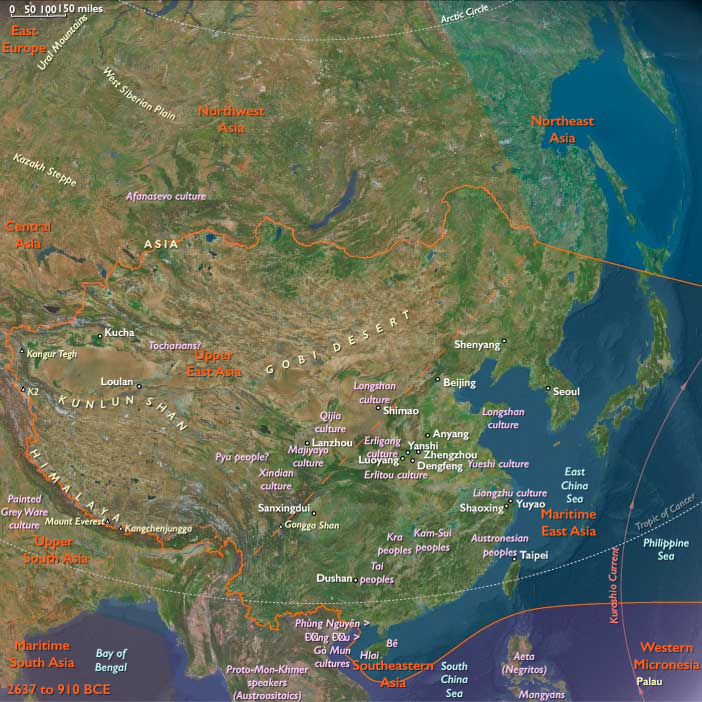
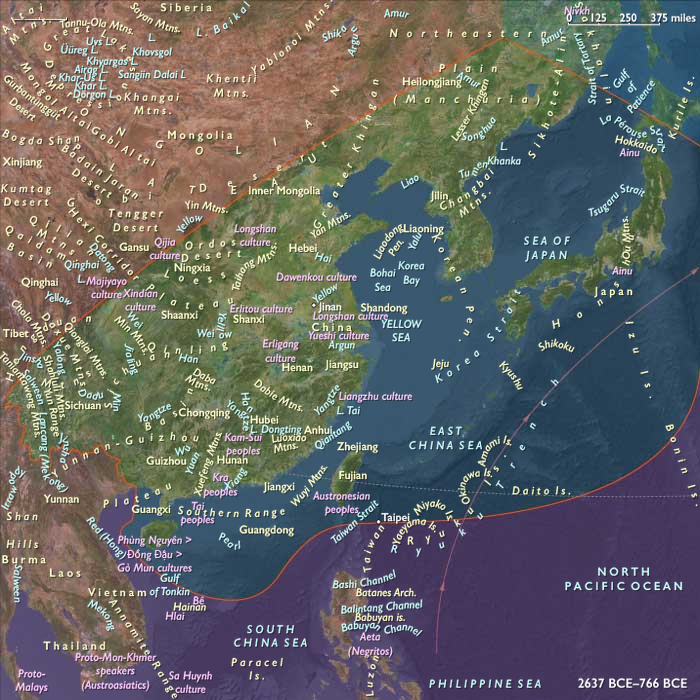
The early Western Zhou supports a strong military split into two major units: “The Six Armies of the West” and “The Eight Armies of Chengzhou”.
The armies campaigns in the northern Loess Plateau, modern Ningxia and the Huanghe floodplain.
The military prowess of Zhou peaks during the nineteenth year of King Zhao's reign, when the Six Armies are wiped out along with King Zhao on a campaign around the Han River.
Locations
Groups
Topics
Subjects
Regions
Subregions
Related Events
Filter results
Showing 10 events out of 66879 total
The reign of King Zhao, which had begun, supposedly, in 996 BCE, has occurred at a point when the Zhou Dynasty had expanded across the Zhouyuan or central plains of China and turned its attention to South China.
In 977, Zhao is killed and his campaigning army wiped out south of the Han river, establishing the limit of direct control of the south during the Western Zhou Dynasty.
Zhao’s son Mu succeeds him as the fifth sovereign of the Zhou Dynasty.
Ashur-rabi II, one of the longest-reigning kings of Assyria, has reigned for forty-one years.
Little is known about his reign, of which few records survive.
He was apparently a younger son of Ashurnasirpal I.
He had become king in 1013 BCE following the reigns of his elder brother, Shalmaneser II, and his nephew Ashur-nirari IV, and reigns until his death in 972 BCE, when he is succeeded by his son Ashur-resh-ishi II.
Bethlehem-born David, a member of the Israelite tribe of Judah is, according to the Bible, the second of the Israelite kings (after Saul, of the tribe of Ephraim), reigning from about 1000 BCE to about 962 BCE.
He establishes what Bible Scholars will call the United Monarchy over the twelve tribes of Israel, with Jerusalem as its capital.
In Jewish tradition, this talented, violent, passionate, adulterous, murdering, but eminently pious ruler will become the ideal king, the founder of an enduring dynasty, around whose figure and reign will cluster messianic expectations of the Jews.
He is also held in high esteem in the Islamic tradition.
David is, according to the Bible, a redhead.
Hori, son of Nespaneferhor, is inducted into the Priesthood at Karnak during the reign of Neterkheperre or Netjerkheperre-setepenamun Siamun, the sixth pharaoh of Egypt during the Twenty-first dynasty, a Year Seventeen I Shemu day [lost], as recorded in an inscription in fragment 3B, lines 3-5 dated to Siamun from the Karnak Priestly Annals.
This date was a lunar Tepi Shemu feast day, and based on the calculation of this lunar Tepi Shemu feast, Year Seventeen of Siamun has been shown by the German Egyptologist Rolf Krauss to be equivalent to 970 BCE.
Hence, Siamun would have taken the throne in 986 BCE, about sixteen years earlier.
A stela dated to Siamun's Year Sixteen records a land-sale between some minor priests of Ptah at Memphis.
The Year Seventeen inscription is an important palaeographical development because it is the first time in Egyptian recorded history that the word pharaoh is employed as a title and linked directly to a king's royal name—as in Pharaoh Siamun here.
References to Pharaoh Psusennes (Psusennes II here), Pharaoh Shoshenq, Pharaoh Osorkon and so forth will henceforth become commonplace.
Prior to Siamun's reign and all throughout the Middle and New Kingdom, the word pharaoh referred only to the office of the king.
One fragmentary but well known surviving triumphal relief scene from the Temple of Amun at Tanis depicts an Egyptian pharaoh smiting his enemies with a mace.
The king's name is explicitly given as [(Neterkheperre Setepenamun) Siamun, beloved of Am(un)] in the relief and there can be no doubt that this person was Siamun as the eminent British Egyptologist, Kenneth Kitchen stresses in his book, On the Reliability of the Old Testament.
Siamun appears here "in typical pose brandishing a mace to strike down prisoners(?) now lost at the right except for two arms and hands, one of which grasps a remarkable double-bladed ax by its socket."
The writer observes that this double bladed ax or 'halbread' has a flared crescent shaped blade which is close in form to the Aegean influenced double ax but is quite distinct from the Palestinian/Canaanite double headed ax, which has a different shape that resembles an X.
Thus, Kitchen concludes Siamun's foes were the Philistines who were descendants of the Aegean-based Sea Peoples and that Siamun was commemorating his recent victory over them at Gezer by depicting himself in a formal battle scene relief at the Temple in Tanis.
Ashur-resh-ishi II, who had succeeded his long-reigning father Ashur-rabi II in 972, has reigned as King of Assyria until his death in 967 BCE, when he is succeeded by his son, Tiglath-Pileser II.
His reign, about which little is known, is a time of political eclipse for Assyria.
China’s Zhou Dynasty is at its peak during the reign of Mu Wang, perhaps the most pivotal emperor of dynasty.
He is reputed to have lived until the age of one hundred and five and reigned nearly sixty-six years, from about 1023 BCE to about 957 BCE.
He liked to travel, and in particular visited the Kunlun Mountains several times during his reign. (The actual place for Kunlun Mountains would be somewhere close to today's Jiuquan County, Gansu Province. Mount Kunlun, extending for almost two thousand miles, from Kara-Kunlun bordering Tibet in the west to Qilian Mountain in the east, is a source of many Chinese myths and legends.)
King Mu, more ambitious than wise, had tried to stamp out invaders in the western part of China and ultimately expand Zhou's influence to the east.
In the height of his passion for conquests, he led an immense army against the Jung tribes, supposedly native to India, that had colonized the western part of China.
His visits and travels allowed him to contact many tribes and swayed them to either join under the Zhou banner or be conquered in war with his mighty army.
This expedition must have been more of a failure than a success, proven by the fact that he brought back only four white wolves and four white deer.
Unintentionally and inadvertently, he thus sowed the seeds of hatred, which will culminate in an invasion of China by the same tribes in 771 BCE.
David's son and successor, Solomon, extends the city and builds his Temple on the threshing floor of Araunah the Jebusite.
The Temple, built as an abode for the Ark and as a place of assembly for the entire people, is reportedly completed in about 957.
Thus, Jerusalem becomes the place of the royal palace and the sacred site of an eventually monotheistic religion, and Canaan becomes, for all practical purposes, the Land of Israel.
The easternmost of the two hills of Jerusalem is called Zion.
Mount Zion, in the Bible often meaning the city rather than the hill itself, is the place where Yahweh, the God of Israel, dwells (Isaiah 8:18 Psalm 74:2), the place where he is king (Isaiah 24:23) and where he has installed his king, David Psalm 2:6).
It is thus the seat of the action of Yahweh in history.
Tiglath-Pileser II has been King of Assyria since 967 BCE, when he succeeded his father Ashur-resh-ishi II, Little is known of his reign.
He dies in 935 BCE, and is succeeded by his son Ashur-dan II.
Egypt’s Twenty-second dynasty, which rises from long-settled Libyan mercenaries, begins in 945 with Hedjkheperre Setepenre Shoshenq, or Sheshonk, or Sheshonq, identified as Shishak in the Hebrew scriptures.
The king is based in the north and his sons rule key centers elsewhere.
Prior to his reign, Shoshenq had been the Commander-in-Chief of the Egyptian Army, and chief advisor to his predecessor Psusennes II, as well as the father-in-law of Psusennes' daughter Maatkare.
He also held his father's title of Great Chief of the Ma or Meshwesh.
His ancestors were Libyans who had settled in Egypt during the late New Kingdom, probably at Herakleopolis Magna, though Manetho claims Shoshenq himself came from Bubastis, a claim for which no supporting physical evidence has yet been discovered.
Significantly, his Libyan uncle Osorkon the Elder had already served on the throne for at least six years in the preceding Twenty-first Dynasty; hence, Shoshenq I's rise to power is not wholly unexpected.
