
The coming of Islam will eventually change …
Years: 532 - 675
The coming of Islam will eventually change the nature of Sudanese society and facilitate the division of the country into north and south.
Islam also fosters political unity, economic growth, and educational development among its adherents; however, these benefits are restricted largely to urban and commercial centers.
The spread of Islam begins shortly after the Prophet Muhammad's death in 632, by which time he and his followers had converted most of Arabia's tribes and towns to Islam (literally, submission), which Muslims maintain united the individual believer, the state, and society under God's will.
Islamic rulers, therefore, exercise temporal and religious authority.
Islamic law (sharia), which is derived primarily from the Quran, encompasses all aspects of the lives of believers, who are called Muslims ("those who submit" to God's will).
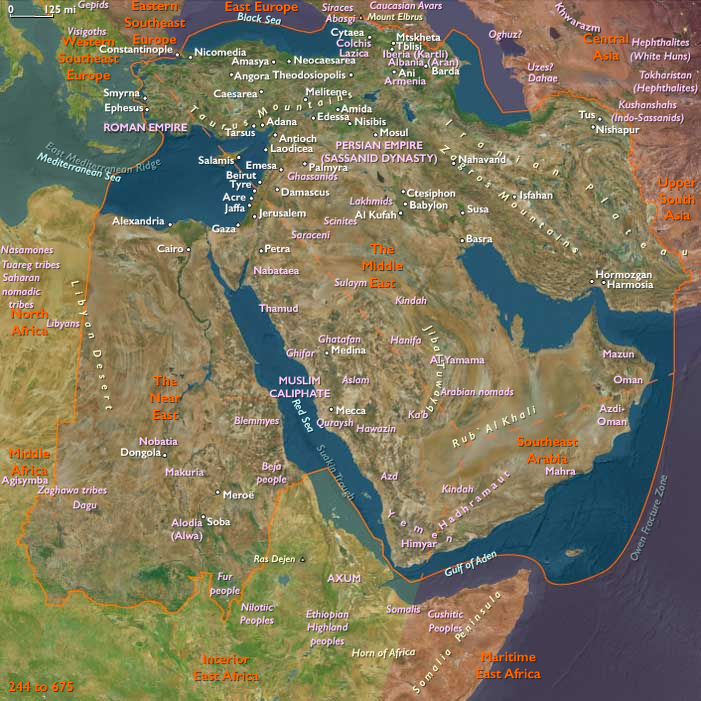
Arab armies carry Islam north and east from Arabia into North Africa within a generation of Muhammad's death.
Muslims impose political control over conquered territories in the name of the caliph (the Prophet's successor as supreme earthly leader of Islam).
The Islamic armies win a major North African victory in 643 in Tripoli (in modern Libya).
However, the Muslim subjugation of all of North Africa will take about seventy-five years.
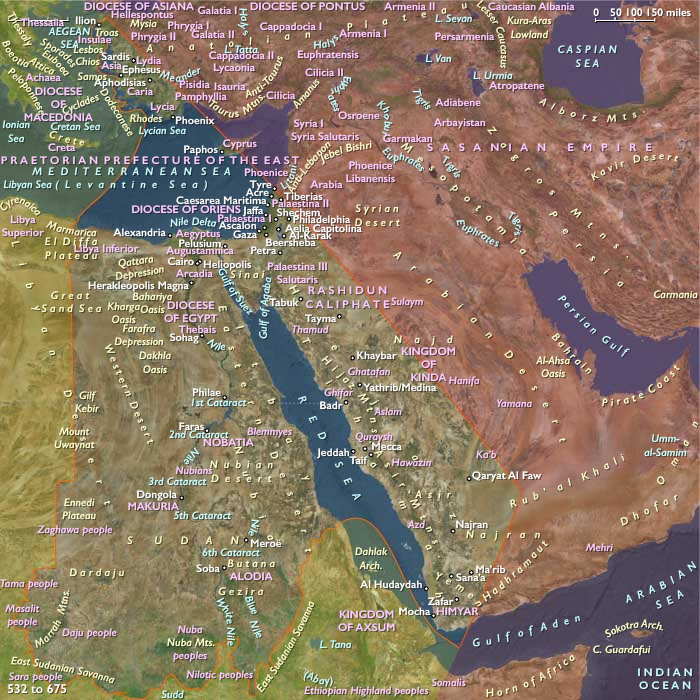
The Arabs invade Nubia in 642 and again in 652, when they lay siege to the city of Dongola and destroy its cathedral.
The Nubians put up a stout defense, however, causing the Arabs to accept an armistice and withdraw their forces.
Locations
Groups
- Nubians
- Arab people
- Blemmyes
- Aksum (or Axum), Kingdom of
- Egypt (Roman province)
- Makuria, Kingdom of
- Nobatia, Kingdom of
- Christians, Monophysite
- Christianity, Chalcedonian
- Coptic Orthodox Church of Alexandria
- Alodia, or Alwa (Subah, or Soba), Kingdom of
- Roman Empire, Eastern: Justinian dynasty
- Islam
Topics
Subjects
Regions
Subregions
Years: 532 - 675
Locations
Groups
- Nubians
- Arab people
- Blemmyes
- Aksum (or Axum), Kingdom of
- Egypt (Roman province)
- Makuria, Kingdom of
- Nobatia, Kingdom of
- Christians, Monophysite
- Christianity, Chalcedonian
- Coptic Orthodox Church of Alexandria
- Alodia, or Alwa (Subah, or Soba), Kingdom of
- Roman Empire, Eastern: Justinian dynasty
- Islam
Topics
Subjects
Regions
Subregions